Why Is My Carbon Monoxide Alarm Going Off? What to Do Right Now
A sounding CO alarm is an emergency until responders say otherwise. Here’s what to do first, how to tell a real alarm from a low-battery or end-of-life chirp, and what to do once the house is safe.
JM Comfort can help: furnace and heating repair for homes in Sacramento and nearby. Licensed C-20 HVAC contractor, CSLB #1016274.
A carbon monoxide alarm going off in the middle of the night is frightening, and the next few minutes matter. The first job is simple: get out and call 911. Once everyone is safe, this guide helps you understand what happened: whether it was a real alarm or a battery or end-of-life chirp, how old your alarm is, and what has to be checked before you use your furnace and other gas appliances again. For the repair side, see furnace and heating repair.
Safety first: If the alarm is sounding its full alarm, not just a single chirp, get everyone outside to fresh air now, then call 911. Don’t try to find the source, and don’t go back in until emergency responders give you permission. If you’re not sure whether it’s an alarm or a chirp, treat it as an alarm.
Why is my carbon monoxide alarm going off?
A CO alarm that’s sounding its full alarm may be detecting carbon monoxide, and CPSC says never to ignore one: it’s warning you of a potentially deadly hazard.
CO alarms are built to sound early. CPSC says they’re designed to alarm before potentially life-threatening levels of CO are reached, which is exactly why leaving right away works. The Seattle Fire Department puts it plainly: a CO alarm that beeps continuously without stopping could mean carbon monoxide is present.
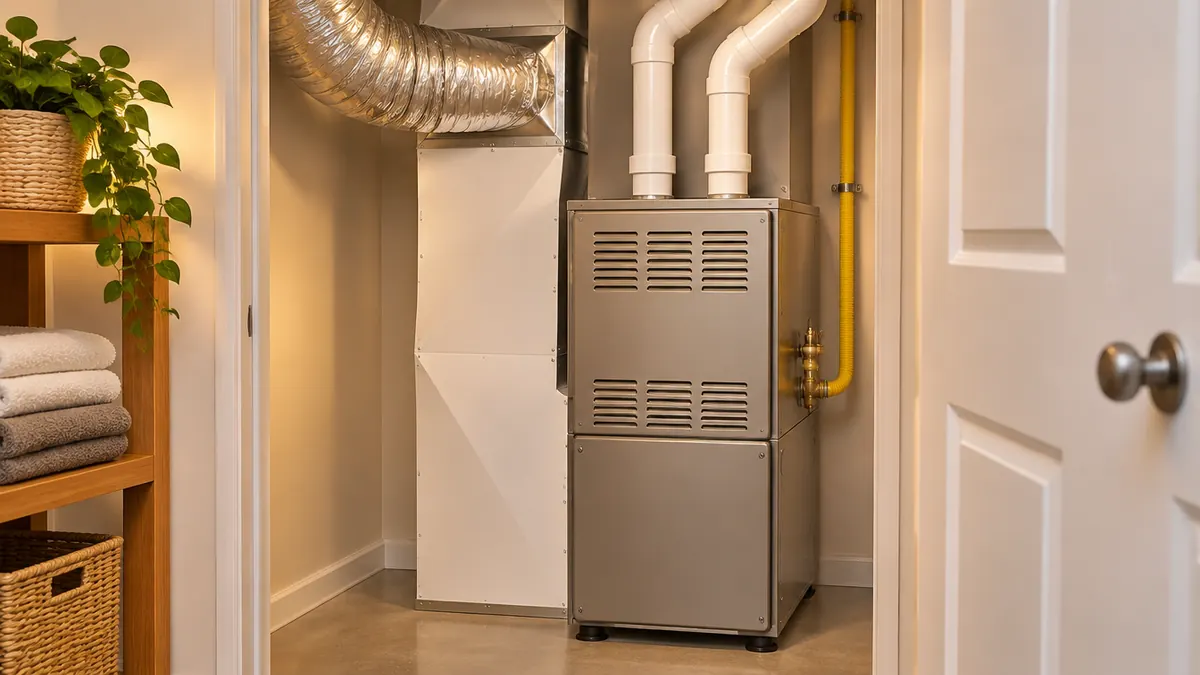
You can’t confirm or rule out CO yourself. It’s colorless and odorless, and the usual sources are hidden inside appliances and vents. CPSC lists malfunctioning fuel-burning appliances such as furnaces, ranges, water heaters and room heaters, and it also warns about cars left running in attached garages. Our guide to carbon monoxide safety covers the common sources and the symptoms to watch for.
What should you do when a CO alarm goes off?
Get everyone outside to fresh air immediately, then call 911, in that order. UL Standards & Engagement gives the same advice: evacuate, then dial 911.
CPSC’s steps:
- Move outside to fresh air. Don’t try to find the source of the CO.
- Call 911, the fire department or your local emergency number from outside.
- Do a head count so you know everyone is out.
- Stay out until emergency responders give you permission to go back in. CPSC warns you could lose consciousness and die if you go back inside.
- Don’t use the source. If responders find a malfunctioning appliance, don’t operate it until trained personnel have serviced it.
- If the alarm sounds again within 24 hours of going back in, repeat these steps and call a qualified appliance technician to check all fuel-burning equipment.
Tell the dispatcher if anyone has symptoms. CDC lists headache, dizziness, weakness, upset stomach, vomiting, chest pain and confusion as the most common, often described as flu-like.
Why is my carbon monoxide alarm beeping or chirping?
A short chirp that repeats at intervals is usually a maintenance signal, either a low battery or an alarm at the end of its life, not a CO alarm. A loud, repeating pattern is an alarm.
| What you hear | What it usually means | What to do |
|---|---|---|
| Loud, repeating 4-beep pattern or continuous beeping | CO alarm: carbon monoxide may be present | Get outside, then call 911 |
| Loud, repeating 3-beep pattern | Smoke alarm: possible fire | Get out and call 911 |
| A single chirp now and then that stops with new batteries | Low battery | Replace the batteries |
| A chirp about every 30 seconds that new batteries don’t stop; screen may read END or ERR | The alarm has reached end of life | Replace the alarm right away |
UL Standards & Engagement says smoke alarms typically use a 3-beep pattern and CO alarms a 4-beep pattern. Chirp signals vary by model, so check the manual or the label on the back of yours.
The end-of-life chirp
CO alarms wear out. The Seattle Fire Department says a CO alarm that beeps every 30 seconds or shows ERR or END has probably reached the end of its life, and that a new battery won’t stop it. One major alarm manufacturer signals end of life with 2 beeps every 30 seconds and warns that its alarms do not detect carbon monoxide in end-of-life mode. Some models let you silence the chirp for a few days at a time, up to 30 days, but that only buys time to buy a new alarm.
An end-of-life chirp isn’t a 911 call, the Seattle Fire Department notes. It does mean you have no CO protection in that spot until you replace the alarm, so do it today. Renters should tell the landlord or property manager right away.
What if responders don’t find carbon monoxide?
Don’t write it off as a false alarm yet. Check the alarm itself, and make sure your fuel-burning appliances get a proper inspection.
CPSC’s guidance covers this case. If you’re allowed back in and the alarm goes off again within 24 hours, repeat the steps above and call a qualified appliance technician to check all fuel-burning equipment and appliances for proper operation. Note any combustion appliance the technician didn’t inspect, and make sure no vehicle is running, or has been running, in an attached garage or next to the house.
Then look at the alarm. If it’s past its replacement age or chirping, replace it. And know the limits of the test button: CPSC says it tests whether the circuitry is working, not the accuracy of the sensor.
How long does a carbon monoxide detector last?
Most CO alarms last about 5 to 10 years, depending on the model, and CDC says to replace yours following the manufacturer’s instructions or every 5 years.
- UL Standards & Engagement says most CO alarms should be replaced every 5 to 7 years, and some combination smoke and CO alarms can last up to 10 years.
- The Seattle Fire Department puts the life expectancy of a CO alarm at around 7 years.
- One major alarm manufacturer says its current CO alarms have a 10-year life, with a couple of exceptions.
- CPSC says to get the recommended replacement age from the product literature or the manufacturer.
Plenty of homes are behind. In a May 2026 UL Standards & Engagement survey, 7% of adults had a CO alarm older than 7 years and another 9% didn’t know how old theirs was. Write the install date on the back of each new alarm. For batteries, CDC suggests checking them when you change your clocks each spring and fall.
Carbon monoxide vs. smoke detector: what’s the difference?
A smoke alarm senses smoke from a fire, and a CO alarm senses carbon monoxide gas. UL Standards & Engagement says it plainly: your standard smoke alarm is not a carbon monoxide alarm.
| Smoke alarm | CO alarm | |
|---|---|---|
| Detects | Smoke from a fire | Carbon monoxide gas |
| Typical alarm sound | 3 beeps, repeating | 4 beeps, repeating |
| Safety standard | UL 217 | UL 2034 |
| Replace | Every 10 years | Per the manufacturer, often 5 to 7 years |
| Test | Monthly | Per the manufacturer’s instructions |
The U.S. Fire Administration says to test smoke alarms monthly and replace the entire smoke alarm every 10 years. UL Standards & Engagement recommends a smoke alarm and a CO alarm on every floor of your home, including outside sleeping areas, and suggests combination smoke and CO alarms when you replace old units. Check the label to know which you have: CO alarms certified to UL 2034 are labeled as CO alarms on the front.
Neither one is a gas leak detector. One major alarm manufacturer says a standard CO alarm detects carbon monoxide, not natural gas or propane. A rotten-egg smell means leave, then call 911 and PG&E from outside; see what to do if you smell gas near your furnace.
Does California require a CO alarm?
Yes, in any home with a fuel-burning appliance or an attached garage. The California Air Resources Board explains that the Carbon Monoxide Poisoning Prevention Act of 2010 requires carbon monoxide detectors or alarms in all dwellings that have any kind of fuel-burning appliance, such as gas or propane, or an attached garage, and that the alarms must be approved by the California Office of the State Fire Marshal. So if your Sacramento-area home has a gas furnace, gas water heater or attached garage, a CO alarm isn’t optional. When you replace one that has reached end of life, pick a State Fire Marshal approved model labeled as a CO alarm, or a combination smoke and CO alarm.
What should happen after a carbon monoxide alarm?
Every fuel-burning appliance should be checked before you rely on it again, starting with anything responders flagged.
CPSC recommends having your heating system professionally inspected and serviced every year, including the chimney and flues, and it says a CO alarm is no substitute for proper use and upkeep of appliances that can produce CO. PG&E, the gas utility for Sacramento County, says not to use a suspected gas appliance again until a qualified professional has determined it’s safe, and to contact PG&E or a qualified professional to have the appliance inspected. If your furnace was the suspect, a technician should find and fix the cause before it runs again. For what a yearly check includes, read what an HVAC tune-up includes, and if a heat exchanger problem comes up, see what a cracked heat exchanger means. If the furnace won’t run afterward, why a furnace stops working covers the usual causes.
Why do Sacramento-area homeowners call JM Comfort?
JM Comfort is the call after the emergency, not during it. If an alarm is sounding, call 911. Once responders say your home is safe, JM Comfort, a locally owned heating and air conditioning contractor based in North Highlands, can repair, maintain or replace your furnace for homes in North Highlands, Sacramento and nearby communities. It’s a licensed C-20 HVAC contractor (CSLB #1016274), licensed since 2016 and bonded, with workers’ comp insurance on file; you can check the license on the CSLB website.
Call (916) 247-6358 or book furnace and heating repair online and we’ll call you back.
Frequently asked questions
Should I open the windows when the CO alarm goes off?
Don’t stop to do it. CPSC’s advice is to move outside to fresh air immediately and call 911, without trying to find the source. Every minute spent inside opening windows is another minute breathing the air the alarm is warning you about. PG&E’s carbon monoxide page does list opening windows among its steps, but with the alarm sounding, getting out comes first.
Can I press the hush button and go back to bed?
Not when the full alarm is sounding. CPSC says never to ignore an alarming CO alarm. A hush or silence feature on some models is meant for an end-of-life chirp, and one major manufacturer notes it only pauses the chirp for a few days at a time. It doesn’t fix anything.
Will a carbon monoxide alarm detect a gas leak?
No. One major alarm manufacturer says a standard CO alarm is designed to detect carbon monoxide, not natural gas or propane. Gas leaks need your nose, since gas carries a rotten-egg odorant, or a separate gas detector. If you smell gas, leave, then call 911 and PG&E from outside. See what to do if you smell gas.
Do hardwired CO alarms need batteries?
They should have them. CPSC says hard-wired and plug-in CO alarms should have battery backup, so they keep working during a power outage. CDC recommends checking CO alarm batteries when you change your clocks each spring and fall.
Who should check my furnace after a carbon monoxide alarm?
A qualified heating technician, once emergency responders say the house is safe. CPSC says not to operate an appliance found to be malfunctioning until trained personnel have serviced it. JM Comfort provides furnace and heating repair; call (916) 247-6358 or book online.
Sources
- Carbon Monoxide Questions and Answers (U.S. Consumer Product Safety Commission)
- Carbon Monoxide (U.S. Consumer Product Safety Commission)
- Carbon Monoxide (CO) Poisoning Basics (Centers for Disease Control and Prevention)
- The Difference Between Smoke Alarms and CO Alarms – And Why It’s Important (UL Standards & Engagement)
- If your CO alarm chirps every 30 seconds, it’s not an emergency but you should replace the CO alarm a.s.a.p. (Seattle Fire Department, Fire Line)
- Carbon Monoxide Safety Basics (Kidde)
- Carbon Monoxide Detectors: What They Do & Do You Need One? (First Alert)
- Smoke Alarms (U.S. Fire Administration)
- Combustion Pollutants & Indoor Air Quality (California Air Resources Board)
- Carbon Monoxide (Pacific Gas and Electric Company)
Find this helpful? Add JM Comfort as a preferred source on Google.