Why Is My Furnace Not Working? Causes and What to Do
A furnace that won’t heat usually has a short list of suspects. Here’s what you can safely check yourself, what stops a furnace from starting or staying on, and when it’s time to call a technician.
JM Comfort can help: furnace repair for homes in Sacramento and nearby. Licensed C-20 HVAC contractor, CSLB #1016274.
When the house is cold and the furnace won’t run, the cause is often simple: a thermostat setting, a switch, a breaker or a filter. Sometimes it’s an ignition part or a safety switch that needs a technician. This guide shows you what you can safely check yourself, why furnaces refuse to start or keep shutting off, and when to stop and call for furnace repair.
Safety first: If you smell gas (a rotten-egg odor) or a carbon monoxide alarm goes off, don’t troubleshoot. Leave the house now with everyone. Once you’re outside, call 911, then PG&E (see PG&E’s Report an Emergency page). Don’t flip light switches or try to relight anything on the way out. Our guide to smelling gas near a furnace explains what happens next.
Why is my furnace not working?
Your furnace stops working when one step in its startup sequence fails: the thermostat doesn’t call for heat, the furnace has no power, airflow is blocked, the gas supply is interrupted, or an ignition or safety part shuts things down. A modern furnace checks itself at every step, so one problem can stop the whole cycle.
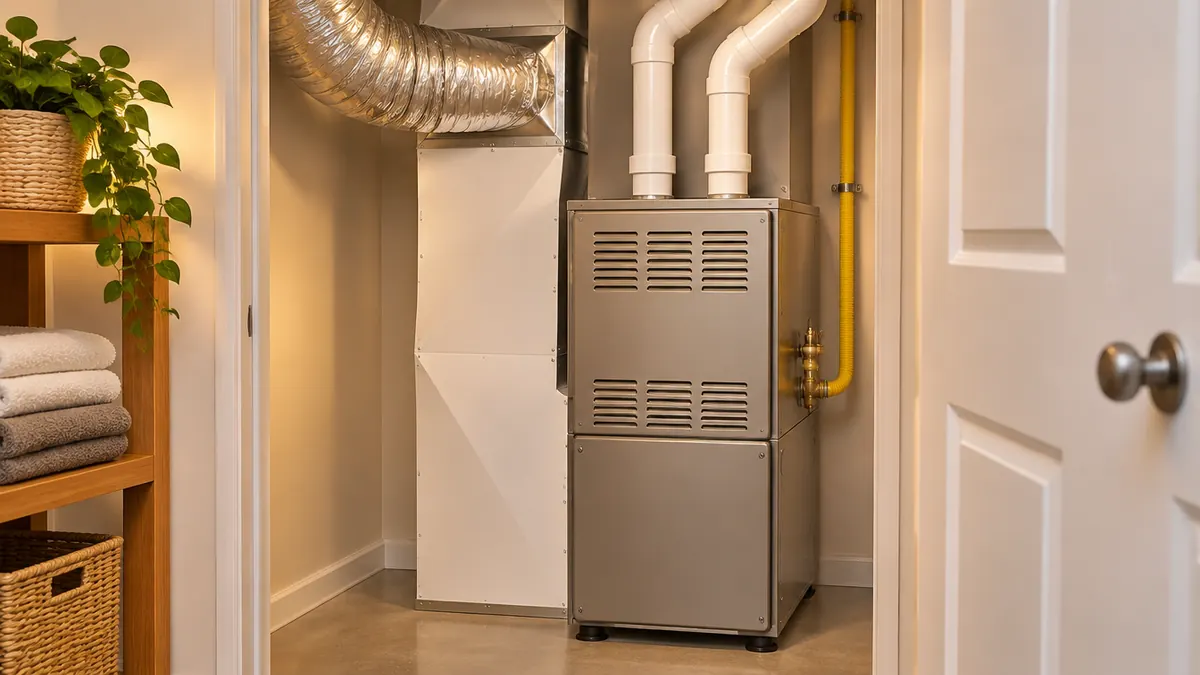
The thermostat signals the furnace. A small fan called the inducer starts, the igniter lights the gas, and the burners heat a metal heat exchanger. A flame sensor confirms the burners are lit, and the blower pushes house air across the hot metal and out through your ducts. If the flame sensor can’t detect a flame, the gas valve shuts off. If the furnace overheats, a limit switch shuts it down. Our guide to how a furnace works walks through each part.
So “not working” can mean a furnace that does nothing, one that runs the blower but never heats (see a furnace blowing cold air), or one that starts and shuts off.
Why won’t my furnace turn on?
A furnace that won’t turn on at all is usually missing a signal, power or fuel: the thermostat isn’t calling for heat, the power switch or breaker is off, the blower door isn’t closed, or the gas supply is interrupted. Match what you’re seeing to the likely cause below. The first 6 are things you can check or fix yourself.
| Cause | What you’ll notice | DIY or pro |
|---|---|---|
| Thermostat on Cool or Off, or set too low | No click, no startup, no heat | DIY: set to Heat, above room temperature |
| Dead thermostat batteries | Blank or dim screen | DIY: replace the batteries |
| Furnace power switch off | No lights or sounds at the furnace | DIY: switch it back on |
| Tripped breaker | Furnace dead; breaker handle in the middle position | DIY: reset once; pro if it trips again |
| Blower door not fully closed | Furnace dead right after a filter change | DIY: reseat the panel |
| Clogged air filter | Furnace starts, then shuts off; weak airflow | DIY: replace the filter |
| Gas supply interrupted | Other gas appliances won’t light either | Contact PG&E |
| Clogged condensate drain | High-efficiency furnace won’t light | Pro to clear the line |
| Igniter or pilot failure | Inducer runs, but the burners never light | Pro |
| Dirty flame sensor | Burners light, then shut off quickly | Pro |
| Failed limit switch, blower motor, capacitor or control board | Hum or buzz with no startup, or repeated shutdowns | Pro |
How do you fix a furnace that’s not working?
Start at the thermostat and work toward the furnace. These 7 checks are safe for any homeowner. Don’t open the burner compartment or touch the gas valve, igniter or wiring; one major manufacturer warns homeowners away from repairs involving gas, electrical or internal furnace parts.
How to fix a furnace that won’t work: 7 safe checks
- Check the thermostat. Set it to Heat and set the temperature a few degrees above the current room temperature; one major manufacturer suggests 3 to 5 degrees. If the screen is blank, replace the batteries. More fixes are in our guide to a thermostat that’s not working.
- Check the furnace power switch. Most furnaces have a switch that looks like a light switch, on the side of the unit or a nearby wall. Make sure it’s on.
- Check the breaker. Find the breaker labeled Furnace or Heat in your electrical panel. If it has tripped to the middle, switch it fully off, then back on. Reset it once. If it trips again, leave it off and call a technician: repeated trips mean an electrical problem.
- Check the air filter. Turn the furnace off and slide out the filter. If it’s gray and caked with dust, replace it with one the same size, with the airflow arrows pointing toward the furnace. ENERGY STAR recommends inspecting filters every month, and one major manufacturer calls for a new one every 30 to 90 days.
- Close the blower door all the way. The panel over the blower presses a safety switch that cuts power to the furnace controls when the door is off. If the door is crooked or loose, the furnace stays off. Seat it flat and latch it. Don’t disable or override the switch: it keeps the blower from running with the door open, where it could spread exhaust gases, and it protects you from live wiring.
- Open the vents and clear the returns. Make sure supply registers are open and that furniture, rugs and drapes aren’t blocking them or the return grilles. Restricted airflow can overheat the furnace and trigger a safety shutoff.
- Look at the gas supply. If your stove, water heater or other gas appliances won’t light either, the supply to the house may be interrupted, so contact PG&E. If you smell gas at any point, stop, leave the house, and call 911 and then PG&E from outside.
Still no heat after all 7 checks? Set the thermostat to Off and call for heating repair. A technician can read the furnace’s error codes and test the parts you can’t safely reach.
Why is my furnace not working after changing the filter?
A furnace that quits right after a filter change usually has a power switch that was left off or a blower door that isn’t fully closed. Both take a minute to fix.
- Power switch. Manufacturers tell you to turn off the furnace before you change the filter. Make sure the switch went back on.
- Blower door. If you removed a panel to reach the filter, put it back so it sits flat and latches. A loose door can leave the safety switch unpressed, and the furnace won’t start.
- Arrow direction. The arrows on the filter frame should point toward the furnace, the way the air flows.
- Size and fit. The new filter should be the same size as the old one and sit snugly in its slot.
- A different kind of filter. If you switched to a thicker or higher-rated filter, make sure your system is designed for it. Read how to pick a MERV rating before you buy the next one.
If all of that checks out, the filter was probably a coincidence: go back through the 7 checks above, and set a reminder with how often to change your air filter.
Why does my furnace keep shutting off?
A furnace that starts and then shuts off, over and over, is usually protecting itself: it’s overheating and tripping the limit switch, or its flame sensor can’t confirm the burners are lit. This on-and-off pattern is called short cycling.
Overheating from poor airflow
A clogged filter, closed vents or blocked returns trap heat inside the furnace. When the heat exchanger gets too hot, the limit switch shuts the burners down. Replace the filter and open every vent first. Repeated overheating can wear out the limit switch itself, and replacing it is a technician’s job.
A dirty flame sensor
The flame sensor is a small safety device in the burner area. When it’s coated with grime, it can’t confirm the flame, so the furnace shuts off the gas soon after lighting and tries again. Cleaning or replacing it means working inside the burner compartment, so leave it to a technician.
Thermostat placement
A thermostat near a heat source, such as a sunny window or a lamp, can read the house as warmer than it is, and one major manufacturer lists placement among the first things to check.
A clogged condensate drain
High-efficiency furnaces have a condensate drain line, and sometimes a small pump. A clog in the line or drain pan triggers a safety control that keeps the furnace from lighting. ENERGY STAR lists the furnace condensate drain as something to inspect at every checkup.
If short cycling continues after a new filter and open vents, call a technician. Unusual sounds can be a clue too; see furnace and AC noises.
Why is my furnace not working after summer?
When a furnace won’t start on the first cold night of fall, the usual reasons are settings and switches left over from summer: a thermostat still on Cool, dead batteries, a power switch turned off for the season, or a dirty filter.
Run the 7 checks above first. Then keep these in mind:
- Older furnaces with a standing pilot may simply have a pilot that went out. A pilot that’s out, or won’t stay lit, is a job for a technician.
- A dusty smell on the first run is normal for a short while as dust burns off the furnace. A smell that lingers, or smells like burning plastic or gas, isn’t normal. See why your furnace smells.
- Test it early. Run the heat on a cool fall day, before the first freeze.
Sacramento winters are mild, but they’re real. At Sacramento Executive Airport, NOAA’s 1991–2020 climate normals put the average January low at 39.2°F, and the monthly normals add up to about 15 nights a year at or below freezing, most of them in December and January. ENERGY STAR recommends checking the heating system in the fall and points out that contractors get busy once winter comes. A fall tune-up is the easiest way to avoid a no-heat call on the first frosty morning. If the power went out recently, also see HVAC not working after a power outage.
When should you call a pro for a furnace that’s not working?
Call a technician when the problem involves ignition, gas, electrical parts or a safety switch that keeps tripping, or when the 7 checks above don’t bring the heat back.
Ignition and flame problems
If you hear the small inducer fan start but the burners never light, one major manufacturer says the likely cause is ignition or a pressure switch. Igniters are often the first part to fail, and a loud bang at startup can mean a clogged burner is delaying ignition. All of these need professional diagnosis.
Safety switches that keep tripping
Limit, pressure and rollout switches shut the furnace down when something is unsafe. Leave switches inside the burner compartment alone; a trip means the furnace found a problem a technician needs to track down.
Electrical warning signs
A breaker that trips a second time, a furnace that hums or buzzes but won’t start, or a burning-plastic smell all need a technician. A hum with no startup can point to a seized blower motor or a failed capacitor.
Gas or carbon monoxide
A gas smell or a carbon monoxide alarm means leave the house first, then call 911 from outside, and call PG&E about a gas smell. ENERGY STAR notes that a dirty burner or a cracked heat exchanger causes improper burner operation, which is one reason CDC recommends having your heating system serviced by a qualified technician every year. If your alarm is going off, see why a carbon monoxide alarm goes off.
When you’re ready, schedule furnace repair and a technician will tell you what failed and what it takes to fix it. If your furnace is more than 15 years old, ENERGY STAR suggests considering a replacement; the repair-or-replace calculator and our guide to repairing or replacing a furnace can help you decide.
What should you look for in an HVAC company?
Look for a company that finds the cause before it replaces parts, explains your choices in plain language, and is easy to reach on a cold morning.
For more questions to ask and red flags, see how to choose an HVAC company.
Why do Sacramento-area homeowners call JM Comfort?
JM Comfort is a locally owned heating and air conditioning contractor based in North Highlands, serving North Highlands, Sacramento and nearby communities. It’s a licensed C-20 HVAC contractor (CSLB #1016274), licensed since 2016 and bonded, with workers’ comp insurance on file; you can check the license on the CSLB website. Along with furnace repair, the same team handles furnace installation, heat pumps, tune-ups, ductwork and indoor air quality for homes.
Call (916) 247-6358 or book furnace repair online to request an estimate, and we’ll call you back.
Frequently asked questions
Is there a reset button on a furnace?
Most furnaces don’t have one main reset button. One major manufacturer suggests turning the furnace off at its power switch or breaker, waiting 30 seconds, and turning it back on. Some furnaces also have a safety reset inside the burner compartment; a trip there means the furnace sensed something unsafe, so leave that one to a technician.
Why is my furnace running but not heating?
Usually the blower is running while the burners aren’t. Check that the thermostat fan is on Auto, not On, and that the filter is clean. If the burners still won’t light or keep shutting off, the cause is likely ignition, the flame sensor or a limit switch. Our guide to a furnace blowing cold air covers it.
Can a dirty filter stop a furnace from working?
Yes. A clogged filter restricts airflow, strains the blower and heat exchanger, and can make the furnace overheat and shut itself down. Replace it, open your vents, and see if the furnace runs normally. Our guide to how often to change your air filter covers the schedule.
Is it safe to keep running a furnace that keeps shutting off?
Not for long. A furnace that keeps shutting off is usually a safety control doing its job. Replace the filter and open the vents; if it still starts and stops, set the thermostat to Off and call for furnace repair. If a carbon monoxide alarm sounds, get everyone outside and call 911.
How often should a furnace be serviced?
Once a year. CDC recommends having your heating system and other gas-burning appliances serviced by a qualified technician every year, and ENERGY STAR suggests checking the heating system in the fall. See what an HVAC tune-up includes.
Can JM Comfort fix a furnace that won’t work?
Yes. JM Comfort is a licensed C-20 HVAC contractor (CSLB #1016274) based in North Highlands, and it repairs furnaces for homes in North Highlands, Sacramento and nearby communities. Call (916) 247-6358 or book a visit online. If you smell gas, leave first, then call 911 and PG&E from outside.
Sources
- Your Guide To A Furnace Not Turning On (Carrier)
- Furnace Not Turning On? Try These Troubleshooting Tips (Trane)
- Heater Not Working? Try Our Furnace Troubleshooting Guide (Carrier)
- Furnace Not Blowing Hot Air? Learn Why and How to Fix It (Trane)
- Three Reasons Why Bypassing a Furnace Door Switch is a Bad Idea (Contracting Business)
- Maintenance Checklist (ENERGY STAR)
- When is it time to replace? (ENERGY STAR)
- Carbon Monoxide (CO) Poisoning Basics (Centers for Disease Control and Prevention)
- Report an Emergency (Pacific Gas and Electric Company)
- U.S. Climate Normals 1991–2020, monthly: Sacramento Executive Airport, CA (USW00023232) (NOAA National Centers for Environmental Information)
Find this helpful? Add JM Comfort as a preferred source on Google.