HVAC Not Working After a Power Outage? How to Restart It Safely
When the lights come back on, your heating and cooling should too. If it doesn’t, the fix is often the thermostat or a breaker. Here’s how to restart an AC, furnace or heat pump without damaging it.
JM Comfort can help: AC repair for homes in Sacramento and nearby. Licensed C-20 HVAC contractor, CSLB #1016274.
The power’s back, the refrigerator is humming, but the house is still getting hotter, or colder. Heating and cooling systems don’t always restart on their own after an outage, and the reason is usually simple: a thermostat that lost power, a breaker that tripped when the power surged back, or a system that just needs a few minutes. This guide walks through safe restart steps for an air conditioner, furnace and heat pump, plus when to stop and call for AC repair or heating service.
Safety first: If you smell gas or a carbon monoxide alarm sounds, leave the home now. Once you’re outside, call 911, then PG&E (see PG&E’s Report an Emergency page). Don’t flip light switches or unplug anything on the way out. For a sparking or downed power line, stay away, call 911 first, then SMUD at 1-888-456-7683. Run a portable generator outside only, at least 20 feet from the house, never in a garage, basement, porch or carport.
Why is my HVAC not working after a power outage?
Your HVAC usually isn’t working after a power outage for one of 4 reasons: the thermostat lost power or got switched to the wrong setting, a breaker tripped, a power switch or outdoor disconnect is off, or the system is still in the middle of restarting. Sometimes a surge damages an electrical part.
Here’s how those show up:
| What you see | Likely reason | What to do |
|---|---|---|
| Thermostat screen is blank | Thermostat lost power or batteries died | Replace batteries; check breakers |
| Thermostat works, nothing else runs | Tripped breaker or a power switch turned off | Check switches; reset an AC or furnace breaker once |
| Indoor fan runs, outdoor unit silent | No power to the outdoor unit | Check its breaker and disconnect; call if they’re fine |
| System starts after a short wait | Normal restart time | Nothing; give it a few minutes |
| Breaker trips again right away | Electrical fault | Leave it off; call a technician |
| Humming, buzzing or a burning smell | Damaged electrical part | Shut the system off; call |
| Heat pump breaker tripped | Fault that a restart could make worse | Don’t reset; call for service |
Why the trouble at restart? Ready.gov warns that power may come back with momentary surges or spikes that can cause damage. That’s also why the rule for breakers is to reset a tripped one once. If it trips again, there’s an electrical problem that needs a technician.
How do you reset your HVAC after a power outage?
Reset your HVAC by working from the thermostat out: check the display and settings, check the power switches and breakers, reset a tripped AC or furnace breaker once, then give the system a few minutes to start.
- Let the power settle. Leave the thermostat on Off until the power has stayed on for a few minutes, so the system isn’t trying to start during a flicker.
- Check the thermostat. A completely dark display usually means it has lost power. Replace the batteries if it uses them. Then confirm the mode (Cool or Heat) and that the setpoint is a few degrees past the room temperature. Smart thermostats may also need to reconnect to Wi-Fi; one manufacturer notes that error codes range from lost Wi-Fi to critical system failures.
- Check the switches. Make sure the power switch on or near the furnace or air handler is on, and that the disconnect box beside the outdoor unit hasn’t been switched off or pulled out.
- Check the breakers. Look for tripped breakers labeled for your furnace, air handler, heat pump or air conditioner. For an AC or furnace, reset a tripped breaker once: switch it fully off, wait about 5 minutes, then switch it back on. If it trips again, leave it off and call.
- Power-cycle an AC or furnace that still won’t start. If nothing is tripped but the system won’t respond, one manufacturer’s advice after power irregularities is to switch the system off, wait 60 seconds, and switch it back on.
- Give it time. After you restore power, the system may take a few minutes to restart. Then check for air at the vents and, in cooling mode, that the outdoor unit is running.
Heat pumps need slightly different handling, especially in winter. That’s covered below.
Why is my AC not cooling after a power outage?
If your AC isn’t cooling after a power outage, the usual suspects are a tripped breaker for the outdoor unit, an outdoor disconnect that’s off, or a thermostat that isn’t calling for cooling. The indoor and outdoor units often have separate breakers, so one can come back while the other doesn’t.
The giveaway is an indoor fan that runs while the outdoor unit stays silent. One major manufacturer says that pattern can mean a lack of power to the outdoor unit specifically. Check its breaker and the disconnect box next to it. If both are fine and the outdoor unit still won’t start, stop there: a failed electrical part needs a technician.
Also check the fan setting. If the thermostat came back with the fan on On, the blower will move air that isn’t being cooled. Set the fan to Auto. And if the outdoor unit hums or buzzes, or you notice a burning smell, shut the system off and call for service. If you see ice on the copper lines, turn cooling off and read why an AC freezes up; for warm air without ice, see why an AC blows warm air.
Summer outages in Sacramento
Summer is when an outage hurts most here. The National Weather Service’s HeatRisk guide warns that at Major heat risk, power interruptions may occur as electrical demand climbs, and at Extreme risk, outages become increasingly likely. A summer outage can make the house dangerously hot, and Ready.gov advises going to a community location with power if heat or cold is extreme. Our guide to what to do when your AC goes out in a heat wave covers staying safe while you wait.
Why is my furnace not working after a power outage?
A gas furnace needs electricity as well as gas, so after an outage it won’t run until its power switch, breaker and thermostat are all back in order. One major manufacturer notes that the furnace uses electricity to start and run the motor and blower fan, and newer furnaces use an electronic ignition.
Work through these:
- Thermostat. Set it to Heat with the setpoint above the room temperature, and replace weak batteries.
- Furnace power switch. Check for a switch on or near the furnace and make sure it’s on.
- Breaker. Reset a tripped furnace breaker once. If it trips again, you have an electrical problem and need a technician.
- Filter. Change it if it looks dirty or you can’t remember the last time.
Leave the gas valves, burners and the furnace’s internal panels alone; relighting, adjusting or resetting anything inside the cabinet is a technician’s job. In Sacramento County, PG&E supplies the natural gas: if you smell rotten eggs, leave the house now, then from outside call 911 and then PG&E. If the furnace still won’t start after these checks, see why a furnace isn’t working or schedule furnace repair.
Why is my heat pump not working after a power outage?
A heat pump may not restart after an outage because of a tripped breaker or a thermostat problem, and in cold weather it may need a warm-up period before it can safely run in heat mode.
After a long outage in cold weather
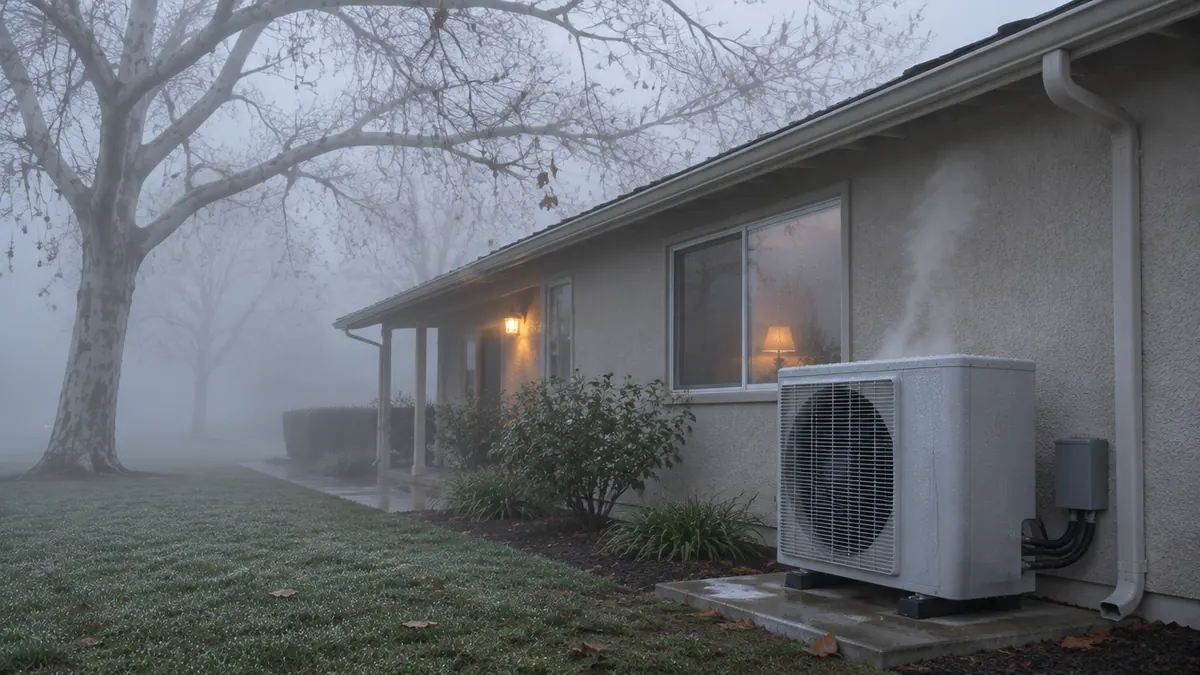
Sacramento winters are mild, but frosty mornings still happen, and that’s when this step matters. Some heat pumps have a compressor crankcase heater. One major manufacturer’s heat pump instructions explain that it protects the compressor from refrigerant slugging during cold-weather operation. Those instructions say that if power to the unit has been interrupted for several hours or more, set the thermostat to Emergency Heat to get temporary heat without risking serious damage. After a six-hour warm-up for the compressor’s crankcase, switch back to Heat and normal operation can resume.
Not every heat pump has the same instructions, so check your owner’s manual. If your thermostat has no Emergency Heat setting, or you’re not sure, call before restarting the heat pump in cold weather. Our guide to emergency heat vs. aux heat explains the settings.
If the breaker tripped
Don’t reset a tripped heat pump breaker and restart the unit. One major manufacturer warns that resetting the breaker and restarting the unit could cause damage. Call for heat pump service instead.
After a storm
Before you restart, look at the outdoor unit from a safe distance. If a limb has landed on it or its lines look bent or damaged, leave it off and call. If a power line is down nearby, stay away from it: SMUD says to call 911 first for sparking or downed lines, then SMUD at 1-888-456-7683. For heat pumps that run but blow cool air afterward, see why a heat pump isn’t heating.
How do you protect your HVAC during the next outage?
Protect your HVAC by turning it off when the power goes out, letting the power settle before you turn it back on, and keeping backup power and heat sources safe.
- Switch the thermostat to Off when the power drops. Ready.gov advises disconnecting appliances and electronics so a surge doesn’t damage them when power returns. Turning the system off at the thermostat is the simple version for your HVAC.
- Report the outage. SMUD lists 1-888-456-7683 for outages, and for sparking or downed lines after you’ve called 911.
- Use generators outside only. CPSC says to run portable generators outside, at least 20 feet from the house, never inside a home, garage, basement, crawlspace or shed, and not on a porch or in a carport. Opening doors or windows won’t provide enough ventilation to prevent deadly carbon monoxide.
- Treat CO alarms as real. CPSC’s advice: never ignore an alarm; get outside immediately, then call 911. See carbon monoxide safety.
- Use portable heaters carefully. Keep every side at least 3 feet from beds, curtains, sofas and other things that can burn, don’t leave one running unattended in a confined space, and plug electric heaters straight into a wall outlet, not a power strip.
- Keep up with maintenance. A seasonal tune-up is a good time to have a technician look over the electrical connections and controls.
When should you call for service after a power outage?
Call a technician when a breaker trips a second time, when the system hums, buzzes or smells like burning, when the outdoor unit won’t start even with power at the breaker and disconnect, or when a heat pump’s breaker has tripped.
Also call if the furnace won’t fire after you’ve checked the thermostat, switch, breaker and filter, or if a smart thermostat shows an error code you can’t clear. Before you call, write down the model number from the unit’s label and what you’ve already tried. It saves time on the visit. If the outage was hard on an older system and the repair is a big one, the repair-or-replace calculator can help you think it through. When you’re ready, schedule AC repair or heating service.
Why do Sacramento-area homeowners call JM Comfort?
JM Comfort is a locally owned heating and air conditioning contractor based in North Highlands, serving North Highlands, Sacramento and nearby communities. It’s a licensed C-20 HVAC contractor (CSLB #1016274), licensed since 2016 and bonded, with workers’ comp insurance on file. The same team repairs air conditioners, furnaces and heat pumps for homes, and handles new installations too, so if an outage leaves you weighing a replacement, you can request an estimate from the people who diagnosed the problem.
Call (916) 247-6358 or book an AC repair visit online and we’ll call you back. Until then, follow the safety steps above and leave the system off if a breaker trips twice.
Frequently asked questions
How long should I wait to turn my AC back on after a power outage?
Give the power a few minutes to settle before you turn the system back on, since power can return with surges. If a breaker tripped, one manufacturer says to switch it fully off and wait about 5 minutes before switching it back on. After that, the system may take a few more minutes to start.
Does a gas furnace work during a power outage?
Generally, no. A gas furnace still uses electricity to run its blower motor, and newer furnaces use an electronic ignition. Without power, it can’t move heat through the house. If you use a portable heater or generator to get by, follow the safety steps in this guide.
Why is my thermostat blank after the power came back?
A completely dark display usually means the thermostat has lost power. Replace the batteries if it uses them, then check the breakers for your furnace, air handler, heat pump or air conditioner. Our thermostat troubleshooting guide covers the rest.
Can a power surge damage my AC?
It can. Ready.gov warns that power may return with momentary surges or spikes that can cause damage, which is why it advises disconnecting appliances and electronics during an outage. If your system hums, buzzes or smells like something is burning after power returns, shut it off and call.
Who do I call to report a power outage in Sacramento?
SMUD sells the electricity in Sacramento County, and its safety page lists 1-888-456-7683 for outages and for sparking or downed lines. For a sparking or downed line, call 911 first, then SMUD, and stay well away from it.
Can JM Comfort help when an AC or furnace won’t restart?
Yes. JM Comfort is a licensed C-20 HVAC contractor (CSLB #1016274) that repairs air conditioners, furnaces and heat pumps in homes in North Highlands, Sacramento and nearby communities. Call (916) 247-6358 or book a repair visit online.
Sources
- AC Unit Not Turning On? Troubleshooting Steps & Solutions (Carrier)
- Common Thermostat Issues and How to Troubleshoot (Carrier)
- Furnace Not Turning On? Try These Troubleshooting Tips (Trane)
- Installation Instructions: Dave Lennox Signature Collection XP17 System Heat Pumps (506586-01) (Lennox)
- Why Is My Heat Pump Not Cooling? Troubleshooting Tips (Trane)
- Power Outages (Ready.gov (FEMA))
- Winter Storms Aren’t Over; CPSC Warns of Deadly Carbon Monoxide Risks and Fires During Power Outages (U.S. Consumer Product Safety Commission)
- Safety tips (SMUD)
- Report an Emergency (PG&E)
- NWS HeatRisk (fact sheet, published May 2023) (National Weather Service)
Find this helpful? Add JM Comfort as a preferred source on Google.