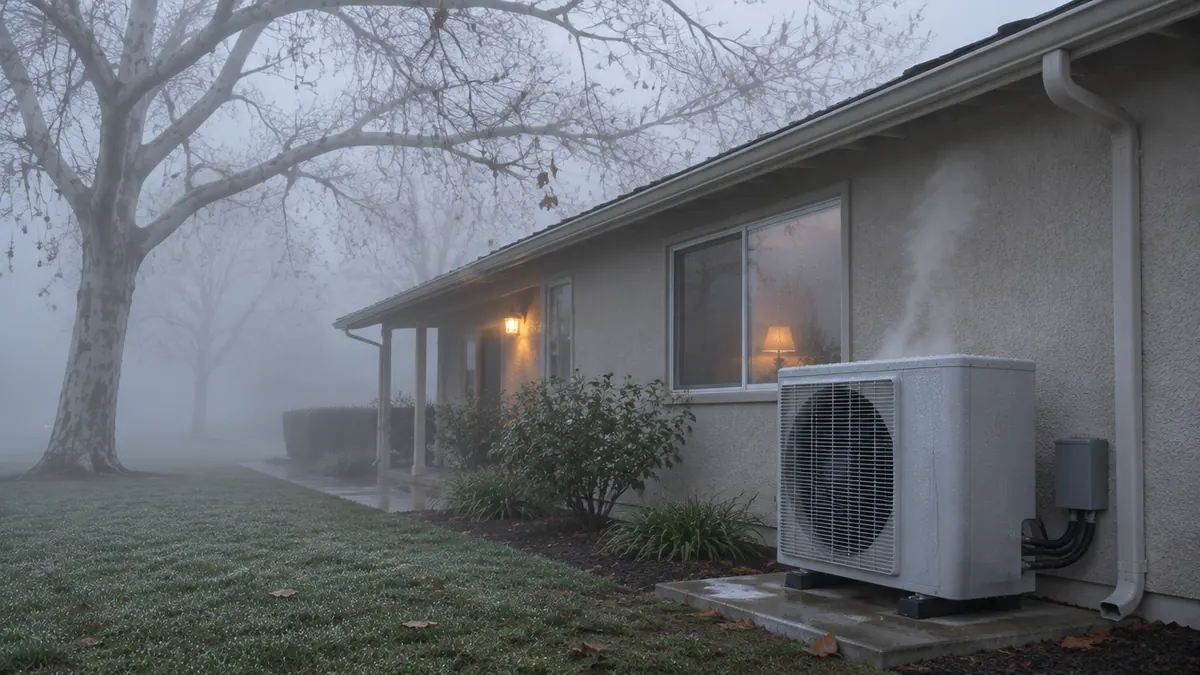
Emergency Heat vs. Aux Heat: What Your Heat Pump Thermostat Means
Aux and Em Heat both use your heat pump’s backup heat, but one is automatic and the other is a manual switch you should rarely touch. Here’s the difference, when each is normal, and what they cost.
JM Comfort can help: heat pump repair for homes in Sacramento and nearby. Licensed C-20 HVAC contractor, CSLB #1016274.
If your thermostat says Aux or Em Heat, you have a heat pump with a backup heat source, and those two labels mean very different things. One is your system quietly doing its job on a cold morning. The other is a manual override that can run up your electric bill if it’s left on. This guide explains both, when each is normal, what they cost, and when it’s time to call for heat pump repair.
Emergency heat vs aux heat: what’s the difference?
Aux heat is automatic backup that runs alongside your heat pump when it needs help; emergency heat is a manual setting that turns the heat pump off and runs only the backup heat.
A heat pump system has two stages of heat. The heat pump itself is the first stage. The backup, usually electric heat strips in the indoor unit or a gas furnace in a dual fuel system, is the second. One major manufacturer defines auxiliary heat as the second stage coming on when the first stage can’t keep up with demand, and emergency heat as using that second stage by itself, without the heat pump. With an electric air handler, aux heat runs together with the heat pump. In a dual fuel system, the furnace takes over and the heat pump shuts off.
| Question | Aux heat | Emergency heat |
|---|---|---|
| Who turns it on? | The system, automatically | You, at the thermostat |
| Is the heat pump running? | Yes, with an electric air handler | No, it’s shut off |
| When is it normal? | Cold weather, defrost cycles, big thermostat bumps | Only when the heat pump has failed |
| Cost to run | Higher than the heat pump alone | Highest with electric backup; all heat comes from the backup |
| What the thermostat shows | Aux or Aux Heat | Em Heat or Emer |
| What to do | Usually nothing; call if it never shuts off | Call for service as soon as you switch it on |
What is emergency heat on a thermostat?
Emergency heat, labeled Em Heat or Emer on most heat pump thermostats, is a setting that shuts the heat pump off completely and heats your home with the backup source alone.
Only heat pump systems have it. One major manufacturer says only a heat pump thermostat will have Em Heat or Aux settings, which makes the labels a handy way to tell whether you have a heat pump at all. If you’re not sure, see how to tell a heat pump from an AC.
What the backup is depends on your system. One major manufacturer says emergency heat usually runs on electric resistance. Another notes that in a dual fuel system, the backup is the furnace. Either way, the heat pump sits idle while emergency heat is on.
When should I use emergency heat?
Use emergency heat only when the heat pump itself has stopped working, such as an outdoor unit that won’t run, is damaged, or is encased in ice that won’t clear, and call for service as soon as you switch it on.
Manufacturers are blunt about this. One says you should only switch to emergency heat if your heat pump has physically broken down or malfunctioned. Another calls it a setting for a true emergency, such as a failed heat pump in very cold weather, and says that if you engage it, you should call for HVAC service right away. A third says to use it sparingly, because relying only on electric resistance heat can significantly increase your electric bill.
Cold isn’t an emergency. On a frigid night, leave the thermostat on Heat. Your system brings on aux heat by itself when the heat pump needs help, and it shuts the backup off again when it doesn’t. Switching to emergency heat just because it’s cold turns off the most efficient part of your system.
Good reasons to use it:
- The outdoor unit won’t run at all and the house is getting cold.
- The outdoor coil is covered in thick ice that stays after a defrost cycle. See heat pump defrost mode for what’s normal.
- A technician has told you to keep the heat pump off until a repair is made.
Not good reasons: a cold snap, a slow morning warm-up, or air from the vents that feels cooler than you expected. For those, see why a heat pump isn’t heating.
Why is my aux heat on?
Aux heat usually comes on for one of 3 normal reasons: it’s cold enough outside that the heat pump needs help, the system is running a defrost cycle, or someone raised the thermostat several degrees at once.
Cold weather
One major manufacturer says aux heat comes on when it’s below 40°F outside or below a set aux trigger temperature. Another says there’s no single outdoor temperature at which every heat pump activates aux heat: it depends on the system’s thermal balance point, and some single-stage, lower-efficiency systems may need it closer to 32°F. Some thermostats have an aux lockout setting: one manufacturer’s example is a 40°F lockout, which lets aux heat come on only when it drops below 40°F outside.
Defrost cycles
In cold, damp weather, frost builds on the outdoor coil and the system periodically switches modes to melt it. Aux heat can come on during that cycle so your vents don’t blow cold air while the outdoor unit de-ices itself. It shuts off again when the cycle ends.
A big thermostat bump
Raise the setting more than 2 to 3 degrees at once and the system may call for aux heat to catch up faster. One major manufacturer adds that recovering from an overnight setback often forces aux heat on in the morning.
When aux heat points to a problem
Aux heat that never seems to shut off is a warning sign. One major manufacturer says that if it’s above 40°F and your thermostat shows aux heat for more than an hour or two, you might want to investigate, because it can indicate a problem with the heat pump or thermostat. Another says dirty filters or low refrigerant can force a system to rely on backup heat even in mild weather. A heat pump owner guide hosted by the Department of Energy lists auxiliary heating mode constantly displayed on the thermostat as a sign to have a qualified HVAC professional check the unit.
That 40°F rule of thumb is handy in the Sacramento area. NOAA’s 1991–2020 normals for Sacramento Executive Airport put the average January high at 56.0°F and the average January low at 39.2°F, so on a typical January day it’s well above 40°F by afternoon. Aux heat on a cold, foggy morning can be normal; Aux showing for hours on a mild afternoon is worth a service call.
Is aux heat expensive?
Yes, compared with the heat pump: electric backup heat turns each unit of electricity into one unit of heat, while a heat pump moves several units of heat for each unit of electricity it uses.
The efficiency gap is big. The Department of Energy-hosted owner guide says an air-source heat pump typically has a coefficient of performance (COP) greater than 3, and can stay above 1.75 even at 5°F, while electric resistance heat has a COP of 1. ENERGY STAR says a heat pump can deliver up to 3 times more heat energy to a home than the electricity it consumes. In plain terms, in mild weather the same heat from electric strips takes roughly 3 times the electricity.
One major manufacturer sums it up: electric auxiliary heat is 100% efficient but much more expensive to operate than a heat pump, and frequent use can increase your electric bill. The owner guide calls auxiliary mode costly and inefficient and says frequent use is a reason to have the unit checked.
Dual fuel is different. If your backup is a gas furnace, its cost depends on what you pay PG&E for gas compared with what you pay for electricity. Our heat pump vs. furnace guide explains how dual fuel splits the work.
How do you keep aux heat from running more than it should?
Hold a steady temperature, keep air moving through the system, and make sure your thermostat and its aux settings are made for a heat pump.
- Skip deep setbacks. ENERGY STAR says that, unlike a furnace, heat pumps do not save energy by being turned down when you’re away or asleep. The owner guide recommends avoiding abrupt changes of 3°F or more and says setbacks typically save energy only for absences longer than a day.
- Raise the temperature gradually. If you like it cooler at night, change the setting by a few degrees at a time rather than all at once.
- Change the filter. A clogged filter cuts airflow and can push the system onto backup heat. Check it regularly and replace it when it’s dirty. See how often to change your air filter.
- Keep the outdoor unit clear. Leaves, debris and ice around the coil block the airflow the heat pump needs to pull in heat.
- Check the mode. Make sure the thermostat is on Heat, not Em Heat, and the fan is on Auto. If your winter bill suddenly jumps, look here first; the owner guide calls a sudden rise in electricity use the most common sign that something isn’t working properly.
- Ask about the aux settings. If aux heat runs on mild days, have a technician check the lockout setting and confirm the backup only comes on when it’s needed. Our thermostat settings guide covers the basics.
Can I leave my thermostat on emergency heat?
Not for long: switch back to Heat as soon as the heat pump is repaired, because while emergency heat is on, all of your heat comes from the backup instead of the heat pump.
Emergency heat will keep you warm through a breakdown, and that’s its job. But it isn’t a fix. If you’ve needed it, something is wrong with the heat pump, and the repair won’t happen until someone looks at it. When the repair is done, set the thermostat back to Heat and watch for the Em Heat light to go off.
When should you call a pro about aux or emergency heat?
Call a technician if you had to switch to emergency heat, if aux heat runs constantly or on mild days, or if your heat pump’s outdoor unit isn’t running when the thermostat calls for heat.
- You switched to emergency heat. The heat pump has a problem that needs a diagnosis.
- Aux shows constantly, or for more than an hour or two when it’s above 40°F outside.
- Your bill jumped with no change in weather or habits.
- The outdoor unit is iced over or won’t start. See why a heat pump isn’t heating for the safe checks.
When you’re ready, schedule heat pump repair and a technician will find out why the backup is doing the heat pump’s job. If your system is older and struggles every cold snap, read do heat pumps work in cold weather and the HVAC glossary before you talk options.
Why do Sacramento-area homeowners call JM Comfort?
JM Comfort is a locally owned heating and air conditioning contractor based in North Highlands, serving North Highlands, Sacramento and nearby communities. It’s a licensed C-20 HVAC contractor (CSLB #1016274), licensed since 2016 and bonded, with workers’ comp insurance on file; you can check the license on the CSLB website. Heat pump repair and installation are among its services for homes, along with furnace and AC repair, tune-ups and ductwork.
Call (916) 247-6358 or book heat pump repair online and we’ll call you back.
Frequently asked questions
What temperature does aux heat come on?
There’s no single number. One major manufacturer says aux heat typically comes on when it’s below 40°F outside or below a set trigger temperature, and another says the point varies by system, with some single-stage systems needing it closer to 32°F. Some thermostats have an aux lockout setting that controls it.
Is emergency heat the same as a furnace?
Only in a dual fuel system. In an all-electric heat pump system, emergency heat usually runs electric heat strips in the indoor unit. In a dual fuel system, the backup is a gas furnace, so emergency heat runs the furnace alone. See heat pump vs. furnace for how dual fuel works.
Does emergency heat use more electricity than aux heat?
Usually, for the same amount of heat. With an electric air handler, aux heat runs alongside the heat pump and only tops up what it delivers. Emergency heat turns the heat pump off, so all of your heat comes from electric resistance.
Should I turn on emergency heat when it’s below freezing?
No. Cold weather alone isn’t an emergency. Your system brings on aux heat automatically when the heat pump needs help. One major manufacturer says to save the emergency setting for a true emergency, such as a heat pump that has failed in very cold weather.
Why is my Aux light on every morning?
Often because the thermostat was set back overnight. One major manufacturer notes that recovering that heat in the morning often forces auxiliary heat to turn on. Holding a steady temperature, or raising it a few degrees at a time, usually cuts it down. See best thermostat settings.
Does JM Comfort repair heat pumps whose aux heat runs too much?
Yes. Heat pump repair, including the backup heat and thermostat setup, is one of JM Comfort’s services for homes in North Highlands, Sacramento and nearby communities. Call (916) 247-6358 or book a visit online.
Sources
- What Is Auxiliary Heat? (Carrier)
- What is Auxiliary Heat and How Does it Affect HVAC Performance? (Trane)
- What Is Auxiliary Heat? Your Complete Guide (Bryant)
- What is the difference between Emergency Heat and Auxiliary Heat? (Lennox)
- You Installed an Air Source Heat Pump. Now What? (Consortium for Energy Efficiency, hosted by the U.S. Department of Energy)
- Air-Source Heat Pumps (ENERGY STAR)
- Heat Pump Not Heating? Here’s How to Troubleshoot (Carrier)
- How Do I Know If I Have a Heat Pump? (Trane)
- U.S. Climate Normals 1991–2020, Monthly: Sacramento Executive Airport, CA (USW00023232) (NOAA National Centers for Environmental Information)
Find this helpful? Add JM Comfort as a preferred source on Google.