Heat Pump Defrost Mode: Why It Steams, Ices Up and How Long It Lasts
Steam, a whoosh and a few minutes of cooler air are a heat pump doing its winter job, and on foggy, frosty Sacramento mornings you’ll see it often. Here’s what a normal defrost cycle looks like, how long it should take, and when ice on the unit means trouble.
JM Comfort can help: heat pump repair for homes in Sacramento and nearby. Licensed C-20 HVAC contractor, CSLB #1016274.
On a cold, foggy morning, your heat pump may suddenly go quiet outside, whoosh, and send up a cloud of steam. Inside, the air from the vents may feel cooler for a few minutes. That’s defrost mode, and most of the time it’s exactly what your heat pump is supposed to do. This guide explains how defrost works, how long it should take, how to tell steam from smoke, and when ice on the unit means it’s time for heat pump repair.
What is heat pump defrost mode?
Defrost mode is a short, automatic cycle in which the heat pump switches into cooling mode for a few minutes to melt frost off its outdoor coil, then switches back to heating.
Frost is a side effect of how a heat pump heats. To pull heat out of winter air, the outdoor coil has to run colder than the air around it. A heat pump owner guide hosted by the Department of Energy explains that when the outdoor coils drop below 32°F, condensation freezes on them and forms frost. Left alone, that frost would block the airflow the coil needs, so the system clears it on a schedule or when sensors detect it.
Why defrost runs so often on Sacramento winter mornings
You don’t need a hard freeze for frost. One major manufacturer says the outdoor coil typically runs 10°F to 20°F colder than the outdoor air, so a heat pump can easily go into defrost when it’s in the low 40s outside, though it’s more common in the 20s and 30s. Another says frost forms especially when temperatures hover around freezing and humidity is high.
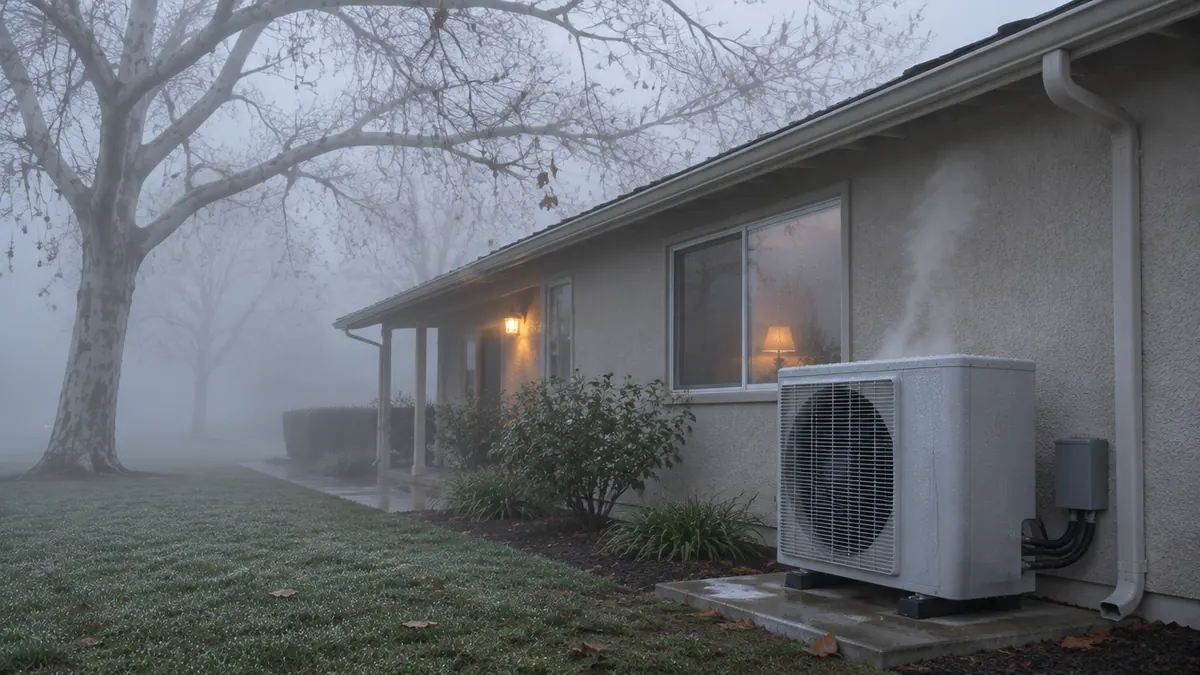
That describes a Sacramento winter morning. NOAA’s 1991–2020 normals for Sacramento Executive Airport put the average January low at 39.2°F, with about 72 nights a year at or below 40°F and about 15 at or below 32°F. NOAA’s Climate of Sacramento memo adds that dense fog comes mostly in midwinter and that fog here is usually confined to the early morning hours. Cold, saturated air on a foggy, frosty morning is exactly when you’ll see your heat pump steam. If your heat pump is new to you, it’s worth knowing what a cycle looks like so a normal one doesn’t send you to the phone. For how heat pumps handle the rest of our climate, see do heat pumps work in Sacramento.
How does a heat pump defrost cycle work?
The heat pump reverses the flow of refrigerant so hot refrigerant runs through the outdoor coil and melts the ice, then reverses again to resume heating once the coil is clear.
- Detect. Sensors and controls watch the outdoor coil’s temperature and operating conditions. One major manufacturer says most systems check for frost every 30 to 90 minutes in heating mode.
- Reverse. A part called the reversing valve switches the system into cooling mode. The outdoor fan may stop or slow, and the compressor sound may change.
- Melt. Warm refrigerant heats the outdoor coil from the inside, and the frost melts and drips off. You’ll often see steam.
- Cover the gap indoors. Warm-air production pauses briefly. In ducted systems, backup heat often comes on during defrost so your vents don’t blow cold air.
- Resume. Once the coil is clear, the system switches back to heating.
Not every heat pump decides when to defrost the same way. One major manufacturer explains that timed systems defrost after a set amount of run time whether they need it or not, while demand defrost uses sensors to defrost only when necessary and ends the cycle as soon as the ice is gone.
| What you notice | Normal during defrost? | Why |
|---|---|---|
| Steam rising from the outdoor unit | Yes | Melting frost evaporating off the warm coil |
| A whoosh or swoosh | Yes | Refrigerant reversing direction as modes switch |
| Outdoor fan stopped or slowed | Yes | Part of the defrost cycle; it restarts after |
| Cooler air at the vents for a few minutes | Yes | Warm-air production pauses while the coil defrosts |
| Aux heat on the thermostat | Yes | Backup heat covers the gap |
| Water dripping under the unit | Yes | Melted frost draining away |
| Dark smoke or a burning smell | No | Not defrost; turn the system off and call |
| Thick ice that stays after the cycle | No | Possible airflow, refrigerant or defrost-control problem |
How long should a heat pump defrost cycle last?
A typical defrost cycle lasts about 5 to 15 minutes, and some demand-defrost systems finish in as little as 3 to 5 minutes.
One major manufacturer and the Department of Energy-hosted owner guide both put a typical cycle at 5 to 15 minutes. Another major manufacturer says its demand-defrost systems usually take 3 to 5 minutes and run fewer cycles than timed systems. Either way, your heat pump should go back to heating within a few minutes.
How often it happens depends on the weather. One manufacturer says most systems check for frost every 30 to 90 minutes in heating mode, so cold, damp days can bring several cycles. On dry or sunny days, the same manufacturer notes, the cycle may run rarely or not at all.
What isn’t normal: a heat pump that seems to be constantly switching into defrost, or cycles that last longer and longer while frost and ice start to cover the unit. One major manufacturer says both are reasons to call for service, and the owner guide says to consult an HVAC professional if your heat pump is stuck in defrost or covered in ice.
Why is my heat pump steaming?
Steam from a heat pump in winter is almost always melting frost evaporating off the warm outdoor coil during a defrost cycle, and it’s normal.
One major manufacturer calls a cloud of steam from the outdoor unit perfectly normal, and another says it’s water vapor and a normal part of the process. On a foggy morning it can look dramatic, but it’s the same harmless vapor. The steam fades as the cycle ends and the unit goes back to heating. You may also see water dripping from the bottom of the unit. That melted frost has to drain somewhere, so the owner guide reminds owners to make sure it doesn’t pool and refreeze on a walkway.
Is my heat pump smoking in winter?
Almost certainly not: what looks like smoke is usually defrost steam, which is white, has no smell, and fades within minutes.
Here’s how to tell the difference:
- Steam is white and wispy, rises during a defrost cycle, has no odor, and stops when the unit goes back to heating.
- Smoke is gray or dark, smells like burning plastic or hot electrical parts, and keeps coming regardless of the cycle.
Safety first: If you see dark smoke or smell burning from the heat pump, switch the thermostat to Off and call for service. Don’t open the unit or touch wiring. If you see flames, or smoke is spreading, get everyone out of the house and call 911 from outside.
Also listen. A whoosh during defrost is normal. Grinding, squealing or banging is not, and one major manufacturer lists those sounds among the reasons to call a technician. Our guide to HVAC noises covers other sounds.
Is ice on my heat pump normal?
A light coat of frost on the outdoor coil is normal and should clear during a defrost cycle; thick ice that covers the coil, or stays after the cycle ends, is not.
One major manufacturer calls periodic frost on the outdoor coil perfectly normal. Another draws the line at about 1/4 inch: ice thicker than that, or ice that remains after defrost, may point to restricted airflow, low refrigerant or a problem with the defrost system. Ice that isn’t going away, or is growing, likely means a bigger issue, such as low refrigerant, faulty defrost controls or a faulty sensor.
Weather can cause it too. One manufacturer lists freezing rain, sleet and heavy wet snow among the causes of a frozen heat pump, because they can overwhelm the defrost system. Those are rare on the Sacramento valley floor; NOAA’s Climate of Sacramento memo says snow is so rare it may be disregarded as a climatic feature. Here, look first for water dripping from a gutter or roof edge onto the unit, which builds ice one drop at a time, and then at the unit itself.
What to do about ice on a heat pump
- Give it a defrost cycle. Watch the unit for up to 90 minutes in heating mode. Light frost should melt in a normal cycle.
- Clear around the unit. Keep about 2 feet of open space around it. Clear leaves and debris, and gently brush any loose snow or slush off the top with a soft broom instead of piling it against the sides.
- Stop the drip. Make sure gutters, downspouts and roof edges aren’t dripping onto the unit.
- Check the filter. A clogged indoor filter restricts airflow. Replace it if it’s dirty. See how often to change your air filter.
- Let heavy ice melt, and call. If thick ice covers the coil or stays after defrost, don’t chip it or pour hot water on it; manufacturers warn both can damage the coil, fins and fan. Switch the thermostat to Emergency Heat to keep the house warm, or to Off, and call. Once it’s above freezing, one manufacturer says ice should melt on its own in roughly 2 to 4 hours; if it hasn’t melted in 6 to 8 hours, or refreezes quickly, a technician needs to look.
For the full list of heating checks, see why a heat pump isn’t heating. And if you’re tempted to cover the unit to keep ice off, read should you cover your heat pump in winter first.
When is defrost mode a sign of a problem?
Defrost points to a problem when it runs constantly, lasts longer and longer, never seems to start while ice builds up, or leaves the unit covered in ice.
- Stuck in defrost. Steam and cool air that go on well past 15 minutes, again and again.
- Defrosting all the time. One major manufacturer says frequent or unusually long cycles may indicate a problem, and repeated long cycles should be checked by a professional.
- Never defrosting. Ice keeps building and the unit never switches modes. One manufacturer says a defrost cycle that never kicks in after several hours of running needs a technician.
- Fan doesn’t restart. The outdoor fan should spin again once the ice is gone.
- Aux heat that never shuts off. Defrost brings on backup heat briefly. If Aux shows constantly, see emergency heat vs. aux heat.
A failed defrost control, timer or sensor is one of the most common reasons for a severe freeze-up, according to one major manufacturer. Diagnosing and repairing it is a technician job. A pre-season tune-up is a good time to have defrost operation checked. If the unit is already iced over, schedule heat pump repair, and if your heat pump struggles every cold snap, read do heat pumps work in cold weather.
Why do Sacramento-area homeowners call JM Comfort?
JM Comfort is a locally owned heating and air conditioning contractor based in North Highlands, serving North Highlands, Sacramento and nearby communities. It’s a licensed C-20 HVAC contractor (CSLB #1016274), licensed since 2016 and bonded, with workers’ comp insurance on file; you can check the license on the CSLB website. Heat pump repair and installation are among its services for homes, along with furnace and AC repair, tune-ups and ductwork.
Call (916) 247-6358 or book heat pump repair online and we’ll call you back.
Frequently asked questions
Why does my heat pump make a whooshing sound in winter?
That’s usually the defrost cycle starting or ending. Manufacturers describe a whoosh or swoosh as the refrigerant reverses direction and the system shifts modes. It’s normal. Grinding, squealing or banging is not, and those sounds need a technician.
Why does cooler air come from my vents during defrost?
While the heat pump melts frost outside, it briefly stops making warm air for the house. Many systems turn on backup heat during defrost so the vents don’t blow cold air. If you feel cool air for a few minutes and it passes, that’s normal; see emergency heat vs. aux heat for how the backup works.
How often should a heat pump go into defrost?
It depends on the weather. One major manufacturer says most systems check for frost every 30 to 90 minutes in heating mode, and that on dry or sunny days the cycle may run rarely or not at all. Cold, damp days bring more cycles.
Should I cover my heat pump to keep ice off it?
No. A heat pump needs open airflow all winter, and covering it can stop it from heating. A heat pump owner guide hosted by the Department of Energy says to avoid covering it, while protecting it from water and snow running off the roof. See should you cover your heat pump in winter.
Why does my outdoor fan stop during defrost?
The outdoor fan may stop or slow while the unit defrosts; it’s part of a normal cycle. It should start again when the heat pump goes back to heating. If the fan doesn’t spin after the ice has melted, call for service.
Does JM Comfort repair heat pump defrost problems?
Yes. Heat pump repair is one of JM Comfort’s services for homes in North Highlands, Sacramento and nearby communities, along with heat pump installation, tune-ups and ductwork. Call (916) 247-6358 or book a visit online.
Sources
- Understanding the Heat Pump Defrost Cycle (Lennox)
- What Is a Heat Pump Defrost Cycle? (Trane)
- You Installed an Air Source Heat Pump. Now What? (Consortium for Energy Efficiency, hosted by the U.S. Department of Energy)
- Heat Pump Not Heating? Here’s How to Troubleshoot (Carrier)
- What Is Auxiliary Heat? (Carrier)
- What to Do If Your Heat Pump Is Frozen? (Lennox)
- How to Troubleshoot Your Heat Pump: Tips and Tricks to Keep Your HVAC Systems Running Smoothly (Trane)
- U.S. Climate Normals 1991–2020, Monthly: Sacramento Executive Airport, CA (USW00023232) (NOAA National Centers for Environmental Information)
- U.S. Climate Normals 1991–2020, Annual/Seasonal: Sacramento Executive Airport, CA (USW00023232) (NOAA National Centers for Environmental Information)
- NOAA Technical Memorandum NWS WR-272: Climate of Sacramento, California (revised June 2005) (NOAA National Weather Service)
Find this helpful? Add JM Comfort as a preferred source on Google.