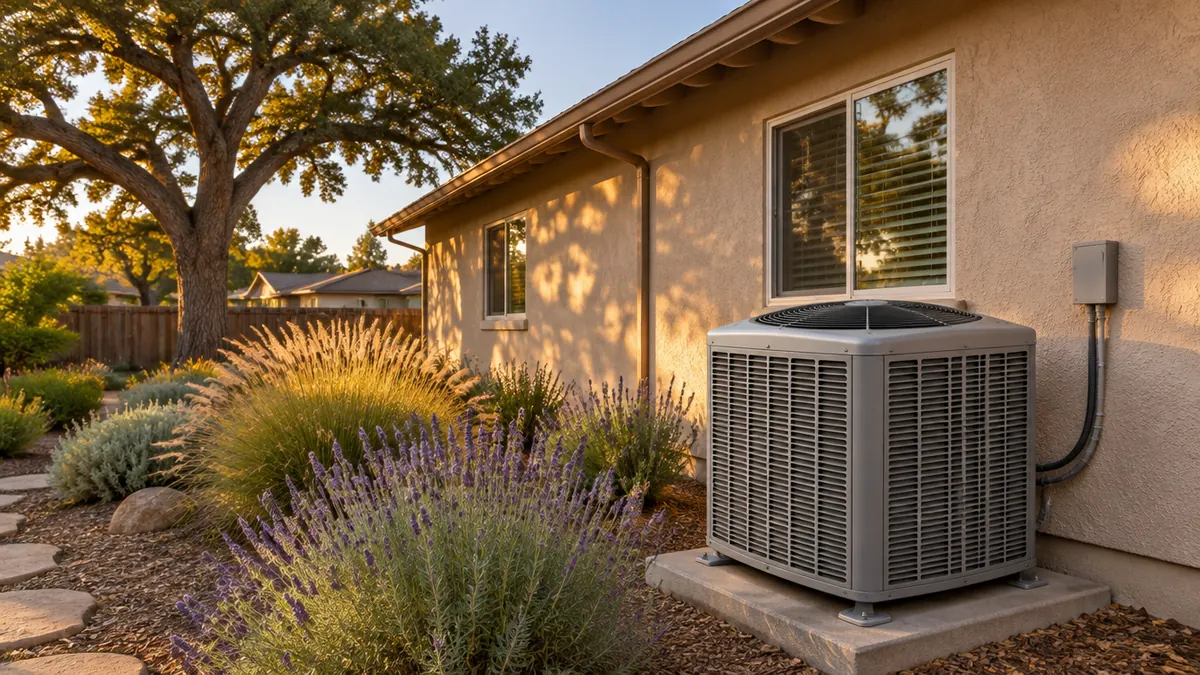
How Often Should You Change Your Air Filter?
The filter is the simplest part of your heating and cooling system and the easiest to forget. Here’s how often to change yours, what happens when you don’t, and which way the arrow points.
JM Comfort can help: HVAC tune-ups and maintenance for homes in Sacramento and nearby. Licensed C-20 HVAC contractor, CSLB #1016274.
Your air filter is the simplest part of your heating and cooling system, and it protects everything behind it. Leave it in too long and the whole system pays for it: weaker airflow, higher bills and, in the worst case, a frozen AC coil or a system that shuts itself down. This guide gives you a schedule by filter type, the things that make a filter clog faster, and the right way to put a new one in. Pair it with a yearly HVAC tune-up and you’ve covered the two habits that keep a system healthy.
How often should you change your air filter?
Check your filter every month and change it whenever it looks dirty, and don’t let any filter go longer than 3 months. That’s ENERGY STAR’s rule for central air conditioners, furnaces and heat pumps.
ENERGY STAR puts it simply: check the filter every month, especially in the heavy-use months of summer and winter. If it looks dirty after a month, change it. At a minimum, change it every 3 months. EPA adds that filter makers typically recommend replacement every 60 to 90 days, and that a filter that comes out heavily soiled is your cue to change it more often.
In the Sacramento area, the heavy-use months are the long stretch of summer heat and the coldest weeks of winter, plus any week when wildfire smoke settles over the valley. That’s when your system runs the most, pulls the most air through the filter, and fills it the fastest. A filter that lasts a full season through a mild spring can turn gray much sooner in July.
So the honest answer to “how often” is: look, don’t guess. A filter that’s gray and caked with dust is due, whatever the package says.
How often should you change each type of air filter?
Thin filters need changing most often: about every 30 days for 1-inch fiberglass, every 30 to 90 days for 1-inch pleated, and every 6 to 12 months for thick 4- to 5-inch media filters.
Filters come in thicknesses from 1 to 5 inches. Thicker filters hold more dust before they clog, so they last longer. Here’s how manufacturer schedules line up:
| Filter type | Where you’ll usually find it | Typical change interval |
|---|---|---|
| 1-inch fiberglass | Return grille or a slot at the furnace or air handler | Every 30 days |
| 1-inch pleated | Return grille or a slot at the furnace or air handler | Every 30 to 90 days (one manufacturer says 60 to 90) |
| 4- to 5-inch media | A filter cabinet built onto the furnace or air handler | Every 6 to 12 months (one manufacturer says about twice a year) |
| Any filter, in a dusty or busy house | Wherever yours is | Check every 30 days and change when dirty |
A thick media filter only works in a cabinet sized for it, so stick with the thickness your system was built for. If your equipment manual or the filter package gives a different schedule, follow it, and keep the monthly check either way.
Thinking about a higher-rated filter while you’re at it? Read what MERV rating you should use first. A more restrictive filter can change how often you need to swap it.
What makes you need to change your filter more often?
Anything that puts more dust, hair or smoke into your air, or makes your system run longer, fills a filter faster.
Manufacturer guides point to the same short list:
- Pets. With more than one pet, one major manufacturer says to check the filter every 30 days. Another lists pets and dusty conditions as reasons to change filters more often.
- Pollen season. Spring pollen loads filters quickly, and one manufacturer names pollen season as a reason to change sooner.
- Smoke, cooking and construction. Smoking indoors, scented candles, wood-burning fireplaces, frequent cooking and construction nearby all add particles. One manufacturer’s guide says to change the filter at least every 30 days in those homes.
- Remodeling. Drywall dust and sawdust from a project inside the house load a filter fast. Check it weekly until the dust settles.
- Long run times. A system that runs almost nonstop through a hot summer needs changes sooner. So does a larger home that moves more air.
- A fan left on On. EPA notes that HVAC filters only clean the air while the system is running. Set the fan to On and the filter works around the clock, so it loads faster.
The flip side: a vacation home or a system that rarely runs can often go longer between changes. The monthly look still tells you when.
Filter dirty again in a couple of weeks? That can point to leaky return ducts. One major manufacturer notes that leaks in the return side can pull dust in from unconditioned spaces like the attic or crawlspace. See the signs in our guide to leaky ductwork.
How often should you change your filter during wildfire smoke?
More often than the package says. EPA advises planning to replace the filter in your HVAC system or air cleaner more often than the manufacturer recommends while smoke is around, and the California Air Resources Board (CARB) says to replace filters when they’re dirty or develop an odor.
Smoke days also change how hard the filter works. EPA suggests a MERV 13 or higher filter if your system can accommodate it, setting any fresh-air intake to recirculate, and running the system’s fan as often as possible by setting it to On instead of Auto while the air quality is poor. That pushes more air, and more smoke, through the filter.
- Keep spares. Buy a few filters in your system’s exact size before fire season, so you’re not hunting for one on a smoky day.
- Check it often. Pull the filter during a smoke event and change it as soon as it looks gray or smells of smoke.
- Check it again after. Once the smoke clears, look at the filter before you go back to your normal schedule.
For the full smoke-day setup, including portable air cleaners and a clean room, see wildfire smoke and your HVAC.
What happens if you don’t change your air filter?
A clogged filter chokes the airflow your system depends on, so it runs harder, costs more to operate, and can freeze up or shut down.
Higher energy bills
ENERGY STAR says a dirty filter slows airflow and makes the system work harder to keep you warm or cool, which wastes energy. Its maintenance checklist adds that a dirty filter can increase energy costs and damage your equipment, leading to early failure.
Uneven comfort
Less air through the filter means less air out of the vents. One manufacturer notes that a clogged filter restricts airflow and causes inconsistent temperatures from room to room.
A frozen AC coil or a shutdown
In summer, a clogged filter can starve the indoor coil of warm air until it ices over. One major manufacturer lists decreased performance, a frozen evaporator coil and even a system shutdown as results of dirty filters. If you see ice, read why an AC freezes up and why an AC blows warm air.
A furnace that overheats or quits
In winter, the furnace needs steady airflow to carry heat away. The Department of Energy’s Building America Solution Center notes that dirt buildup can greatly increase the resistance across a filter, and that excessive resistance can damage furnaces by overheating, freeze cooling coils and burn out blower motors. If your furnace keeps shutting off, start with the filter, then see why a furnace stops working.
Dirt inside the system
A clean filter keeps dust and dirt from building up on the blower and coils. ENERGY STAR says that buildup can lead to expensive maintenance or early system failure.
Which way does a furnace filter go?
The arrow on the filter frame points toward the furnace or air handler, which is the direction the air flows.
Air leaves your rooms through the return grilles, passes through the filter, and heads into the blower. So the arrow should always point away from the room and toward the equipment:
- Filter in a wall or ceiling return grille: the arrow points into the wall or ceiling, away from you.
- Filter in a slot beside the furnace or air handler: the arrow points toward the furnace or air handler.
- Horizontal unit in an attic or crawlspace: the arrow still points toward the unit, along the duct.
Size matters as much as direction. EPA says the filter should fit snugly so air doesn’t leak around it, and one major manufacturer warns that the wrong size can damage your system and hurt indoor air quality. The easiest way to get the size right is to pull out the old filter and read its frame.
How do you change an HVAC air filter?
Turn the system off, slide the old filter out, and slide a new one of the same size in with the arrow pointing toward the equipment. It takes a few minutes.
Safety first: Change the filter only through the grille or filter door made for it. Don’t remove the panels that cover the furnace burners, blower or wiring to reach a filter. If yours seems to sit behind a panel, ENERGY STAR notes your contractor can show you how to change it. If you smell gas near the furnace, leave the house now without flipping any switches, then call 911 and PG&E from outside. PG&E’s Report an Emergency page has its emergency line. See what to do if you smell gas.
- Find the filter. Check for a return grille in a wall or ceiling, a slot beside the furnace or air handler, or a filter cabinet next to the equipment. Some homes have more than one filter.
- Turn the system off at the thermostat.
- Slide the old filter out. Note the size printed on the frame and which way its arrow points.
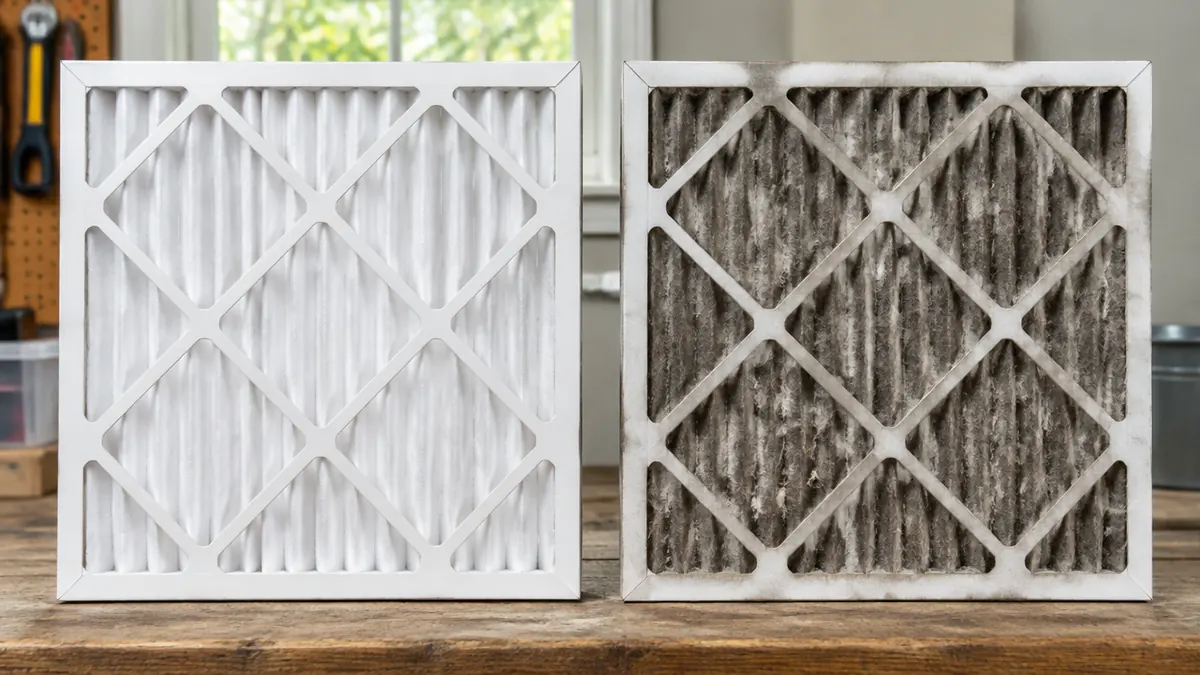
- Look at what came out. Gray and caked means you were due. Heavily soiled means you should shorten your schedule.
- Slide the new filter in with the arrow toward the furnace or air handler. Make sure it sits snugly with no gaps at the edges.
- Close the grille or door and turn the system back on.
- Write the date on the frame and set a reminder to check it in 30 days.
Want the rest of the homeowner to-do list? Our DIY HVAC maintenance checklist covers the outdoor unit and the condensate drain too.
Does a better filter mean you change it less often?
Not by itself: thickness is what stretches the change interval, and a high-efficiency filter still has to be changed on time so it doesn’t choke your system.
EPA says most furnaces and HVAC systems can handle a MERV 13 filter without equipment problems, provided the filter is replaced frequently. The Department of Energy’s Building America guidance says filters should be replaced every 3 months or sooner if needed, especially when the equipment runs continually, and right away if they’re clogged with debris.
A better filter catches more of what’s in your air. That’s good for your lungs and your equipment, but it also means the filter fills up. Keep the monthly check no matter which filter you buy. Our guide to the best air filter and MERV rating explains the tradeoffs.
When does a filter problem need a technician?
Call a technician when a fresh filter doesn’t fix the symptom: ice that comes back, a system that keeps shutting off, weak airflow everywhere, or a filter that’s filthy within weeks.
- Ice that returns. If you replaced a clogged filter, let the coil thaw, and the ice comes back, the cause is deeper, such as low refrigerant or another airflow problem. Turn cooling off and call.
- Repeated shutdowns. A furnace or AC that keeps cutting out with a clean filter needs a diagnosis.
- Weak airflow with a clean filter. Crushed, disconnected or leaky ducts can starve rooms of air. Our guide to uneven temperatures walks through the signs.
- A filter you can’t reach safely. Ask a technician to show you where it is and how to change it.
ENERGY STAR recommends a professional check-up every year, with the cooling system checked in spring and the heating system in fall. See what an HVAC tune-up includes.
Why do Sacramento-area homeowners call JM Comfort?
JM Comfort is a locally owned heating and air conditioning contractor based in North Highlands, serving North Highlands, Sacramento and nearby communities. It’s a licensed C-20 HVAC contractor (CSLB #1016274), licensed since 2016 and bonded, with workers’ comp insurance on file; you can check the license on the CSLB website. The team handles tune-ups and maintenance for air conditioners, furnaces and heat pumps, along with AC and furnace repair, ductwork repair and sealing, and indoor air quality work focused on filtration and ventilation, for homes.
Call (916) 247-6358 or book a tune-up online and we’ll call you back.
Frequently asked questions
How often should I change my air filter if I have pets?
Check it every 30 days. One major manufacturer recommends monthly checks in homes with several pets, because hair and dander load a filter quickly. If it’s gray or matted with hair at the monthly check, change it then instead of waiting for the date on the package.
Does a dirty air filter raise my electric bill?
It can. ENERGY STAR says a dirty filter slows airflow and makes the system work harder to keep you warm or cool, which wastes energy. Changing it on schedule is one of the simplest efficiency steps you can take.
Can a dirty air filter make my AC freeze up?
Yes. When a clogged filter starves the indoor coil of airflow, the coil can get cold enough to ice over, and the system may even shut down. Turn cooling off, let the ice melt, then replace the filter. Our guide to an AC freezing up covers the rest.
How do I know what size air filter to buy?
Pull out the filter you have now. The size is printed on its frame, usually as length, width and thickness in inches. Buy that exact size, because a filter that doesn’t fit lets air slip around the edges, and one manufacturer warns that the wrong size can damage your system.
Can I run my AC or furnace without a filter for a day?
It’s best not to. The filter keeps dust and dirt from building up inside the system, and ENERGY STAR links that buildup to expensive maintenance and early failure. Buy the right size first, then turn the system back on.
Sources
- Maintenance Checklist (ENERGY STAR)
- Heat & Cool Efficiently (ENERGY STAR)
- Guide to Air Cleaners in the Home (U.S. Environmental Protection Agency)
- High-MERV Filters (Building America Solution Center, U.S. Department of Energy)
- Air Conditioner Filter Replacement 101 (Trane)
- How Often to Change Air Filters in Your Home (Carrier)
- Furnace Filters: Types, MERV Ratings & Replacement Guide (Bryant)
- Top 3 Signs Your HVAC Ductwork Is Leaking (Trane)
- Wildfires and Indoor Air Quality (IAQ) (U.S. Environmental Protection Agency)
- Smoke Ready California (California Air Resources Board)
Find this helpful? Add JM Comfort as a preferred source on Google.