Leaky Ductwork: The Signs, Whether Duct Sealing Is Worth It, and When to Replace
Your ducts can waste a big share of the air your system works to heat and cool. Here’s how to spot leaks, what sealing actually does, what California requires when you replace equipment, and how to tell when ducts are past repair.
JM Comfort can help: ductwork repair and sealing for homes in Sacramento and nearby. Licensed C-20 HVAC contractor, CSLB #1016274.
Your heating and cooling system can be in perfect shape and still waste a big share of its work, because the air has to travel through ducts to reach you. When those ducts leak into an attic, crawlspace or garage, you pay to heat or cool air that never makes it to a room. Leaks are invisible from the living room, so most people only notice the symptoms: bills that keep climbing, a bedroom that never cools, dust that comes back the day after you clean. This guide covers the signs, what duct sealing and repair are worth, what California’s energy code requires when you replace equipment, and how to tell when ducts need replacing instead.
How much air do leaky ducts lose?
A lot: ENERGY STAR says about 20 to 30 percent of the air that moves through the duct system in a typical house is lost to leaks, holes and poorly connected ducts.
Think about what that means on a hot summer afternoon. Your AC cools the air, the blower pushes it into the ducts, and a fifth to nearly a third of it can leak out before it reaches a vent. If those ducts run through a hot attic or a crawlspace, the lost air is gone for good. ENERGY STAR says leaky ducts can reduce heating and cooling system efficiency by as much as 20 percent.
The leaks work in both directions. Supply ducts push conditioned air out through the gaps. Return ducts, which run under suction, pull air in, and that air comes from wherever the leak is. ENERGY STAR notes that fumes from household and garden chemicals, insulation particles and dust can enter a leaky duct system, so a leaky return in the garage or crawlspace can bring those into your house.
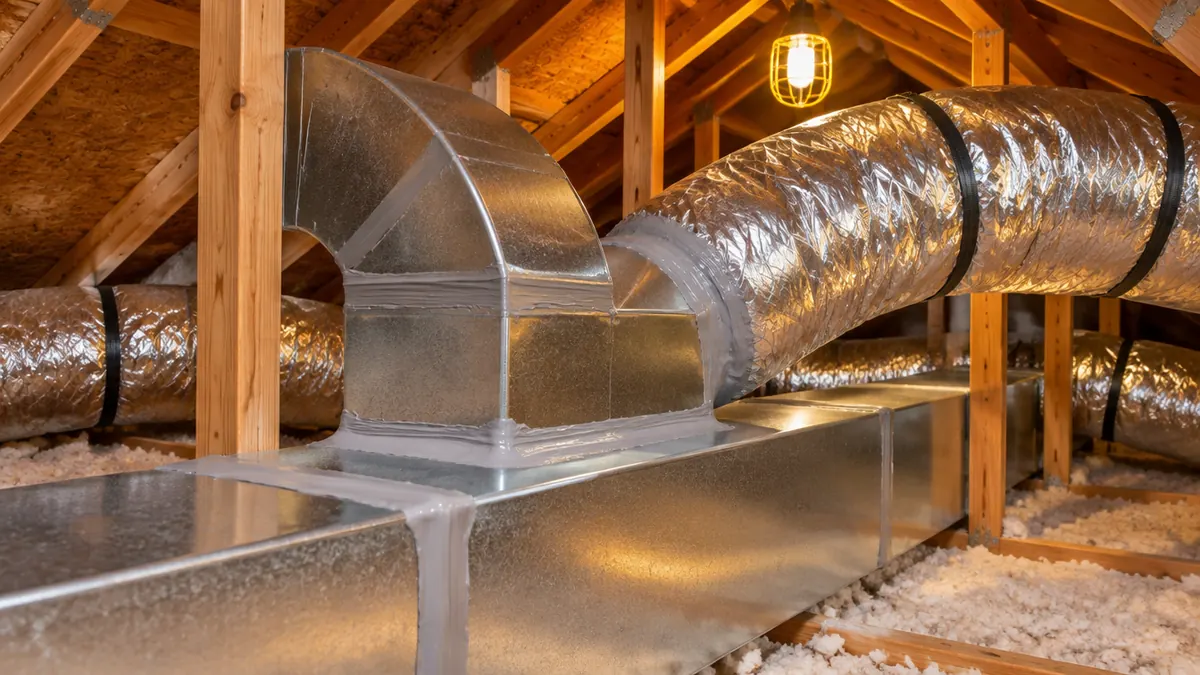
ENERGY STAR names attics, crawlspaces, unfinished basements and garages as the places where accessible ducts should be sealed and insulated.
What are the signs of leaky ductwork?
The main signs are high summer and winter bills, rooms that are hard to heat or cool, stuffy rooms that never feel comfortable, extra dust, and ducts that run through an attic, crawlspace or garage.
ENERGY STAR lists most of those, plus one you can see with a flashlight: tangled or kinked flexible ducts. Extra dust belongs on the list too, because dust and insulation particles can enter a leaky duct system. Here’s how to read the signs:
| Sign | What it can mean | What to check |
|---|---|---|
| High summer and winter bills | Conditioned air leaking into unconditioned space | Compare bills to last year at similar thermostat settings |
| Rooms that are hard to heat or cool | Leaky, crushed or disconnected ducts to those rooms | Airflow at that room’s vent compared with others |
| Stuffy rooms that never feel right | Not enough supply air reaching the room | Closed or blocked vents first, then the duct run |
| Extra dust soon after cleaning | Return leaks pulling in dust from the attic, crawlspace or garage | Exposed return ducts and connections near the equipment |
| Tangled, kinked or crushed flexible ducts | Restricted airflow, often with leaks at the ends | Visible runs in the attic or crawlspace |
| Ducts in an attic, crawlspace or garage | The highest-risk places for leaks | Seams, joints and connections at registers |
You can look at exposed ducts yourself: check for gaps at connection points and where ducts meet the vents, and leave hidden ductwork to a professional. If one part of your house is always warmer, see why upstairs is so hot. If your ducts drip, see why air ducts sweat; leaks can be part of the cause.
Is duct sealing worth it?
For most homes with ducts in an attic, crawlspace or garage, yes: ENERGY STAR says leaky ducts can cut heating and cooling efficiency by as much as 20 percent, and that sealing and insulating them can often pay for itself in energy savings.
The payoff shows up in more than one place:
- Lower bills. ENERGY STAR says sealing and insulating ducts increases efficiency and lowers your energy bills.
- Comfort. It can help with rooms that are too hot in summer or too cold in winter.
- Cleaner air. Sealed ducts reduce the chance of dust, insulation particles and fumes being pulled into the system.
- Smaller equipment later. If you’re planning a replacement, ENERGY STAR says a well-designed, sealed duct system may let you downsize to a smaller, less costly system that also provides better dehumidification.
- Safety. Sealing leaks lowers the risk of backdrafting, explained below.
Don’t count on a rebate for sealing alone. As of November 2026, SMUD’s heating and cooling rebates page doesn’t list a separate duct-sealing rebate. Its heat pump rebates do set duct rules: the system must pass Title 24 (SMUD’s page still calls the form a HERS CF3R), and any new ductwork must be insulated to at least R-8. Those rebates also require a contractor in the SMUD Contractor Network, so ask any contractor whether they’re in it before you count on the money, and check SMUD’s rebate page for current terms. See HVAC rebates in Sacramento for the rest.
Safety first: Gas appliances such as furnaces, water heaters and dryers give off combustion gases like carbon monoxide. ENERGY STAR warns that leaky ductwork can cause backdrafting, which draws those gases back into your living space instead of sending them outdoors. After ducts are sealed, ENERGY STAR says the contractor should make sure there’s no backdrafting of gas- or oil-burning appliances and do a combustion safety test. If your carbon monoxide alarm sounds or you suspect CO poisoning, get outside to fresh air immediately, then call 911. Read more about carbon monoxide safety.
Can you seal leaky ducts yourself?
You can seal ducts you can reach, such as an exposed run in the garage or along an accessible attic path, but hidden ducts and anything that needs testing are a job for a professional.
If you tackle exposed ducts, follow ENERGY STAR’s rules:
- Use the right material. Seal seams and connections with mastic sealant or metal tape.
- Skip the duct tape. ENERGY STAR says never use duct tape, because it isn’t long-lasting.
- Don’t forget the registers. Seal the connections where vents and registers meet the floors, walls and ceilings.
- Seal first, then insulate. After sealing ducts in the attic, crawlspace or garage, insulate them so they don’t get hot in summer or cold in winter.
Most ductwork sits behind walls, under floors or deep in an attic. For ducts you can’t reach, ENERGY STAR lists aerosol-based sealant among the methods a contractor can use. Stay safe in the attic, too: step only on the joists or on boards laid across them, and leave wiring alone. And if you’re replacing equipment, DIY sealing doesn’t replace the installer sealing and ECC-Rater testing California requires, covered below.
What does professional duct sealing include?
A good duct job starts with an inspection of the whole system and ends with an airflow and safety check, with repairs, sealing and insulation in between.
ENERGY STAR says to look for a contractor who will do the following. Use it as your checklist when you compare estimates:
What does California require when you replace HVAC equipment?
In California, replacing a major part of a central system means your ducts get sealed and tested too: under the 2025 Energy Code, replacing the air handler, the outdoor unit of a split AC or heat pump, a whole packaged unit, or a cooling or heating coil requires the installer to seal the connected ducts and a third-party ECC-Rater to verify them.
The California Energy Commission (CEC) says installing a space-conditioning appliance, other than a plug-in room unit, requires a building permit. It also says replacing just the outdoor unit, or just the indoor unit, of a split system is enough to trigger the duct sealing rule. Here’s what the CEC’s 2025 compliance manual calls for:
| Situation | What the 2025 Energy Code calls for |
|---|---|
| Air handler, outdoor unit, packaged unit or coil replaced | Ducts sealed and tested: leakage of 10% or less of system airflow, or 7% or less to the outside |
| Neither leakage target can be met | All accessible leaks sealed and checked by a visual inspection and a smoke test, with no sampling: every house is tested |
| Altered ducts or equipment in a garage | Leakage of 6% or less, or all accessible leaks in the garage sealed and smoke-tested |
| More than 25 feet of new duct added | Sealing and leakage testing to the same 10% or 7% targets |
| An entirely new duct system | Leakage of 5% or less of system airflow |
| New ducts in unconditioned space in climate zone 12 | Insulation of at least R-8 |
There are exceptions. The manual exempts ducts that have already been sealed, tested and certified by an ECC-Rater, duct systems with less than 40 feet of duct in total, and duct systems that contain asbestos. The CEC’s ZIP code table puts North Highlands (95660) and Sacramento ZIP codes such as 95814 and 95821 in building climate zone 12, which is why the R-8 row applies here.
What it means for you: if you’re replacing equipment, ask any contractor whether the job includes a permit and ECC-Rater duct testing, who schedules the test, and what happens if the ducts don’t pass. The Title 24 permit guide covers the paperwork, and what a new HVAC system includes covers the rest of the job.
When does ductwork need to be replaced?
Replace ductwork when repair stops making sense: major visible damage that would be costly and labor-intensive to fix, or insulated ducts that have gotten wet or moldy.
Most leaky ducts can be sealed, and ENERGY STAR’s checklist treats disconnected, tangled and crushed ducts as repairs. Replacement is for the cases repair can’t handle:
- Extensive damage. One major manufacturer says replacement may be the best option when there’s visible damage and repairing the existing system would be labor-intensive and cost-prohibitive.
- Wet or moldy insulated ducts. EPA says insulated ducts that get wet or moldy can’t be effectively cleaned and should be removed and replaced. Fix the moisture source too, or the new ducts will have the same problem.
- A new system that doesn’t fit the old ducts. The same manufacturer notes that newer energy-efficient systems may or may not be compatible with existing ductwork. If you’re replacing equipment, have the ducts evaluated as part of the job.
If you’re weighing a big repair against a new system, the repair-or-replace calculator can help you think it through.
How long is ductwork good for?
One major manufacturer says HVAC ductwork lasts 10 to 25 years, depending on the type of ductwork, with the quality of the installation, maintenance and how hard the system is used also playing a part.
That’s a wide range, and other published estimates vary, so treat any number as a rough guide. Age alone isn’t a reason to tear out ducts. Condition is. Ducts that are sealed, connected, dry and well insulated can keep doing their job, while ducts that are crushed, disconnected, damp or falling apart need attention no matter how old they are. A technician who inspects the attic and crawlspace can tell you which you have. For equipment lifespans, see how long HVAC systems last.
What should you look for in an HVAC company?
Look for a licensed contractor who inspects the ducts before quoting, puts the scope in writing, and tells you plainly what the code requires for your job.
For license checks, questions to ask and red flags, see how to choose an HVAC company.
Why do Sacramento-area homeowners call JM Comfort?
JM Comfort is a locally owned heating and air conditioning contractor based in North Highlands, serving North Highlands, Sacramento and nearby communities. It’s a licensed C-20 HVAC contractor (CSLB #1016274), licensed since 2016 and bonded, with workers’ comp insurance on file; you can check the license on the CSLB website. The ductwork service covers duct repair, replacement and sealing for homes, and the same team handles AC, furnace and heat pump repair and installation.
Call (916) 247-6358 or book a ductwork visit online and we’ll call you back.
Frequently asked questions
Why shouldn’t I use duct tape on ducts?
Because it doesn’t last. ENERGY STAR says never to use duct tape on duct leaks because it isn’t long-lasting. Use mastic sealant or metal tape instead, and seal the joint before you insulate over it.
Can leaky ducts make my house dusty?
Yes. ENERGY STAR notes that dust, insulation particles and fumes from household and garden chemicals can enter a leaky duct system. Return-side leaks pull air from wherever the gap is, such as the attic, crawlspace or garage. Keep up with filter changes while you sort out the leaks.
Can sealing my ducts let me buy a smaller AC?
It can. ENERGY STAR says that if you’re planning new heating and cooling equipment, a well-designed and sealed duct system may let you downsize to a smaller, less costly system that also provides better dehumidification. Have the ducts checked before you size new equipment. See what size AC you need.
Is there a rebate for duct sealing in Sacramento?
Not as a separate item, as of November 2026: SMUD’s heating and cooling rebates page doesn’t list one. Its heat pump rebates require the system to pass Title 24 and any new ductwork to be insulated to at least R-8, and the work must be done by a contractor in the SMUD Contractor Network. The Sacramento rebates guide has the details.
Does JM Comfort seal and repair ductwork?
Yes. JM Comfort’s ductwork service covers duct repair, replacement and sealing for homes in North Highlands, Sacramento and nearby communities. Call (916) 247-6358 or book online.
Sources
- Duct Sealing (ENERGY STAR)
- Benefits of Duct Sealing (ENERGY STAR)
- Hire a Professional Contractor for Duct Improvement Projects (ENERGY STAR)
- 2025 Single-Family Residential Compliance Manual, Chapter 9: Additions, Alterations, and Repairs (PDF) (California Energy Commission)
- 2025 Single-Family Heating, Ventilation, and Air Conditioning (HVAC) (California Energy Commission)
- Building Climate Zones by Zip Codes (California Energy Commission)
- Heating and cooling rebates (SMUD)
- What Does HVAC Duct Installation Cost? (Trane)
- Should You Have the Air Ducts in Your Home Cleaned? (U.S. Environmental Protection Agency)
- Carbon Monoxide (U.S. Consumer Product Safety Commission)
Find this helpful? Add JM Comfort as a preferred source on Google.