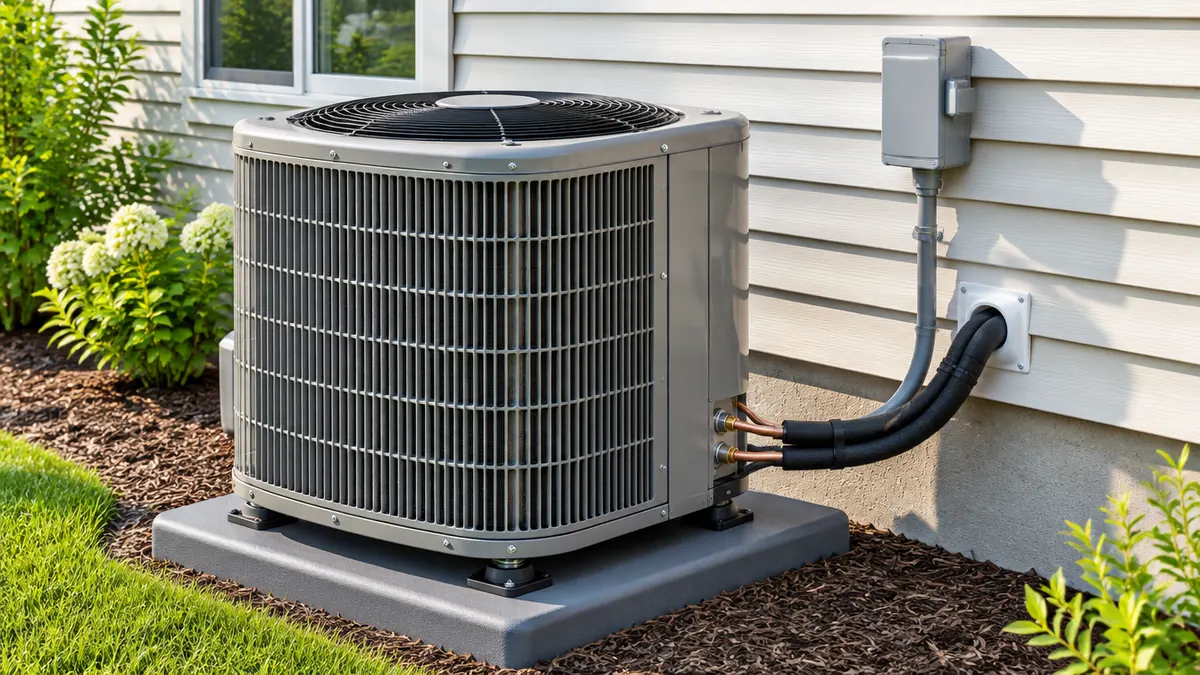
What Size AC Do I Need? Tons, BTUs and How Sizing Really Works
Square footage gets you a ballpark. Your house decides the real answer. Here’s how to estimate AC size in BTUs and tons, what a Manual J load calculation adds, and why bigger isn’t better in hot, dry Sacramento summers.
JM Comfort can help: AC installation for homes in Sacramento and nearby. Licensed C-20 HVAC contractor, CSLB #1016274.
“What size AC do I need?” sounds like a square-footage question. It isn’t, quite. Two houses of the same size can need very different systems, and getting it wrong in either direction costs you comfort and money. This guide gives you a fast estimate you can do at the kitchen table, then explains how a proper sizing works before you commit to a new AC installation.
What size air conditioner do I need?
You need an air conditioner sized to your home’s cooling load: the heat your house gains on a hot day through its walls, roof, windows, air leaks and ducts, plus the heat from people and appliances. Square footage gives you a ballpark; a load calculation gives you the answer.
For the ballpark, use the ENERGY STAR sizing chart below. It was built for room air conditioners and assumes an 8-foot ceiling, so treat it as a starting estimate for a whole house, not a final size. The tons column divides each row by 12,000, because one ton of cooling equals 12,000 BTU per hour.
| Area to cool (sq ft) | Capacity (BTU per hour) | About this many tons |
|---|---|---|
| 100 up to 150 | 5,000 | 0.4 |
| 150 up to 250 | 6,000 | 0.5 |
| 250 up to 300 | 7,000 | 0.6 |
| 300 up to 350 | 8,000 | 0.7 |
| 350 up to 400 | 9,000 | 0.75 |
| 400 up to 450 | 10,000 | 0.8 |
| 450 up to 550 | 12,000 | 1 |
| 550 up to 700 | 14,000 | 1.2 |
| 700 up to 1,000 | 18,000 | 1.5 |
| 1,000 up to 1,200 | 21,000 | 1.75 |
| 1,200 up to 1,400 | 23,000 | 1.9 |
| 1,400 up to 1,500 | 24,000 | 2 |
| 1,500 up to 2,000 | 30,000 | 2.5 |
| 2,000 up to 2,500 | 34,000 | 2.8 |
ENERGY STAR adjusts the chart for a few conditions: cut capacity by 10% for a heavily shaded space, add 10% for a very sunny one, add 600 BTU per hour for each regular occupant beyond two, and add 4,000 BTU per hour if the space includes a kitchen. The AC size calculator does that math for you in a few seconds.
How many tons of AC do you need for a 1,500 sq ft house?
A 1,500-square-foot house often lands around 2 to 2.5 tons on rule-of-thumb charts, but the real answer can range from about 1.5 tons for a tight, well-insulated home to nearly 4 tons for an older, leaky one.
Here’s where those numbers come from. The ENERGY STAR chart puts 1,400 to 1,500 square feet at 24,000 BTU per hour (2 tons) and the next row up at 30,000 (2.5 tons). One major manufacturer’s rules of thumb show how much insulation matters: about 400 square feet per ton for older homes with original single-pane windows, 600 square feet per ton or less for most newer homes, and closer to 1,000 square feet per ton for new construction. At 1,500 square feet, that’s roughly 3.75, 2.5 or 1.5 tons. Same floor plan, very different systems.
What size HVAC system do you need for a 2,000 sq ft house?
A 2,000-square-foot house usually falls between 2.5 and 3.5 tons on rule-of-thumb charts, and anywhere from about 2 to 5 tons once insulation and windows are accounted for.
The ENERGY STAR chart lists 30,000 BTU per hour (2.5 tons) for 1,500 to 2,000 square feet and 34,000 (about 2.8 tons) for 2,000 to 2,500. Using the same manufacturer’s square-feet-per-ton rules, 2,000 square feet comes to about 5 tons at 400 square feet per ton, 3.3 tons at 600, and 2 tons at 1,000. If some rooms run hotter than others, ENERGY STAR counts that among the signs of duct problems, so look at airflow, not just tonnage. See why your upstairs is so hot.
The heating side gets sized too. A heat pump has to handle both your cooling and heating loads, which is one more reason to size from a calculation. See heat pump vs. furnace and whether heat pumps work in Sacramento.
Why isn’t square footage enough?
Square footage leaves out most of what makes a house gain heat. A load calculation looks at the home itself, and one major manufacturer lists the inputs: square footage, ceiling height, layout, the number and type of windows, sun exposure, insulation types and ratings, exterior doors and skylights, heat-producing appliances, how many people live there, the home’s location, and the existing duct system.
Ducts matter more than most people expect. ENERGY STAR says a typical house loses about 20 to 30 percent of the air moving through its ducts to leaks, holes and poor connections. A system sized for the house but fed through leaky attic ducts may still fall short; fixing the ducts can matter as much as the tonnage. See leaky ducts and duct sealing.
What is Manual J?
Manual J is the Air Conditioning Contractors of America (ACCA) standard for calculating how much heating and cooling a house needs. ACCA calls it the national ANSI-recognized standard for producing HVAC equipment sizing loads for single-family detached homes.
A Manual J calculation accounts for local design conditions, windows, walls and roof, air leakage, duct losses and internal loads such as people and appliances to find the heat the house gains in summer and loses in winter. ACCA says a proper load calculation performed with the Manual J procedure is required by national building codes and most state and local jurisdictions. California is one of them: the California Energy Commission’s guide to the 2025 Energy Code says new HVAC systems require load calculations. One manufacturer adds that contractors should use ACCA-approved software and real data about your home rather than default values.
Manual S picks the equipment
Manual J gives the load. ACCA’s Manual S is the guide for selecting and sizing the equipment to meet it. ACCA says Manual S sets size limits so properly installed equipment can deliver optimal comfort, and those limits account for regional outdoor conditions to prevent short cycling. In plain terms: J tells you how much cooling the house needs, and S keeps the system you buy from being much bigger or smaller than that.
When you get quotes, ask any contractor: How did you size this system? Did you do a room-by-room load calculation, and can I see the results? Be wary of a size based only on the old unit’s label.
What happens if your AC is too big?
An AC that’s too big cools the air near the thermostat quickly and shuts off in short bursts, so you pay for capacity you don’t use and some rooms never catch up. ENERGY STAR says an oversized unit costs more to buy, wastes energy and doesn’t provide better cooling.
In humid parts of the country, the classic complaint is a house that feels cool but clammy, because ENERGY STAR notes a unit that’s too large cools the room before it has a chance to remove the humidity. Sacramento is different. The Department of Energy puts California in its “hot-dry” Southwest region, and a clammy house with the AC running is unusual here. The real costs of oversizing in the valley are short cycling and uneven rooms: the system satisfies the thermostat before the far bedrooms cool, then starts and stops all afternoon.
Those short, frequent cycles are exactly what ACCA’s Manual S size limits are designed to prevent. If your current system turns on and off every few minutes, see AC short cycling. If your house does feel sticky with the AC running, read ideal indoor humidity.
What happens if your AC is too small?
An AC that’s too small runs nonstop on hot afternoons and still can’t hold the temperature you set. One major manufacturer says an undersized unit won’t be able to hold temperatures consistently on hot days, and another notes that a system running constantly to keep up adds wear and raises energy bills.
That shows up fast on a 100-degree Sacramento afternoon. Before you blame the size, rule out other causes. A dirty filter, a dirty outdoor coil, low refrigerant or leaky ducts can make a correctly sized system act undersized. See why an AC runs constantly and why an AC blows warm air.
How do you make sure a new AC is sized right?
Ask for a sizing based on your house, compare it with your own ballpark estimate, and make sure the quote explains the difference.
- Run your square footage through the AC size calculator so you have a ballpark.
- Ask each contractor how they sized the system, and whether the number came from a room-by-room load calculation.
- Mention any upgrades since the old system went in: new windows, added insulation, sealed ducts or a finished room.
- Ask whether the ducts can deliver the airflow the new system needs.
- Compare efficiency only after the size is settled. DOE says EER is especially important in hot-dry climates, which see more high-temperature days; see SEER2 ratings explained.
- If two quotes differ by a ton or more, ask each contractor to explain why.
What should you look for in an HVAC company?
Look for a licensed contractor that sizes from your house, puts everything in writing, and handles the permit the replacement needs.
For what a new system costs and what should be in the quote, see what a new HVAC system costs and how to choose an HVAC company.
Why do Sacramento-area homeowners call JM Comfort?
JM Comfort is a locally owned heating and air conditioning contractor based in North Highlands, serving North Highlands, Sacramento and nearby communities. It’s a licensed C-20 HVAC contractor (CSLB #1016274), licensed since 2016 and bonded, with workers’ comp insurance on file. The same team handles AC installation, heat pump installation and ductwork repair and sealing for homes, so the equipment and the ducts that feed it can be planned together.
Call (916) 247-6358 or request an AC installation estimate online and we’ll call you back.
Frequently asked questions
How many BTUs do I need per square foot?
There’s no single number. The ENERGY STAR chart works out to about 50 BTU per hour per square foot for a small 100-square-foot room and under 14 for 2,500 square feet, because smaller spaces need more per foot. For a whole house, insulation, windows and air leaks matter more than a per-foot rule.
Should I just replace my AC with the same size?
Not without checking. If you’ve added insulation, sealed ducts or replaced windows, your home may need less cooling than when the old system went in. One major manufacturer warns against sizing a system strictly on square footage or simply matching the current unit without calculations. Ask how the new size was chosen.
Is a 3-ton AC enough for a 2,000 square foot house?
Often, but not always. The ENERGY STAR chart puts 1,500 to 2,000 square feet at 30,000 BTU per hour, or 2.5 tons, and one manufacturer’s square-feet-per-ton rules put 2,000 square feet anywhere from 2 to 5 tons depending on how well the house is insulated. A load calculation tells you which end your house is on.
Does a bigger AC cool my house faster?
It cools the air near the thermostat faster, but that isn’t better. ENERGY STAR says an oversized unit costs more to buy, wastes energy and doesn’t provide better cooling. It tends to run short on-off cycles, which ACCA’s Manual S size limits are meant to prevent. See AC short cycling.
Do I need a permit to replace my AC in Sacramento?
Yes. The California Energy Commission says installing a space-conditioning appliance, other than a plug-in room unit, requires a building permit, and replacing the outdoor or indoor unit of a split system triggers duct sealing and testing. See HVAC permits and Title 24 in Sacramento.
Does JM Comfort install central air conditioners?
Yes. JM Comfort installs central air conditioners and heat pumps for homes in North Highlands, Sacramento and nearby communities. It’s a licensed C-20 HVAC contractor (CSLB #1016274). Call (916) 247-6358 or request an estimate online.
Sources
- Room Air Conditioners (ENERGY STAR)
- Manual J® Residential Load Calculation (ACCA)
- Manual S® Residential Equipment Selection (ACCA)
- How Many Tons Should My Central AC Unit Be? (Trane)
- What Is an HVAC Load Calculation? (Trane)
- Ton | HVAC Glossary & Definitions (Lennox)
- 2023 Central Air Conditioner Standards FAQ (Guidance, issued October 5, 2022) (U.S. Department of Energy)
- Duct Sealing (ENERGY STAR)
- 2025 Single-Family Heating, Ventilation, and Air Conditioning (HVAC) (California Energy Commission)
- Check A License (Contractors State License Board (CSLB))
Find this helpful? Add JM Comfort as a preferred source on Google.