What Is the Ideal Indoor Humidity for a Sacramento Home?
Sacramento summers are dry and its winters are damp and foggy, so indoor humidity swings with the seasons. Here’s the range to aim for, what pushes a home out of it, and when moisture turns into mold.
JM Comfort can help: indoor air quality for homes in Sacramento and nearby. Licensed C-20 HVAC contractor, CSLB #1016274.
Indoor humidity in a Sacramento-area home doesn’t behave the way it does in a muggy climate. Summers here are dry, so the moisture problems that do show up tend to start inside: showers and cooking, a swamp cooler, a clogged AC drain or a damp crawlspace. In winter, the heat can leave the air feeling dry even on a foggy morning. This guide covers the range to aim for, what pushes your home out of it, and the signs of mold in your system, plus when to call for indoor air quality help.
What is the ideal indoor humidity?
The ideal indoor humidity is 30% to 50% relative humidity, and EPA advises keeping it below 60% whenever you can. ENERGY STAR gives the same range, calling 30% to 50% the optimum for most buildings.
Relative humidity is how much moisture the air holds compared with the most it could hold at that temperature. You can’t judge it reliably by feel, so measure it. EPA describes a humidity meter, or hygrometer, as a small, inexpensive instrument sold at many hardware stores. Put one in a main living area, away from the shower and the stove, and check it at a few different times of day.
| Hygrometer reading | What it means | What to do |
|---|---|---|
| Under 30% | Dry air, most likely in winter | A humidifier can help, but EPA says not to humidify above 50% |
| 30% to 50% | The target range | Nothing; keep the filter and drain maintained |
| 50% to 60% | On the high side | Set the fan to Auto, run exhaust fans, watch the trend |
| Over 60% | Above EPA’s guidance | Find the source; call if the AC can’t bring it down |
| Water on windows, walls or pipes | Condensation, a sign of too much moisture at that surface | EPA says act quickly: dry it and reduce the moisture source |
Too much moisture isn’t just uncomfortable. EPA’s mold guidance is blunt: the key to mold control is moisture control.
How humid does it get in the Sacramento area?
Outdoors, Sacramento is dry in summer and damp in winter, and that seasonal swing shapes what happens inside your house. NOAA’s 1991–2020 climate normals for Sacramento Executive Airport show 18.14 inches of precipitation a year, with 10.58 inches falling from December through February and just 0.27 inches from June through August.
The humidity follows the rain. NOAA’s Climate of Sacramento report (revised 2005) describes summers as virtually cloudless, with warm, dry days, and points to the extremely low relative humidity that comes with the valley’s summer heat. Its averages put July’s 4 p.m. relative humidity at 29%. In January, the same 4 p.m. average is 70%, and the 4 a.m. average is 90%.
Winter is fog season. The same report says dense fog happens mostly in midwinter, seldom in spring or autumn and never in summer, and it averages about 10 days of dense fog in January. Add about 15 nights a year at or below freezing, per NOAA’s normals, and you get cold, damp air outside a heated house.
Here’s what that means indoors:
- Summer: the outdoor air is already dry, and your AC removes more moisture as it cools. A high reading usually traces to a source inside the house.
- Winter: cold air holds little moisture, even when it’s foggy. When your furnace or heat pump warms that air, its relative humidity drops, so rooms can feel dry while windows on a frosty morning still collect condensation.
Dry summer air has its own bad days. When wildfire smoke settles over the valley, see wildfire smoke and your HVAC for filter and fan settings.
Does AC remove humidity?
Yes. ENERGY STAR says air conditioners remove both heat and humidity from the air, and a central system dehumidifies every time it runs a cooling cycle.
Here’s how. The indoor blower pushes house air across a cold coil called the evaporator. Moisture in the air condenses on that coil the way water beads on a cold glass. The water drips into a drain pan and runs out of the house through the condensate line. EPA recommends keeping air conditioning drip pans clean and drain lines unobstructed and flowing properly. When that drain clogs, you get the problems covered in why an AC leaks water.
The fan setting matters
For everyday cooling, set the thermostat fan to Auto, not On. On Auto, the blower stops when cooling stops, so water on the coil can drain away. On On, the blower keeps running between cycles and blows air across a wet coil. A Florida Solar Energy Center study published in ASHRAE Transactions found indoor humidity was higher with the fan on On than on Auto. In one test cycle, 19% of the moisture the coil had pulled out of the air evaporated back into the house. Smoke days are the exception, and the wildfire smoke guide explains the setting for those. More everyday tips are in the best thermostat settings.
Why is my house humid with the AC on?
In a dry Sacramento summer, a house that stays humid with the AC running usually comes down to one of six things: moisture made indoors, a swamp cooler, a fan set to On, an oversized system, a drain that isn’t carrying water away, or damp air from a crawlspace or leaky ducts.
| Cause | What you’ll notice | DIY or pro |
|---|---|---|
| Showers, cooking and laundry | Steamy bathroom, fogged kitchen windows, damp laundry room | DIY: run exhaust fans; vent the dryer outdoors |
| Swamp cooler running | Rooms feel cooler but the hygrometer climbs | Expected: it cools by adding moisture |
| Fan set to On | Blower never stops; the house feels damp between cycles | DIY: set the fan to Auto |
| Oversized AC | Short on-off cycles; rooms cool fast but feel clammy | Pro: check sizing and operation |
| Clogged drain or dirty drain pan | Water standing in the pan; system may shut off | Look only; pro to clear the clog |
| Damp crawlspace or leaky ducts | Musty smell; sweating ducts or wet soil under the house | Pro: duct sealing; fix the moisture source |
Swamp coolers add moisture on purpose
If your home has an evaporative (swamp) cooler, higher humidity is part of how it works. The Department of Energy’s Building America Solution Center explains that, unlike standard air conditioning, direct evaporative coolers increase rather than decrease the humidity in the air, and that they work best in dry climates where outdoor humidity is low during the cooling season. If your hygrometer climbs while the cooler runs, that’s the cooler doing its job, not a broken AC.
Oversized systems cool too fast to dry the air
ENERGY STAR’s sizing advice for room air conditioners makes the point: a unit that’s too large will cool the room before it has a chance to remove the humidity, and cool, moist air makes a room feel damp and clammy. A central system that cycles on and off every few minutes may have the same problem; see why an AC short cycles and what size AC you need.
Crawlspaces and ducts under the house
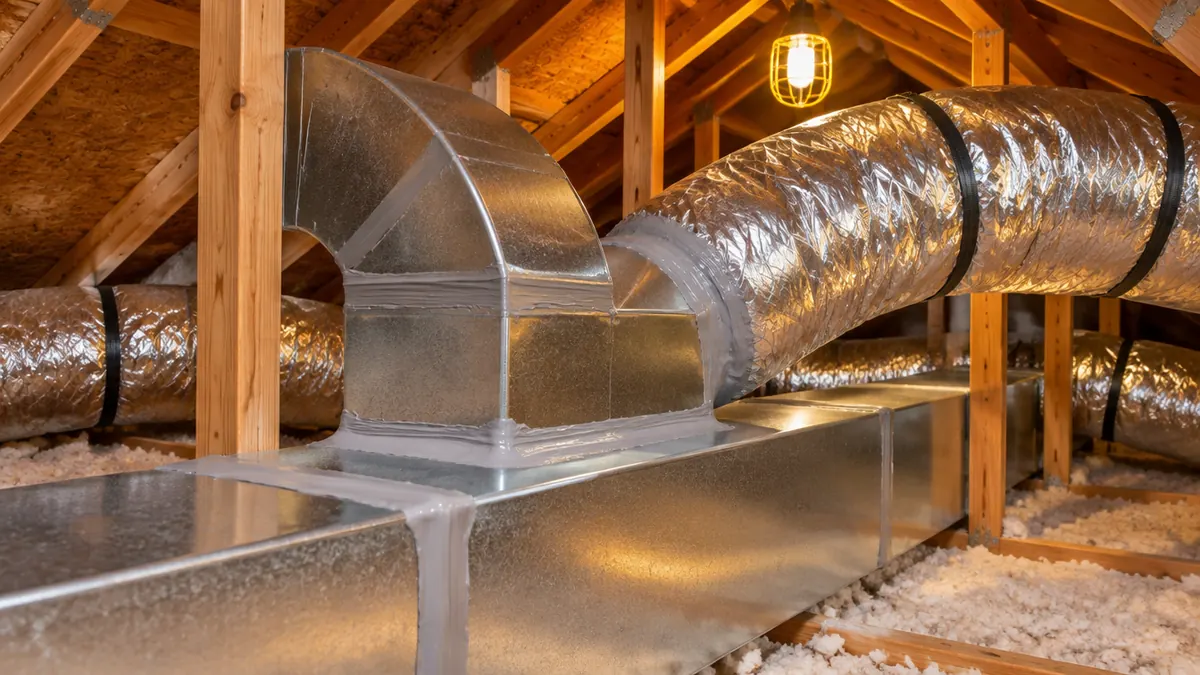
EPA’s duct guidance says moisture should not be present in ducts, and that ducts in unconditioned spaces such as attics and crawlspaces should be properly sealed and insulated. If your home sits over a crawlspace, wet soil or standing water under the house is worth a look. Ducts that drip or vents that bead with water are another clue; sweating air ducts and leaky ductwork explain the fixes.
Do I need a dehumidifier?
Most Sacramento-area homes don’t. In the Energy Information Administration’s 2020 survey of home energy use, 4% of California homes used a dehumidifier, compared with 17% of homes nationwide.
You may need one if humidity stays above 55% to 60% after you’ve vented moisture sources, set the fan to Auto and had the AC checked, or if one room stays damp on its own. ENERGY STAR describes two kinds:
- Portable dehumidifiers dry a single room and can be moved around. Keep the doors and windows to that room closed while one runs. ENERGY STAR says capacity is usually measured in pints of water removed per 24 hours, and the right size depends on how big and how damp the space is.
- Whole-home dehumidifiers use your ductwork and are often permanent installations. ENERGY STAR recommends them for homes in a humid climate with central air conditioning, especially where readings stay above 55% throughout the house. Sacramento’s dry summers make that combination uncommon. If you do go this route, ENERGY STAR says to hire a contractor to size and install it.
ENERGY STAR-certified dehumidifiers use about 20% less energy than conventional units that remove the same amount of moisture. ENERGY STAR also suggests using the dehumidifying ability of your central AC, for example by adding an AC vent to a damp room that lacks one.
One caution: if the real problem is an oversized AC, a fan set to On or a clogged drain, a dehumidifier treats the symptom and leaves the cause in place. Have the air conditioner checked first. A tune-up shows whether it’s draining and cycling the way it should.
Why is the air in my house so dry in winter?
Because heating lowers relative humidity: cold winter air carries little moisture, and warming it to room temperature spreads that moisture thin. EPA notes that humidifiers are commonly used to relieve dry nose, throat, lips and skin, and to ease the nuisances that come with winter heating, such as static electricity.
If you add moisture, don’t overdo it. EPA’s humidifier guidance says not to humidify above 50% relative humidity. ENERGY STAR suggests keeping humidity between 30% and 40% during the heating season in colder climates to prevent window condensation. If your windows fog on cold mornings, aim for the low end. And if water condenses on windows, walls or pictures, EPA says to move the humidifier, lower its setting or use it less.
Keep a portable unit clean. EPA advises cleaning portable humidifiers every third day to reduce the buildup of scale and microorganisms, and using water with low mineral content, such as distilled water, so minerals don’t end up in the air.
What are the signs of mold in an HVAC system?
The main signs are a musty smell when the system runs, visible growth on or around the indoor coil, drain pan or duct openings, and standing water or wet insulation near the coil.
- A musty odor. EPA’s duct guidance points to a musty odor and visible mold growth as the things to check before you decide anything about your ducts.
- Visible growth. EPA lists substantial visible mold growth inside hard-surface (sheet-metal) ducts or on other parts of the heating and cooling system as a reason to consider cleaning. It also notes that confirming mold may require lab analysis.
- Water where it shouldn’t be. EPA says moisture should not be present in ducts and names condensation as a major contributor to contamination. Keep the drain pan clean and the drain line flowing.
Suspect mold in the system? EPA advises not running the HVAC system if you know or suspect it’s contaminated with mold, because it could spread mold through the building. Turn it off at the thermostat and call. EPA also says insulated ductwork that gets wet or moldy can’t be effectively cleaned and should be removed and replaced, and mold will keep coming back unless the moisture problem is fixed.
Mold matters for health, too: EPA says it can cause allergic reactions in sensitive people and asthma attacks in people with asthma who are allergic to mold. For medical questions, talk with your doctor. Cleaning without fixing the moisture source rarely lasts. Read whether air duct cleaning is worth it, and before you buy a UV lamp for mold, see what EPA says about UV lights and air purifiers.
When should you call a pro about indoor humidity?
Call a technician when humidity stays high after the simple fixes, or when you see signs that water is collecting inside the system.
A yearly check-up also catches dirty coils and slow drains before they become a moisture problem. See what an HVAC tune-up includes, or look up any unfamiliar term in the HVAC glossary.
Why do Sacramento-area homeowners call JM Comfort?
JM Comfort is a locally owned heating and air conditioning contractor based in North Highlands, serving North Highlands, Sacramento and nearby communities. It’s a licensed C-20 HVAC contractor (CSLB #1016274), licensed since 2016 and bonded, with workers’ comp insurance on file; you can check the license on the CSLB website. The indoor air quality service covers filtration and ventilation, and the same team handles AC repair, tune-ups and ductwork repair and sealing for homes, so one visit can look at both the air and the equipment that conditions it.
Call (916) 247-6358 or book an indoor air quality visit online and we’ll call you back.
Frequently asked questions
Is 60% humidity too high for a house?
It’s at the limit. EPA advises keeping indoor humidity below 60% and ideally between 30% and 50%. If your hygrometer sits at 60% or higher for days at a time, set the thermostat fan to Auto, run bath and kitchen exhaust fans, turn off any swamp cooler, and have the AC checked if the reading doesn’t come down.
How do I measure the humidity in my house?
Use a humidity meter, also called a hygrometer. EPA describes it as a small, inexpensive instrument sold at many hardware stores. Check the reading in a main living area at different times of day, since cooking, showers and laundry all push it up for a while.
Does a swamp cooler raise indoor humidity?
Yes. The Department of Energy’s Building America Solution Center says direct evaporative coolers increase rather than decrease the humidity in the air, and that they work best where outdoor humidity is low during the cooling season. On smoky days, see wildfire smoke and your HVAC before you run one.
Can mold in my AC make me sick?
It can bother some people. EPA says mold can cause allergic reactions in sensitive individuals and asthma attacks in people with asthma who are allergic to mold. If you know or suspect the system is contaminated with mold, EPA advises not running it until it’s checked.
Should I use a humidifier in winter?
Only if the air feels dry and your hygrometer agrees. EPA says humidifiers relieve dry nose, throat, lips and skin, and advises not humidifying above 50%. Clean a portable unit every third day and use low-mineral water, such as distilled water.
Can JM Comfort help with indoor humidity?
JM Comfort’s indoor air quality service covers filtration and ventilation, and the same team handles AC repair, tune-ups and ductwork repair and sealing for homes in North Highlands, Sacramento and nearby communities. Call (916) 247-6358 or book online.
Sources
- A Brief Guide to Mold, Moisture and Your Home (U.S. Environmental Protection Agency)
- Use and Care of Home Humidifiers (U.S. Environmental Protection Agency)
- Should You Have the Air Ducts in Your Home Cleaned? (U.S. Environmental Protection Agency)
- Dehumidifiers (ENERGY STAR)
- ENERGY STAR Certified Room Air Conditioners (ENERGY STAR)
- Another Aspect of Duty Cycling: Effects on Indoor Humidity (Florida Solar Energy Center, University of Central Florida)
- 1991–2020 Annual/Seasonal Climate Normals: Sacramento Executive Airport, USW00023232 (CSV) (NOAA National Centers for Environmental Information)
- Climate of Sacramento, California (NOAA Technical Memorandum NWS WR-272, revised June 2005, PDF) (NOAA National Weather Service)
- Highlights for air conditioning in U.S. homes by state, 2020 (Residential Energy Consumption Survey, PDF) (U.S. Energy Information Administration)
- Evaporative Cooling Systems (Building America Solution Center, U.S. Department of Energy)
Find this helpful? Add JM Comfort as a preferred source on Google.