Does Air Conditioning Help With Wildfire Smoke? Filters, Settings and Clean Rooms
Your cooling can keep smoke out or pull more of it in, depending on the system and how it’s set. Here’s what EPA, CARB and CDC recommend, and how to get your home ready before the next smoke day.
JM Comfort can help: indoor air quality for homes in Sacramento and nearby. Licensed C-20 HVAC contractor, CSLB #1016274.
When wildfire smoke reaches Sacramento, your cooling system can help keep it out or pull more of it in. Central air doesn’t clean the air by itself: it moves indoor air past a filter, and the filter does the cleaning. Here’s what EPA, the California Air Resources Board (CARB) and CDC recommend, and when to get help with indoor air quality.
Safety first: Smoke is hardest on children, older adults, pregnant women and people with heart or lung disease. Call 911 or go right away to an emergency department for a medical emergency, such as severe trouble breathing or chest pain. Listen to local officials and follow any evacuation order.
Does air conditioning help with wildfire smoke?
Central air conditioning helps with wildfire smoke only through its filter: the system recirculates the air already in your house, and a high-efficiency filter is what pulls the smoke particles out.
EPA notes that furnace and HVAC filters work only when the system is operating, and that HVAC systems usually run less than 25% of the time during heating and cooling seasons. On a mild, smoky day the thermostat may barely call for cooling, so the filter sits idle.
Set up right, central air is the one option that cleans the whole house. EPA says portable and DIY air cleaners are meant for a single room, while HVAC filters can deliver cleaner air to the whole home. CDC also advises people with chronic conditions to turn on an HVAC system with a filter. A heat pump with an indoor air handler works the same way.
Do air conditioners filter wildfire smoke?
Most air conditioners don’t filter smoke well on their own, and some pull outdoor air inside, so it depends on the type you have.
EPA lists fans that vent outdoors and HVAC systems with a fresh-air intake among the ways smoke gets indoors.
| System | On a smoky day |
|---|---|
| Central AC or furnace that recirculates | Filters only while the fan runs. Use a snug MERV 13 filter and set the fan to On. |
| Central system with a fresh-air intake | Can draw smoke in. Set it to recirculate or close the outdoor intake damper. |
| Window air conditioner | Close its outdoor-air damper; if you can’t, don’t use it. Seal it to the window as tightly as possible. |
| Portable air conditioner | Can bring more smoke inside. Use it sparingly and seal the window vent kit tightly. |
| Evaporative (swamp) cooler | CARB says don’t run it. EPA says use it sparingly unless its outside intakes are covered with MERV 13 filters. |
| Whole-house fan | Don’t run it during smoke. |
| Bathroom and kitchen exhaust fans | They vent outdoors and can draw smoky air in. Save them for airing out once the air improves. |
What is the best HVAC filter for wildfire smoke?
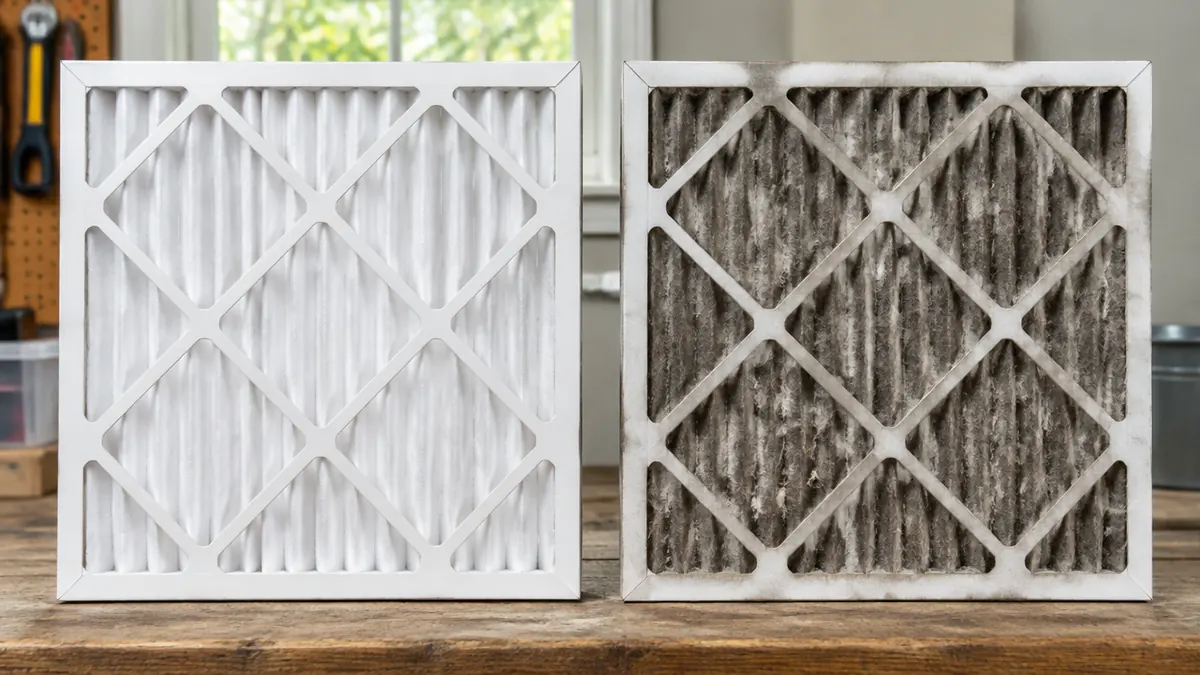
The best HVAC filter for wildfire smoke is a pleated filter rated MERV 13 or higher, or the highest rating your system can handle, in the exact size of your filter slot.
EPA’s air cleaner guide says to select a filter rated at least MERV 13 or as high as your system will accommodate, and CARB’s smoke guidance says the same. To compare MERV 8, 11 and 13, see the guide to picking a MERV rating or the glossary.
Is the best furnace filter for smoke any different?
No. In most homes the furnace and central AC share one blower and one filter, so the furnace filter is the HVAC filter. Keep the MERV 13 filter in after summer, too: smoke can arrive in fall, as it did in November 2018.
Why fit matters as much as the MERV number
A filter only cleans the air that goes through it. EPA says the filter should fit snugly so air doesn’t leak around it, and you shouldn’t bend or crush a filter to make it fit. Buy the exact size printed on the old filter’s frame.
Can your system handle a MERV 13 filter?
It depends on the system. EPA notes that HVAC systems usually aren’t labeled with filter recommendations and suggests asking a professional HVAC technician. The risk is lost airflow: the Department of Energy’s Building America Solution Center says excessive pressure drop across a filter can overheat a furnace, freeze an AC coil and burn out a blower motor. Filters with deeper or more pleats tend to have lower pressure drop, and dirt greatly increases it.
How should you set your HVAC system during wildfire smoke?
Close the house, stop outdoor air from coming in, install a high-efficiency filter and run the fan on On, so the filter works all day.
- Check the air quality. Look up the AQI on AirNow.gov or its Fire and Smoke Map.
- Close up the house. Shut windows and doors. Turn off any swamp cooler or whole-house fan.
- Install a MERV 13 filter that fits. Use MERV 13, or the highest rating your system can handle, in the exact size of your slot.
- Stop outdoor air from coming in. If your system has a fresh-air intake, EPA and CARB say to set it to recirculate or close the outdoor intake damper.
- Run the fan on On. With a high-efficiency filter installed, EPA says to set the fan to On instead of Auto to remove particles while the air quality is poor. CARB agrees.
- Check the filter often. Change it when it looks dirty or starts to smell.
What’s the trade-off of running the fan on On?
Cost and filter life. EPA says longer run times filter more air but also raise electricity costs and may make humidity control less reliable during cooling season. EPA adds that two or more well-placed portable air cleaners may cost less than running a central system continuously with a high-efficiency filter. A sensible plan: fan on On while the AQI is bad, back to Auto once the air clears.
How often should you change the filter during and after smoke?
Change it as soon as it looks dirty or smells like smoke. EPA says to plan on replacing filters more often than the manufacturer recommends during smoke, so buy spares before fire season. Building America guidance says every 3 months or sooner, especially when the equipment runs continually. When the smoke clears, EPA suggests opening windows and running the kitchen and bathroom exhaust fans; then check the filter again. See how often to change your air filter for the swap.
What is the best air purifier for wildfire smoke?
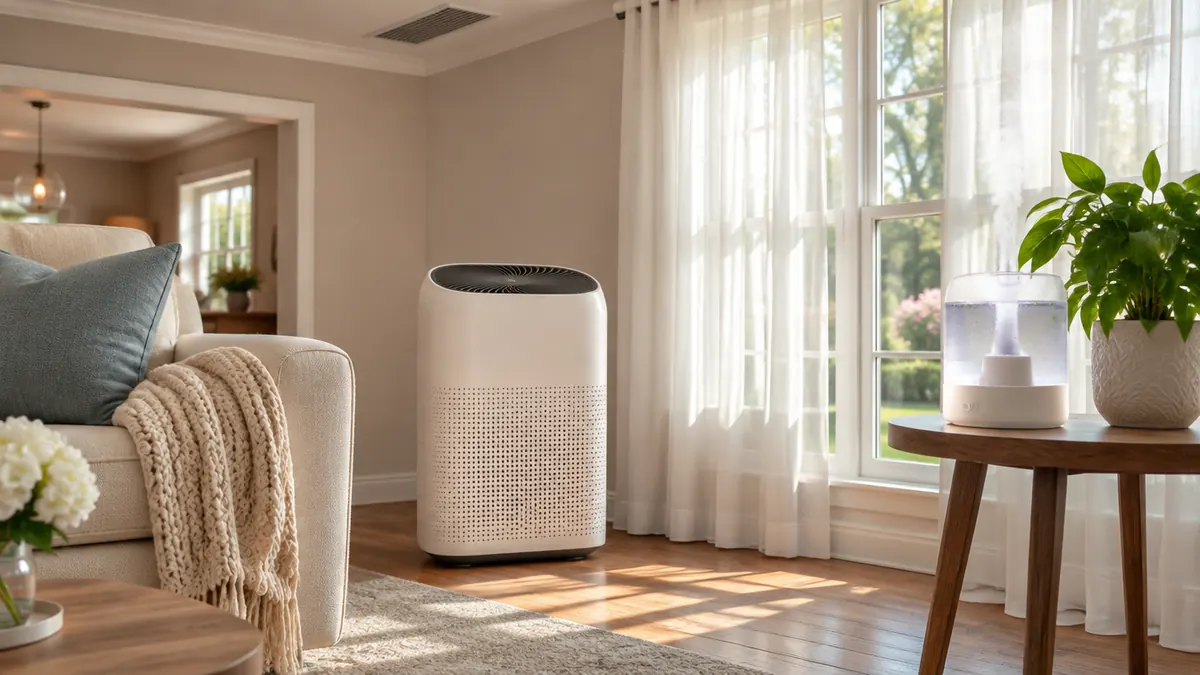
For a single room, the best air purifier for wildfire smoke is a CARB-certified portable air cleaner with a HEPA filter and a smoke CADR of at least two-thirds of the room’s floor area in square feet.
- CARB-certified. Certified cleaners must keep ozone emissions within 0.050 parts per million. CARB notes that certification doesn’t reflect how effective a cleaner is, so check the CADR too.
- HEPA. EPA says portable air cleaners often reach a high CADR by using a HEPA filter.
- CADR. The clean air delivery rate is how much filtered air the unit delivers. EPA’s sizing chart works out to at least 65 cfm for a 100-square-foot room, 130 for 200, 260 for 400 and 390 for 600, based on an 8-foot ceiling. Go higher for taller ceilings.
Put it where people spend the most time, leave room for air to flow around it, and run it on the highest setting, continuously if you can, as EPA and CARB advise. Before buying add-ons, read whether UV lights and air purifiers work.
Does a DIY box-fan air cleaner work?
It can, as a backup. EPA describes one as furnace filters attached to a box fan, and CARB says to use MERV 13 filters. EPA says commercial cleaners with a known CADR are typically preferred, and that DIY performance varies. Use a box fan made in 2012 or later with a UL or ETL mark, which EPA says reduces the risk of overheating; CARB says never leave an older fan unattended or running while you sleep. Change the filter when it gets dirty: CARB cites EPA research that found DIY cleaners almost completely ineffective with dirty filters.
How do you set up a clean room during wildfire smoke?
Pick one room, keep smoke out, keep it cool and filter the air, then spend as much time there as you can.
- Choose the room. EPA suggests one big enough for everyone, such as a bedroom with an attached bathroom.
- Close it up. Shut windows and doors, but don’t make it hard to leave in an emergency.
- Keep it cool. Use fans, a window AC or central air, with any fresh-air option off and the system on recirculation.
- Filter it. Run a portable or DIY air cleaner sized for the room.
- Don’t make smoke indoors. Skip smoking, vaping, candles, incense, aerosol sprays and frying or broiling.
Heat matters too: CARB notes that heat waves often coincide with wildfire season. If you don’t have AC that recirculates, or someone is sensitive to smoke, Sacramento County suggests a temporary relocation plan: cleaner, filtered air may be found at a public library or shopping mall. If your AC quits during a hot, smoky stretch, see what to do when your AC goes out in a heat wave.
Why is Sacramento air quality bad today?
On smoky days the cause is usually wildfire smoke, sometimes from fires far away, and the Air Quality Index (AQI) for your area tells you how bad it is right now.
The AQI is EPA’s index for reporting air quality. It also covers pollutants such as ground-level ozone, so a bad reading isn’t always smoke. Here are AirNow’s categories:
| AQI | Category | What it means |
|---|---|---|
| 0–50 | Good | Little or no risk |
| 51–100 | Moderate | Some risk for people unusually sensitive to air pollution |
| 101–150 | Unhealthy for Sensitive Groups | Sensitive groups may feel health effects |
| 151–200 | Unhealthy | Some of the general public may be affected |
| 201–300 | Very Unhealthy | Health alert: higher risk for everyone |
| 301 and higher | Hazardous | Emergency conditions |
Where to check locally:
- AirNow.gov and its Fire and Smoke Map, which CARB recommends for smoke.
- The Sacramento Region Air Quality app, which Sacramento County says gives forecasts and current readings from monitors around the region.
- SpareTheAir.com and airquality.org, the regional sites the county points to.
Sacramento County says Camp Fire smoke covered the region for more than a week in November 2018. It calls that event unusual but reminds residents that fire season isn’t over, so plan before the next one.
When should you call an HVAC pro about wildfire smoke?
Call a technician when you’re not sure your system can take a MERV 13 filter, when you can’t find or close a fresh-air intake, or when airflow changes after a filter upgrade.
- Filter compatibility. Building America guidance says total static pressure can be measured with a manometer, and the reading should be no more than 0.4 or 0.5 inches of water column.
- Not enough filter area. If MERV 13 chokes the airflow in your slot, ask about options with more filter area or deeper pleats.
- Air leaking around the filter. A bent rack or missing slot cover lets smoky air skip the filter.
- Fresh-air intakes. Not sure whether your system brings in outdoor air? Have it checked before smoke season.
- Warning signs. Weak airflow, ice on the refrigerant lines or a furnace that shuts off early can mean the filter is too restrictive. See why an AC freezes up and why a furnace stops working.
Safety first: If you see ice on the refrigerant lines, switch the thermostat from Cool to Off and let it melt. If the ice comes back or the furnace keeps shutting off after a filter upgrade, go back to the filter you used before and call a technician. Don’t open the furnace’s burner or electrical compartments, and don’t disable or override any safety switch.
The easiest time to sort this out is before fire season, at a tune-up. JM Comfort’s indoor air quality service covers filtration and ventilation for homes in North Highlands, Sacramento and nearby communities.
What should you look for in an HVAC company?
Look for a licensed contractor who checks your system before recommending a filter or a fix, and who puts the plan in writing.
For questions to ask and red flags, see how to choose an HVAC company.
Why do Sacramento-area homeowners call JM Comfort?
JM Comfort is a locally owned heating and air conditioning contractor based in North Highlands, serving North Highlands, Sacramento and nearby communities. It’s a licensed C-20 HVAC contractor (CSLB #1016274), licensed since 2016 and bonded, with workers’ comp insurance on file; you can check the license on the CSLB website. The indoor air quality service covers filtration and ventilation, and the same team handles AC repair, furnace repair, tune-ups and ductwork repair and sealing for homes.
Call (916) 247-6358 or book an indoor air quality visit online and we’ll call you back.
Frequently asked questions
Should I turn off my AC when it’s smoky outside?
Not if it recirculates indoor air through a good filter. EPA’s cleaner air room advice is to stay cool with fans, a window AC or central air, with any fresh-air option turned off or the intake closed. Turn off cooling that pulls in outdoor air, such as a swamp cooler or a window unit whose outdoor-air damper won’t close.
Can I run a swamp cooler during wildfire smoke?
CARB says not to run swamp coolers or whole-house fans during smoke. EPA says that if the cooler is safely accessible, you can completely cover its outside air intakes with 4-inch-thick MERV 13 furnace filters, which may need frequent replacement. Otherwise, use it sparingly, because it can bring more smoke inside.
Do ozone air purifiers help with wildfire smoke?
Skip them. EPA advises avoiding portable air cleaners and HVAC filters that intentionally produce ozone, a lung irritant, and Sacramento County says ozone air cleaners should not be used for smoke. Choose a CARB-certified model, which must keep its ozone emissions within 0.050 parts per million.
Can I put a HEPA filter in my furnace?
Usually not in a standard home system. HEPA filters are common in portable air cleaners, which EPA says often reach a high CADR that way. For a central system the guidance is MERV 13 or as high as the system will accommodate, and a filter that’s too restrictive can overheat a furnace or freeze an AC coil. Have a technician check before you go past MERV 13.
When can I open the windows after wildfire smoke?
When the air quality improves, even for a while, EPA says to air out your home by opening windows and running the kitchen and bathroom exhaust fans. Check the AQI on AirNow first. Then check your HVAC filter and change it if it looks dirty or smells of smoke.
Does JM Comfort help with wildfire smoke?
Yes. JM Comfort’s indoor air quality service covers filtration and ventilation for homes in North Highlands, Sacramento and nearby communities. A technician can look at your filter slot, airflow and any fresh-air intake before smoke season. Call (916) 247-6358 or book online.
Sources
- Wildfires and Indoor Air Quality (IAQ) (U.S. Environmental Protection Agency)
- Indoor Air Filtration (U.S. Environmental Protection Agency)
- How to Create a Cleaner Air Room at Home (U.S. Environmental Protection Agency)
- Guide to Air Cleaners in the Home (U.S. Environmental Protection Agency)
- Smoke Ready California (California Air Resources Board)
- Indoor Air Cleaners and Wildfire Smoke FAQ (California Air Resources Board)
- Air Quality Index (AQI) Basics (AirNow.gov (U.S. EPA))
- Fire Season Not Over: Plan Now for Wildfire Smoke (Sacramento Ready, Sacramento County)
- Wildfire Smoke and People with Chronic Conditions (Centers for Disease Control and Prevention)
- High-MERV Filters (Building America Solution Center, U.S. Department of Energy)
Find this helpful? Add JM Comfort as a preferred source on Google.