AC Out in a Heat Wave? How to Stay Safe Until It’s Fixed
When the AC quits during a heat wave, people come first and the repair comes second. Here’s how to spot heat illness, keep your household cool until the system is fixed, and get help.
JM Comfort can help: AC repair for homes in Sacramento and nearby. Licensed C-20 HVAC contractor, CSLB #1016274.
When the AC quits in the middle of a heat wave, the real risk is to the people inside, not the equipment. Take care of people first, then the system. This guide covers the warning signs of heat illness, how to stay cool until the repair, who to check on, what to do if the power goes out too, and when to call for AC repair.
Safety first: Heat stroke is a medical emergency. If someone has a body temperature above 103°F, confusion, slurred speech, or faints, call 911 or get them to a hospital immediately. While you wait, move them somewhere cooler and cool them with wet cloths or a cool bath. Don’t give them fluids. For a sparking or downed power line, call 911 first, then SMUD.
What should you do when your AC goes out in summer?
When your AC goes out in summer, check on the people in the house first, get anyone at risk somewhere cool, run a few safe checks on the system, and then call for repair.
- Look at the people, not the thermostat. Watch for the heat illness signs in the next section, especially in older adults, young children and anyone with a chronic illness.
- Cool the most vulnerable first. If the house is heating up, take them somewhere air-conditioned now rather than waiting to see whether the repair is quick.
- Run the safe checks. The thermostat, a tripped breaker, a clogged filter or ice on the lines can each stop cooling. The checks are below.
- Turn it off and call. If the checks don’t bring back cold air, switch the system off so a small problem doesn’t become a bigger one, and call for service.
- Make a plan for the wait. Decide where everyone will spend the hottest hours and where they’ll sleep if the house stays hot overnight.
What are the signs of heat exhaustion and heat stroke?
Heat exhaustion shows up as heavy sweating, weakness, cool, pale, clammy skin and a fast, weak pulse; heat stroke adds confusion, slurred speech and a body temperature above 103°F, and needs 911. The National Weather Service describes three stages:
| Condition | Signs | What to do |
|---|---|---|
| Heat cramps | Painful muscle cramps and spasms, usually in the legs and abdomen; heavy sweating | Press firmly on or gently massage the cramping muscle. Give small sips of water unless nausea develops. Get medical help if cramps last longer than 1 hour. |
| Heat exhaustion | Heavy sweating; weakness or tiredness; cool, pale, clammy skin; fast, weak pulse; muscle cramps; dizziness; nausea or vomiting; headache; fainting | Move to a cooler place, ideally a well air-conditioned room. Loosen clothing, apply cool wet cloths or use a cool bath, and offer sips of water. Get medical help right away if the person vomits or symptoms get worse or last longer than 1 hour. |
| Heat stroke | Throbbing headache; confusion; slurred speech; nausea; dizziness; body temperature above 103°F; hot, red, dry or damp skin; rapid, strong pulse; fainting or loss of consciousness | Call 911 or get the person to a hospital immediately. Move them somewhere cooler and cool them with cloths or a bath. Don’t give fluids. |
The NWS calls heat stroke a severe medical emergency in which delay can be fatal. Don’t wait for the AC to come back on, and don’t wait to see whether the person improves. Call 911.
How hot is too hot inside a house?
There’s no single indoor temperature that’s safe for everyone, so the National Weather Service built HeatRisk, a 0-to-4 scale that compares the forecast heat with what’s normal for your location and says who is at risk.
Here’s what the NWS HeatRisk fact sheet says at each level, with the lines that matter most for a house without working AC:
| HeatRisk level | What the NWS says | What it means at home |
|---|---|---|
| 0, None | Little to no risk | No extra steps needed |
| 1, Minor | Tolerated by most; a minor risk for extremely heat-sensitive people | Drink more; open windows at night and use fans to bring in cooler air |
| 2, Moderate | Moderate risk for heat-sensitive groups | Without AC, living spaces get warm during the day but should cool below dangerous levels at night |
| 3, Major | Dangerous to anyone without proper hydration or adequate cooling; power interruptions may occur | Use AC if you have access to it; fans may not be adequate |
| 4, Extreme | A multi-day excessive heat event; can be deadly for heat-sensitive people without effective cooling | Stay in a cool place, including overnight; find access to air conditioning, because fans will not be adequate |
One more NWS rule helps inside the house: don’t aim a portable fan at yourself when the room is hotter than 90°F, because dry, blowing air can dehydrate you.
Don’t let dry heat fool you, either. NOAA’s climate study of Sacramento points out the extremely low humidity that comes with high summer temperatures in the valley, which is why a Sacramento reading can feel different from the same number in a humid city. HeatRisk already compares each forecast with the local climate, so take a Major or Extreme day seriously even if the air feels dry.
Who’s in the house matters as much as the number. Ready.gov says older adults, children and people with certain illnesses and chronic conditions are at greater risk from extreme heat. A house that’s merely miserable for a healthy adult can be dangerous for them. If the indoor temperature is climbing toward 90°F, or anyone shows signs of heat exhaustion, move them somewhere air-conditioned.
How do you stay cool without AC?
To stay cool without AC, spend the hottest hours somewhere air-conditioned, cool your body directly with water, drink often, dress light, keep heat-making activity to a minimum, and let cooler night air in when it’s safe to.
- Go where the AC works. The NWS suggests air-conditioned public places such as malls and libraries. Ready.gov says to go to a cooling center if your home lacks air conditioning, and to contact your local health department to find cooling options.
- Find the coolest spot. The NWS says people at higher risk should stay in the coolest available place, which isn’t necessarily indoors.
- Cool your body. Take cool showers or baths.
- Drink before you’re thirsty. Keep drinking water and other non-alcoholic, decaffeinated fluids, even if you don’t feel thirsty.
- Dress for it. Wear loose, lightweight, light-colored clothing.
- Eat light. The NWS suggests cool, easy-to-digest foods such as fruit or salads.
- Move the hard work. Cut back on strenuous activity or move it to the coolest time of day.
- Use the evening air. At Minor and Moderate HeatRisk, the NWS says to open windows at night and use fans to bring cooler air inside. That often works in Sacramento: NOAA’s climate study says summer nights here are usually pleasant thanks to breezes blowing up from San Francisco Bay through the Delta. The exception is a heat wave driven by hot north winds, when nights stay warm. Keep the windows shut if wildfire smoke is in the air; see wildfire smoke and your HVAC.
What AC checks can you safely make before calling for repair?
You can safely check the thermostat, the breaker, the filter, the outdoor unit and the refrigerant lines for ice; anything beyond that, including refrigerant and electrical parts, is a job for a technician.
- Thermostat: set it to Cool, below the current indoor temperature, with the fan on Auto. Replace the batteries if the screen is blank.
- Breaker: for a central AC, reset a tripped breaker once. If it trips again, leave it off and call. For a heat pump, don’t reset it: one major manufacturer warns that resetting the breaker and restarting the unit could cause damage, so call for repair instead.
- Filter: replace it if it’s clogged.
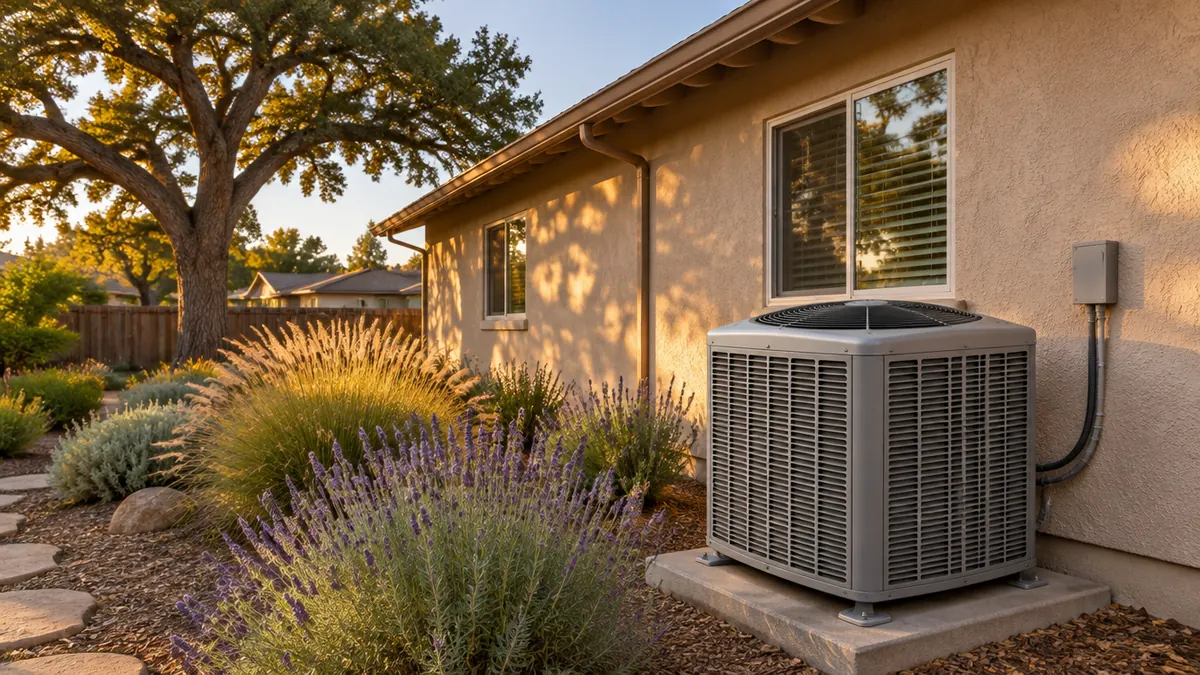
- Outdoor unit: with cooling on, make sure it’s running and its fan is spinning, and clear away leaves and debris.
- Ice: if the copper lines are iced over, switch the thermostat from Cool to Off and let the ice melt on its own before trying again.
The full walk-through, with what each symptom means, is in why your AC is blowing warm air. If the ice keeps coming back, see why an AC freezes up. If none of it brings back cold air, turn the system off and call.
Who should you check on during a heat wave?
Check on older adults, young children, people who are sick or frail, and your neighbors; Ready.gov says to check on family members, older adults and neighbors during extreme heat.
The NWS adds that older, sick or frail people may need help coping with the heat, and at Extreme HeatRisk it says to check on others who may not be able to take precautions. Knock on the door or stop by if you can, and look for the warning signs in the table above. If a neighbor’s AC is out too, offer a cool room or a ride to an air-conditioned place.
One rule applies to every household: never leave a child alone in a vehicle, even briefly and even with the windows cracked. Pets need the same protection from the heat in a parked car.
What if the power goes out during a heat wave?
If the power goes out, follow the same stay-cool steps, report the outage to SMUD, stay away from downed lines, and never run a portable generator inside the house or garage.
The NWS HeatRisk fact sheet warns that power interruptions may occur at Major risk as electrical demand climbs, and that outages become increasingly likely at Extreme risk. In Sacramento County, SMUD sells the electricity. SMUD’s safety page says to call 911 first for sparking or downed lines, then SMUD at 1-888-456-7683, the same number it lists for outages.
If you use a generator, the CPSC says never to use portable generators inside homes or garages, even if doors and windows are open, because of the risk of carbon monoxide poisoning. If you suspect carbon monoxide poisoning, get outside to fresh air immediately, then call 911.
If the AC doesn’t start working again when the power comes back, see HVAC not working after a power outage before you call.
How hot do Sacramento summers get?
Sacramento summers are hot and dry: NOAA’s 1991–2020 normals for Sacramento Executive Airport put the average June-to-August high at 90.8°F, with about 76 days a year reaching 90°F or more and about 14 reaching 100°F or more.
NOAA’s climate study of Sacramento, last revised in 2005, explains the pattern behind the worst stretches. Summer heat waves come with hot, dry north winds off the Great Basin, and they’re usually followed within two or three days by the cool southwest delta breeze, especially at night. Two or three days is a long time to go without AC, though, and the study’s records include four runs of nine straight days at 100°F or hotter.
That’s why a cooling check-up belongs in the spring. ENERGY STAR recommends checking the cooling system in spring, before contractors get busy once summer arrives. A spring tune-up catches dirty coils, weak parts and drain problems before the 100-degree days. If your system is older and struggling, see signs you need a new HVAC system.
Why do Sacramento-area homeowners call JM Comfort?
JM Comfort is a locally owned heating and air conditioning contractor based in North Highlands, serving North Highlands, Sacramento and nearby communities. It’s a licensed C-20 HVAC contractor (CSLB #1016274), licensed since 2016 and bonded, with workers’ comp insurance on file. The same team handles AC repair, heat pump repair, tune-ups and ductwork for homes, so whatever stopped the cooling, you can start with one call.
Call (916) 247-6358 or book an AC repair visit online and we’ll call you back. Until the system is fixed, keep everyone cool with the steps above, and if anyone shows signs of heat stroke, call 911 first.
Frequently asked questions
Should I point a fan at myself when it’s hot inside?
Not once the room is hotter than 90°F: the National Weather Service says not to aim a portable fan at yourself then, because dry, blowing air can dehydrate you. Fans can help pull cooler evening air into a room, but at Major and Extreme HeatRisk the NWS says fans may not be adequate.
Is it safe to sleep in a house without AC in a heat wave?
It depends on how hot the house stays and who’s sleeping there. Ready.gov says older adults, children and people with certain illnesses and chronic conditions are at greater risk from extreme heat, and at Extreme HeatRisk the NWS says to stay in a cool place, including overnight. If the house stays hot after dark, move them somewhere air-conditioned.
What should I drink during a heat wave?
The National Weather Service says to keep drinking water and other non-alcoholic, decaffeinated fluids, even if you don’t feel thirsty. People on fluid-restricted diets should check with their doctor first.
Should I keep running an AC that’s blowing warm air?
No, not once the basic checks don’t fix it. If there’s ice on the refrigerant lines, switch the thermostat from Cool to Off and let it melt before running cooling again. Then call for AC repair.
Who do I call about a downed power line or an outage in Sacramento?
SMUD sells the electricity in Sacramento County. For sparking or downed lines, SMUD says to call 911 first, then SMUD at 1-888-456-7683, the same number it lists for outages. Stay well away from the line while you wait.
Is JM Comfort licensed to repair air conditioners?
Yes. JM Comfort is a licensed C-20 HVAC contractor (CSLB #1016274), licensed since 2016, based in North Highlands and serving North Highlands, Sacramento and nearby communities. Call (916) 247-6358 or book a visit online. For a medical emergency, call 911.
Sources
- Heat Cramps, Exhaustion, Stroke (National Weather Service)
- During a Heat Wave (National Weather Service)
- NWS HeatRisk (fact sheet, published May 2023) (National Weather Service)
- Extreme Heat (Ready.gov)
- U.S. Climate Normals 1991–2020, annual and seasonal normals for Sacramento Executive Airport, CA (USW00023232) (NOAA National Centers for Environmental Information)
- Climate of Sacramento, California (NOAA Technical Memorandum NWS WR-272, revised June 2005) (National Weather Service / NOAA)
- Safety tips (SMUD)
- Carbon Monoxide (U.S. Consumer Product Safety Commission)
- Why Is My Heat Pump Not Cooling? Troubleshooting Tips (Trane)
- Maintenance Checklist (ENERGY STAR)
Find this helpful? Add JM Comfort as a preferred source on Google.