
Do Heat Pumps Work in Sacramento? Climate, Costs, Noise and Rebates
Long, hot summers and mild winters make the Sacramento Valley easy heat pump country. Here’s what the climate numbers say, how a heat pump cools and heats, what it costs to run against gas, and when one may not fit your house.
JM Comfort can help: heat pump installation for homes in Sacramento and nearby. Licensed C-20 HVAC contractor, CSLB #1016274.
If your air conditioner or furnace is getting old, put a heat pump on the short list. It’s one system that cools through long Sacramento summers and heats through mild, damp winters, and as of November 2026 SMUD offers rebates to switch from gas. Here’s the climate fit, how it works in each season, and the trade-offs. When you’re ready to price one, JM Comfort handles heat pump installation and repair in North Highlands, Sacramento and nearby communities.
Do heat pumps work in California?
Yes, and the Sacramento Valley is one of the easier places to own one: winters rarely get cold enough to challenge a heat pump, and summers keep its cooling side busy for months.
For air conditioner efficiency rules, the Department of Energy puts California in its “hot-dry” Southwest region. A heat pump owner guide hosted by the Department of Energy says well-designed air-source heat pumps can heat and cool any U.S. home year-round, and ENERGY STAR says a heat pump can deliver up to 3 times more heat energy than the electricity it consumes.
How hot and cold does Sacramento get?
Here’s what NOAA’s 1991–2020 climate normals for Sacramento Executive Airport show. They’re 30-year averages, so any one year can run hotter or colder.
| Sacramento Executive Airport (1991–2020 normals) | Average |
|---|---|
| Summer (June–August) average high | 90.8°F |
| Summer average low | 58.2°F |
| Days a year at 90°F or hotter | About 76 |
| Days a year at 100°F or hotter | About 14 |
| Winter (December–February) average high | 57.8°F |
| Winter average low | 39.7°F |
| Nights a year at or below 32°F | About 15 |
| Nights a year at or below 20°F | 0 (rounded) |
The owner guide says a typical air-source heat pump delivers more than 3 units of heat per unit of electricity (a COP above 3) and stays above 1.75 even at 5°F. A typical Sacramento winter night bottoms out near 40°F, so the harder job here is cooling. Mountain areas are a different story; see do heat pumps work in cold weather.
How does a heat pump work in summer?
In summer, a heat pump works like a central air conditioner, pulling heat out of your house and releasing it outdoors; it’s an air conditioner that can also run in reverse to bring outdoor heat inside in winter.
The owner guide describes the same loop: heat pulled from indoors and expelled outside in warm months, and the reverse in cold months. Like any AC, it drains the moisture it removes through a condensate line, and it has to handle Sacramento’s hottest afternoons. The Department of Energy says peak-load efficiency (EER) is especially important in hot-dry climates, so ask for each model’s EER2 rating along with its SEER2.
How does it heat in winter?
In heat mode, the refrigerant loop runs the other way and gathers heat from outdoor air, even on a 40-degree night. Expect warm rather than hot air: the owner guide says heat pumps deliver a gentle, steady flow of warm air, while fuel-fired systems give hot air in shorter bursts.
What happens on frosty or foggy mornings?
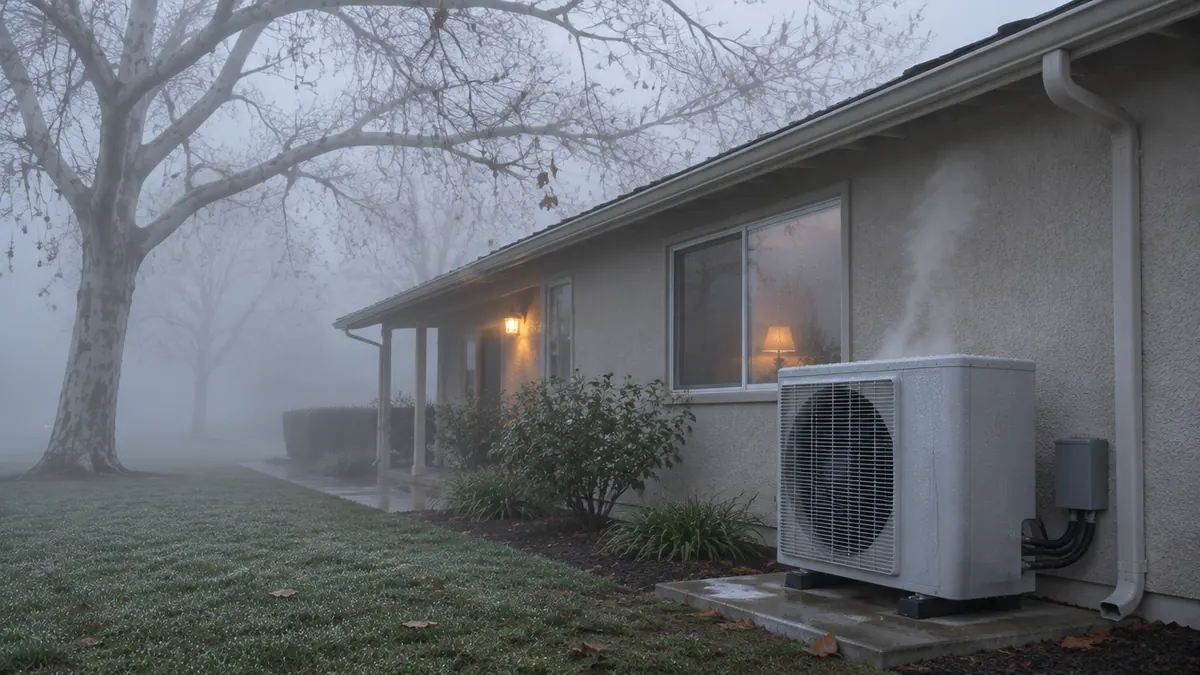
Light frost on the outdoor unit on a cold, damp morning is normal. The owner guide explains that when the outdoor coils drop below 32°F, condensation freezes on them, so the unit runs a defrost cycle: it briefly switches to cooling mode to melt the frost, the fans may stop or slow, and it typically takes 5 to 15 minutes. If the unit stays stuck in defrost or covered in ice, call for service. More in heat pump defrost mode.
Does it need backup heat?
Not much here. The owner guide says properly sized heat pumps offer year-round comfort without backup, and calls auxiliary electric strip heat costly and inefficient; if your thermostat shows it often, have the system checked. See emergency heat vs. aux heat.
Heat pump vs gas furnace in Sacramento: which costs less to run?
It depends on current SMUD and PG&E rates and on your house, but SMUD’s published estimate shows lower energy bills for homes that switch from gas to a heat pump.
Safety first: If you ever smell gas, leave the house now, then call 911 and PG&E from outside. Don’t flip switches or use anything that could spark on your way out.
SMUD’s Go Electric page lists estimated savings of $450 to $610 a year for switching from gas to a heat pump HVAC system. The page says its all-electric estimate is based on 2020 PG&E gas and SMUD electricity rates, so treat it as SMUD’s estimate, not a promise for your house. Cooling counts too: the owner guide says cooling costs should drop if the heat pump is more efficient than the AC it replaces. If you heat with electric resistance or propane today, ENERGY STAR says switching to a heat pump lowers energy bills.
Can you keep the gas furnace as backup?
Yes. ENERGY STAR suggests that if you have a relatively new furnace and an older central AC, you consider a heat pump in place of the AC, creating a dual-fuel system for a modest extra cost. Ask whether that setup qualifies before you count on a rebate, since SMUD’s largest heat pump rebates are for gas-to-electric conversions. Our heat pump vs. furnace guide compares the options.
Are heat pumps noisy?
Not usually: modern variable-speed heat pumps are much quieter at their lower speeds than older or single-stage equipment.
One major manufacturer’s guide lists its quietest heat pump, a low-profile model, at a nominal 43 to 57 dBA, against 40 dBA for a refrigerator hum and 60 dBA for normal conversation. It says older units are louder than comparable new ones, and single-stage models generally rate louder because they cycle at full power. SMUD says a variable-stage system runs so quietly you may not notice it’s on. Excessive noise from the unit or ductwork isn’t normal: the owner guide lists it as a sign of a problem. See HVAC noises.
Where should the outdoor unit go?
- Against the house. The same manufacturer says an exterior wall can help deaden the sound.
- Away from bedroom windows, yours and the neighbors’. You should be able to talk with your neighbor without yelling.
- With open space around it. The owner guide says to keep the unit clear of debris all year.
- Compared on paper first. Ask for each quoted model’s sound rating in dBA.
Is a heat pump worth it?
For many Sacramento-area homes, yes, especially when your AC is near the end of its life, when you’d otherwise replace both an AC and a furnace, or when you heat with electric resistance or propane.
| Your situation | Usually the better fit |
|---|---|
| AC and gas furnace both old | Heat pump; price it against a new furnace and AC |
| AC failing, gas furnace fairly new | Heat pump with the furnace kept as backup (dual fuel), or a full switch |
| Electric furnace, baseboard or propane heat | Heat pump |
| Both systems young and working | Keep them; plan a heat pump for when the AC wears out |
| Full electrical panel or leaky ducts | Heat pump, with the panel or duct work priced into the job |
For price ranges, see what a new HVAC system costs; if your system just broke, try the repair-or-replace calculator.
SMUD rebates as of November 2026
As of November 2026, SMUD’s heating and cooling rebates page lists:
- $3,000 for a variable-stage heat pump that replaces gas heat.
- $2,000 for a two-stage heat pump (15.2 SEER2 minimum) that replaces gas heat.
- $1,000 for an electric-to-electric upgrade to a two-stage or variable-stage heat pump.
- Up to $5,500 in Go Electric rebates for smart panels, panels and circuits, which require a gas-to-electric conversion.
The fine print: a participating contractor in the SMUD Contractor Network must install the system and submit the rebate, you need an active SMUD account and an individually metered home, and the system must pass Title 24 with a HERS CF3R form and include a connected Wi-Fi thermostat. Rebates are subject to available funding, so check the page before you sign, and ask any contractor whether they’re in SMUD’s network.
Is there still a federal tax credit?
No, not for a heat pump installed in 2026. The IRS Energy Efficient Home Improvement Credit page says the credit can be claimed for improvements made through December 31, 2025. More in our Sacramento rebates and tax credits guide.
When might a heat pump not fit your home?
A heat pump may not fit yet if your electrical panel has no room for it, your ducts are leaky or in poor shape, or the system can’t be sized properly; each is fixable, but it belongs in the plan and the price.
- Your electrical panel. A heat pump runs on electricity, so your panel needs the capacity for it. PG&E’s 2026 homeowner guide describes a customer whose limited panel capacity decided which upgrades she could do first, and advises checking your panel early to avoid delays. When converting from gas, SMUD’s Go Electric rebates can help with a new panel, subpanel or circuits (as of November 2026). Panel work is a job for a licensed professional.
- Your ducts. A central heat pump can use your existing ductwork, ENERGY STAR says, so their condition matters. The California Energy Commission says replacing just the outdoor or indoor unit of a split system triggers duct sealing, with ECC-Rater field verification required for most HVAC alterations. See signs of leaky ductwork; homes without ducts have ductless options, covered in mini split vs. central air.
- Sizing. ENERGY STAR says properly sized equipment is essential to the best performance and comfort, and that your contractor should verify the size with a tool called Manual J. Ask how the system in each quote was sized; see what size AC you need.
Should I get a heat pump, and what should I check first?
Run 5 safe checks yourself before anyone visits; they tell you which options are really on the table.
- Find out what you have now. Some homes already have a heat pump. Our guide to telling a heat pump from an AC walks you through it.
- Note each unit’s age. The data plate usually lists a model and serial number a technician can date. The owner guide says air-source heat pumps typically last about 15 years; see how long HVAC systems last.
- Pull a year of bills. Winter PG&E bills and summer SMUD bills show what heating and cooling cost you now.
- Photograph your electrical panel. Without removing any covers, open the panel door and photograph the breakers, including the main breaker.
- Walk the house. Note rooms that run hot or cold, and where your ducts run.
When should you bring in a pro, and what should the quote show?
Bring in a pro before you buy, because panel capacity, duct condition, sizing and permits can’t be judged from the hallway; then compare quotes on the same ratings.
The Department of Energy’s regional rules, including the Southwest EER2 requirement, apply only to air conditioners. Heat pumps follow the national minimums:
| Rating | What it measures | Federal minimum, split-system heat pump |
|---|---|---|
| SEER2 | Cooling efficiency over a whole season | 14.3 |
| HSPF2 | Heating efficiency over a whole season | 7.5 |
| EER2 | Cooling efficiency at peak load (95°F) | None for heat pumps; ask for it anyway |
Single-package heat pumps need at least 13.4 SEER2 and 6.7 HSPF2, and SMUD’s two-stage rebate needs at least 15.2 SEER2. The Department of Energy notes that SEER2, HSPF2 and EER2 aren’t directly comparable to the old SEER, HSPF and EER numbers. Our SEER2 guide and the glossary explain the terms.
Plan for a permit, too. The California Energy Commission says installing a space-conditioning appliance requires a building permit, and PG&E’s guide notes that permits and inspections add time. See HVAC permits and Title 24 in Sacramento. When you’re ready, schedule a heat pump estimate.
What should you look for in an HVAC company?
Look for a licensed company that checks your house first, puts every option in writing, and explains the trade-offs plainly.
For license checks, questions to ask and red flags, see how to choose an HVAC company.
Why do Sacramento-area homeowners call JM Comfort?
JM Comfort is a locally owned heating and air conditioning contractor based in North Highlands, serving North Highlands, Sacramento and nearby communities. We’re a licensed C-20 HVAC contractor (CSLB #1016274), licensed since 2016 and bonded, with workers’ comp insurance on file. We repair and install heat pumps, air conditioners and furnaces for homes, along with ductwork and indoor air quality work, so you can price a heat pump and a furnace with one team.
Call (916) 247-6358 or book a heat pump visit online.
Frequently asked questions
Do heat pumps have a condensate line?
Yes. When a heat pump cools, it pulls moisture out of the indoor air, and that water drains through a condensate line, just as it does with a central AC. A heat pump owner guide hosted by the Department of Energy says to check that the line is clear and drains somewhere it won’t cause damage, mold or a slip hazard. If you see water where it shouldn’t be, read why an AC leaks water.
Should I leave my heat pump thermostat on Auto?
Usually not. The Department of Energy-hosted owner guide recommends Heat mode in winter and Cool mode in summer, and avoiding the Auto mode that switches between them, because it can heat on cool summer nights or cool on sunny winter days. Keep the fan on Auto, though: the guide says continuous indoor fan operation can harm heat pump performance. See best thermostat settings.
Should I cover my heat pump in winter?
No. The owner guide says to avoid covering a heat pump in winter so it gets the airflow it needs to pull heat from the outdoor air. Keep it clear of leaves and debris instead, and keep roof runoff from pouring onto it. More in should you cover your AC in winter.
Will a heat pump keep up on 100-degree days?
A properly sized one should, because in cooling mode a heat pump works the way a central air conditioner does. Sacramento averages about 14 days a year at 100°F or hotter, and the Department of Energy says peak-load efficiency (EER) is especially important in hot-dry climates, so ask for each model’s EER2 rating. If your current system falls behind on hot afternoons, see why an AC runs constantly.
Does JM Comfort install heat pumps in the Sacramento area?
Yes. JM Comfort is a licensed C-20 HVAC contractor (CSLB #1016274) based in North Highlands that repairs and installs heat pumps, along with air conditioners, furnaces and ductwork, for homes in Sacramento and nearby communities. Call (916) 247-6358 or book a heat pump visit online.
Sources
- U.S. Climate Normals 1991–2020, Annual/Seasonal: Sacramento Executive Airport, CA (USW00023232) (NOAA National Centers for Environmental Information)
- 2023 CAC Standards FAQ (Central air conditioners guidance, issued October 5, 2022) (U.S. Department of Energy)
- You Installed an Air Source Heat Pump. Now What? (Consortium for Energy Efficiency, hosted by the U.S. Department of Energy)
- Air-Source Heat Pumps (ENERGY STAR)
- Heating and cooling rebates (SMUD)
- Residential Go Electric (SMUD)
- Energy Efficient Home Improvement Credit (Internal Revenue Service)
- 2025 Single-Family Heating, Ventilation, and Air Conditioning (HVAC) (California Energy Commission)
- Plan your heat pump upgrade with confidence: Lessons from one homeowner (Pacific Gas and Electric Company)
- What Is a Decibel? (American Standard Heating and Air Conditioning)
Find this helpful? Add JM Comfort as a preferred source on Google.