Do Heat Pumps Work in Cold Weather? What Happens as It Gets Colder
Heat pumps keep heating well below freezing; they just lose some capacity as the air gets colder. Here’s where they start to struggle, what cold climate models change, how backup heat fits in, and why a Sacramento winter rarely puts a heat pump to the test.
JM Comfort can help: heat pump installation for homes in Sacramento and nearby. Licensed C-20 HVAC contractor, CSLB #1016274.
The old line is that heat pumps quit when it gets cold. It isn’t true. A heat pump’s output slides gradually as the air gets colder, backup heat fills the gap on the coldest hours, and cold climate models keep working in weather far harsher than anything a Sacramento winter brings. This guide explains where heat pumps lose capacity, what cold climate models change, what happens in a deep freeze, and what local temperature records say about our own winters. If you’re shopping for a system, JM Comfort offers heat pump installation and repair across the Sacramento area.
Do heat pumps work in cold weather?
Yes: modern air-source heat pumps keep heating well below freezing, losing some capacity and efficiency as it gets colder, with a backup heat source to cover the coldest hours.
One major manufacturer calls the idea that heat pumps don’t work in cold weather a myth. A heat pump owner guide hosted by the Department of Energy says properly sized air-source heat pumps work well in most U.S. climates during winter and handle sustained cold periods effectively. ENERGY STAR adds that many new certified models excel at space heating even in the coldest climates.
How can a heat pump find heat in 25°F air? Its refrigerant runs colder than the outdoor air, so heat still flows from the air into the coil, and the compressor concentrates it for your house. As it gets colder, there’s less heat to collect and the system works harder for it, so output slowly drops. That’s why heat pumps don’t have an on-off temperature so much as a gradual slope.
At what temperature does a heat pump stop working?
There’s no single cutoff: a standard heat pump keeps running below freezing with falling output, most traditional models won’t operate much below 0°F, and cold climate models are tested down to 5°F and keep working below it.
What matters more than a shutoff point is your system’s balance point, the outdoor temperature where the heat pump alone can no longer keep up with the heat your house loses. One major manufacturer says there’s no single outdoor temperature at which every heat pump brings on auxiliary heat: it depends on the system, and some single-stage, lower-efficiency systems may need it closer to 32°F. Variable-speed and multi-speed inverter-driven heat pumps boost capacity in low temperatures, so they hold out longer before backup heat joins in. Another manufacturer says today’s most efficient traditional heat pumps can provide 100% of their heating capacity down to around 32°F, and only then may start losing efficiency.
| Outdoor temperature | What a heat pump typically does |
|---|---|
| Above 32°F | The most efficient traditional models deliver full heating capacity |
| Around 32°F and below | Capacity and efficiency start to drop; some single-stage systems call on aux heat; frost and defrost cycles increase |
| 5°F | Cold climate models are tested here; a typical air-source heat pump can still keep a COP above 1.75 |
| Much below 0°F | Most traditional heat pumps won’t operate; cold climate models keep working below 5°F |
Efficiency is worth a closer look, because it’s why heat pumps still pay off in the cold. The Department of Energy-hosted owner guide says an air-source heat pump typically has a coefficient of performance (COP) greater than 3, meaning it delivers more than 3 units of heat for each unit of electricity, and can keep a COP above 1.75 even at 5°F. Electric resistance heat, the kind in baseboard heaters and backup heat strips, has a COP of 1. So even on a bitter night, the heat pump usually makes heat more cheaply than electric resistance does.
Do heat pumps work in very cold weather?
Cold climate models do, and in a deep freeze any heat pump gets help from its backup heat, which is exactly how the system is designed.
On the coldest nights, a standard heat pump runs alongside its backup heat, usually electric heat strips, or hands off to a gas furnace in a dual fuel system. ENERGY STAR says that even a cold climate heat pump, which keeps working below 5°F, will heat your home most efficiently paired with a backup energy source when temperatures drop that low. The owner guide notes that some cold climate models have been tested at subzero temperatures, including in Alaska.
Expect your heat pump to run longer, run more defrost cycles, and show Aux on the thermostat during a hard freeze. Our guides to emergency heat vs. aux heat and heat pump defrost mode explain both.
What is a cold climate heat pump?
A cold climate heat pump is a model designed and tested to keep heating efficiently at low temperatures, usually with a variable-speed, inverter-driven compressor; ENERGY STAR says its certification requires third-party verified low-temperature performance, with testing down to 5°F.
The difference is mostly the compressor. Single-stage heat pumps run at one speed. Inverter-driven and multi-speed models vary their output, which the owner guide says helps them keep up across large temperature swings, and one major manufacturer says it boosts capacity in low outdoor temperatures. If cold-weather performance matters to you, look at the HSPF2 rating, which measures heating efficiency over the whole season. Under the Department of Energy’s 2023 standards, every new split-system heat pump must reach at least 7.5 HSPF2, so anything above that is a step up.
Ask any contractor to show you each option’s HSPF2 rating and how it performs at low temperatures. Whether you need a cold climate model depends on where you live, which is where local temperature records come in.
How cold does it get in Sacramento?
Not cold enough to test a heat pump very often: NOAA’s 1991–2020 normals for Sacramento Executive Airport put the average January low at 39.2°F, with about 15 nights a year at or below freezing.
| Sacramento Executive Airport (1991–2020 normals) | Average |
|---|---|
| January average high | 56.0°F |
| January average low | 39.2°F |
| December average low (the coldest month) | 38.5°F |
| Nights a year at or below 32°F | About 15 |
| Nights a year at or below 20°F | Rounds to 0 |
| Days a year that stay below 32°F | 0.0 |
These are 30-year averages, so any one winter can be colder. NOAA’s Climate of Sacramento memo notes, for example, that downtown Sacramento logged a record 11 straight days with lows of 32°F or below from December 20, 1990 through January 1, 1991. A stretch like that means longer run times, more defrost cycles and more help from backup heat, which is how the system is designed to cope.
The more common winter challenge here is damp, foggy mornings. The same memo says dense fog occurs mostly in midwinter and that Sacramento fog is usually confined to the early morning hours. Those chilly, moist mornings are when frost builds on the outdoor coil and defrost cycles run. For the full picture of whether a heat pump suits a Sacramento-area home, read do heat pumps work in Sacramento.
How do you keep a heat pump comfortable in a cold snap?
Mostly, leave it alone: hold a steady temperature, keep the outdoor unit clear, and let the system bring on backup heat by itself.
- Hold a steady setting. The owner guide says heat pumps are efficient with a steady thermostat setting, recommends avoiding abrupt changes of 3°F or more, and says setbacks typically save energy only for absences longer than a day. See best thermostat settings.
- Leave it on Heat. Cold weather isn’t a reason to switch to Em Heat. One major manufacturer says to use emergency heat only if the heat pump has broken down.
- Keep the fan on Auto. The owner guide says continuous indoor fan operation can harm heat pump performance.
- Keep the outdoor unit clear. Clear leaves, debris and any ice, and keep airflow open. Don’t cover the unit; the owner guide says to avoid covering a heat pump in winter.
- Change a dirty filter. A clogged filter strains the system and can push it onto backup heat. See how often to change your air filter.
Also expect the air from the vents to feel warm rather than hot. The owner guide describes heat pump heat as a consistent, gentle flow of warm air, compared with shorter bursts of hotter air from fuel-fired systems.
Heat pump, furnace or dual fuel: which handles the cold best?
A heat pump with backup heat handles most winters well, and a dual fuel system adds gas heat for the deepest cold if you have gas service.
One major manufacturer describes dual fuel as an electric heat pump combined with a gas furnace, calls it a useful option in regions with moderate to cold climates, and says it typically switches from the heat pump to the furnace when outdoor temperatures drop to between 35°F and 40°F. Your technician can adjust that switch-over point based on your local climate and energy rates. Our heat pump vs. furnace guide compares all three for Sacramento homes, including SMUD rebates.
When should you call a pro about a heat pump in cold weather?
Call a technician if your heat pump can’t keep the house at the set temperature, shows aux heat constantly, ices over, or your electric bill jumps without a reason.
The owner guide lists these signs that a heat pump isn’t working properly: a sudden increase in electricity use, a setpoint that’s never reached, the unit not running or cycling on and off often, auxiliary heat constantly displayed on the thermostat, frozen coils, and dirty coils or filters. If you see any of them, it says to have a qualified HVAC professional check the unit. Start with the safe checks in why a heat pump isn’t heating, then schedule heat pump repair if they don’t solve it. If your heat pump is older and struggles every winter, the repair-or-replace calculator is a good next step.
Why do Sacramento-area homeowners call JM Comfort?
JM Comfort is a locally owned heating and air conditioning contractor based in North Highlands, serving North Highlands, Sacramento and nearby communities. It’s a licensed C-20 HVAC contractor (CSLB #1016274), licensed since 2016 and bonded, with workers’ comp insurance on file; you can check the license on the CSLB website. JM Comfort installs and repairs heat pumps, furnaces and central air conditioners for homes, and handles the ductwork that helps a heat pump deliver its heat.
Call (916) 247-6358 or request a heat pump estimate online and we’ll call you back.
Frequently asked questions
Is it normal for a heat pump to run constantly in cold weather?
Long run times are normal. A heat pump owner guide hosted by the Department of Energy says heat pumps provide a steady, gentle flow of warm air and operate best when running continuously. If it runs nonstop and the house still never reaches the set temperature, that’s different; see why a heat pump isn’t heating.
Does a heat pump use more electricity in cold weather?
Yes. As the air gets colder, the heat pump moves less heat for each unit of electricity, and backup heat may come on. Even so, the owner guide says a typical air-source heat pump can keep a coefficient of performance above 1.75 at 5°F, while electric resistance heat stays at 1.
Should I cover my heat pump during a freeze?
No. A heat pump needs open airflow to pull heat from outdoor air, and the owner guide says to avoid covering it in winter. Keep leaves, debris and any ice clear instead. See should you cover your heat pump in winter.
Why is my heat pump covered in frost on cold mornings?
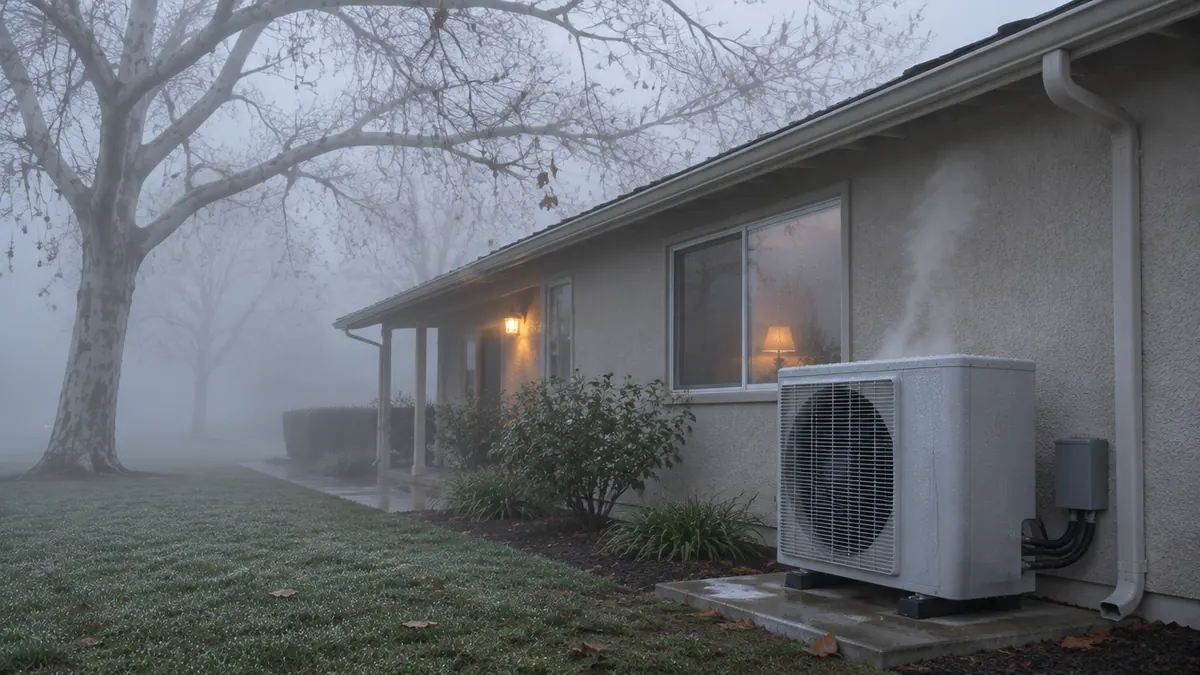
A light frost is normal on cold, damp mornings, including foggy Sacramento ones. The heat pump clears it with a short defrost cycle, often with steam rising from the unit. Thick ice that stays after defrost needs a technician; see heat pump defrost mode.
Does JM Comfort install heat pumps for Sacramento-area homes?
Yes. JM Comfort installs and repairs heat pumps, along with furnaces, central air conditioners and ductwork, for homes in North Highlands, Sacramento and nearby communities. Call (916) 247-6358 or request an estimate online.
Sources
- At What Temperature Do Heat Pumps Stop Working? (Trane)
- Air-Source Heat Pumps (ENERGY STAR)
- You Installed an Air Source Heat Pump. Now What? (Consortium for Energy Efficiency, hosted by the U.S. Department of Energy)
- What Is Auxiliary Heat? (Carrier)
- What is a Dual Fuel Heating System? Benefits & Guide (Carrier)
- Guidance: Central Air Conditioners, 2023 Energy Conservation Standards FAQ (issued October 5, 2022) (U.S. Department of Energy)
- U.S. Climate Normals 1991–2020, Monthly: Sacramento Executive Airport, CA (USW00023232) (NOAA National Centers for Environmental Information)
- U.S. Climate Normals 1991–2020, Annual/Seasonal: Sacramento Executive Airport, CA (USW00023232) (NOAA National Centers for Environmental Information)
- NOAA Technical Memorandum NWS WR-272: Climate of Sacramento, California (revised June 2005) (NOAA National Weather Service)
Find this helpful? Add JM Comfort as a preferred source on Google.