Why Is My Heat Pump Not Heating? Causes and What to Do
Cool air from a heat pump isn’t always a breakdown. Here’s how to tell normal from broken, what you can safely check yourself, and when it’s time to call a technician.
JM Comfort can help: heat pump repair for homes in Sacramento and nearby. Licensed C-20 HVAC contractor, CSLB #1016274.
A heat pump that isn’t heating has a short list of suspects, and several of them aren’t breakdowns at all. Sometimes it’s a thermostat setting or a defrost cycle doing its job. Sometimes it’s a clogged filter or an outdoor unit buried in leaves. And sometimes it’s a refrigerant leak or a failed part that needs a technician. This guide shows you how to tell the difference, what you can safely check, and when to stop and call for heat pump repair.
Why is my heat pump not heating?
Most of the time a heat pump stops heating because the thermostat isn’t calling for heat, the unit is in a defrost cycle, airflow is blocked by a dirty filter or a buried outdoor unit, or the system has lost power; less often, refrigerant has leaked out or a part like the reversing valve has failed.
Here’s how it’s supposed to work. In winter, a heat pump pulls heat out of the outdoor air with refrigerant and pumps it inside, where a blower pushes air across a warm indoor coil. A part called the reversing valve flips the direction of the refrigerant so the same system can cool in summer. Anything that stops the outdoor unit from running, blocks air across either coil, or keeps the refrigerant from carrying heat will leave you with cool or lukewarm air.
Why is my heat pump blowing cold air?
Often it isn’t truly cold: heat pump air is cooler than furnace air, and for a few minutes at a time a defrost cycle can make it feel cool on purpose.
One major manufacturer says heat pump supply air typically runs around 85°F to 100°F during heating, which feels cooler than gas furnace air. Since that’s below your body temperature, your hand at the vent can read it as cool even when the house is warming up fine. The real test is whether the house reaches and holds the temperature you set.
The other common reasons are simple:
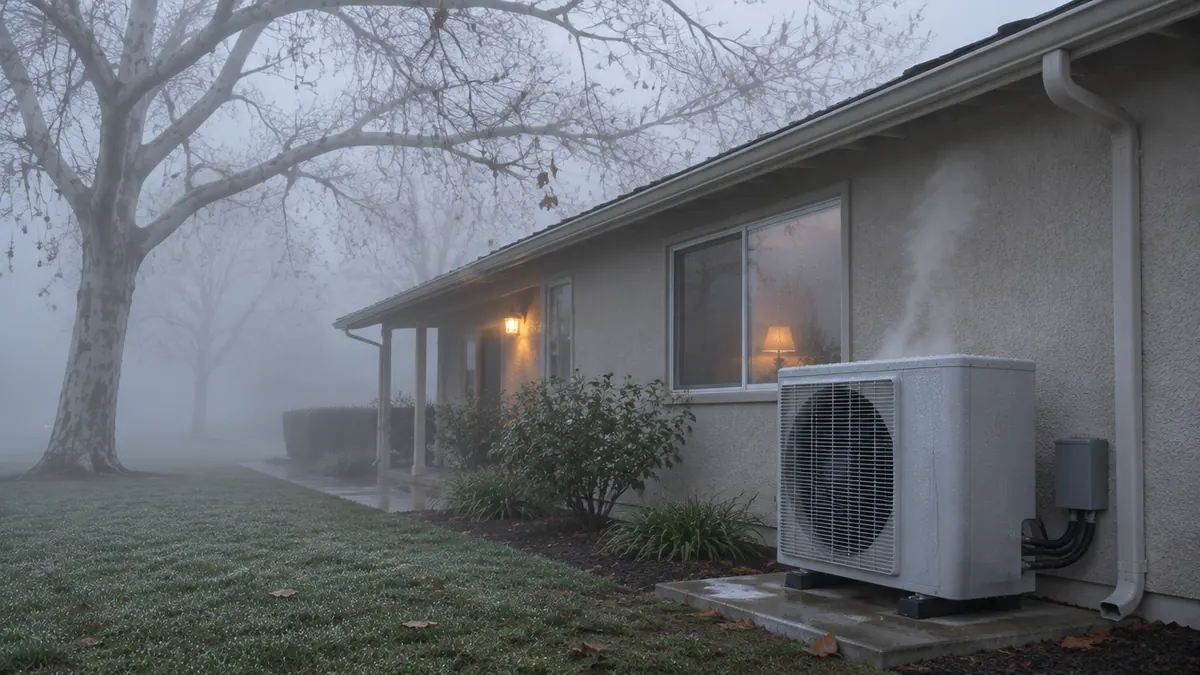
- Defrost mode. In cold, damp weather, frost builds on the outdoor coil and the system briefly switches modes to melt it. Two major manufacturers say to wait: once the unit exits defrost, it should go back to heating. You may see steam rising outside while it happens. Our defrost mode guide explains what’s normal.
- The fan is set to On. On keeps the blower running even when the heat pump isn’t heating, so you feel room-temperature air between cycles. Set it to Auto.
- The thermostat is on Cool. It happens more than you’d think after a warm fall afternoon. Switch it back to Heat.
What causes a heat pump not to heat?
Match what you’re seeing to the likely cause in this table. The first 5 are things you can check or fix yourself; the rest belong to a technician.
| Cause | What you’ll notice | DIY or pro |
|---|---|---|
| Thermostat on Cool, or fan on On | Cool air at the vents; house not warming | DIY: set to Heat and Auto |
| Defrost cycle | Cool air for a few minutes; steam rising outside | Normal: wait |
| Dead batteries or a thermostat error | Blank screen, warning or error code | DIY: batteries; pro if it persists |
| Clogged air filter | Weak, lukewarm airflow; gray, dusty filter | DIY: replace the filter |
| Leaves, debris or plants crowding the outdoor unit | Unit buried or crowded; weak heat | DIY: clear it gently |
| Tripped breaker | Outdoor unit or whole system dead | Pro: don’t reset a heat pump breaker |
| Heavy ice that won’t clear | Coil encased in ice after defrost | Pro |
| Refrigerant leak | Hissing near the outdoor unit, frozen coil, weak heat | Pro |
| Stuck reversing valve | Cools fine in summer, won’t heat in winter | Pro |
| Leaky ducts | Some rooms cold, others fine | Pro |
What should you check when your heat pump isn’t putting out heat?
Start at the thermostat and work outward: thermostat, defrost, power, filter, outdoor unit, then ice. These 6 checks are safe for any homeowner and cover every cause you can fix yourself.
Safety first: Don’t open the outdoor unit’s electrical panel, touch wiring, or do anything to the refrigerant lines. One major manufacturer tells homeowners not to open the refrigerant circuit or work on high-voltage parts. Refrigerant work is a job for a certified technician.
How to troubleshoot a heat pump that’s not heating: 6 safe checks
- Check the thermostat. Set it to Heat, set the temperature a few degrees above the room temperature, and set the fan to Auto. If the screen is blank or shows a low-battery warning or error code, replace the batteries and check the manual. One manufacturer adds that a thermostat that’s consistently more than 2 to 3°F off from the real room temperature should be checked. See thermostat not working.
- Wait out a defrost cycle. If the thermostat shows Defrost or you see steam rising from the outdoor unit, give it up to 15 minutes. Heating should resume on its own.
- Check the power switches and breaker. Make sure the power switch near the outdoor unit and the switch at the indoor unit are both on. If a breaker for the heat pump has tripped, leave it alone: one major manufacturer warns that resetting the breaker and restarting the unit could cause damage. Call instead. If the problem started after a storm, see HVAC not working after a power outage.
- Check the air filter. Turn the system off and slide out the filter. If it’s gray and caked with dust, replace it with the same size, arrow pointing toward the indoor unit. Manufacturers suggest checking it anywhere from monthly to every 60 to 90 days.
- Clear the outdoor unit. Remove leaves and debris from the top and sides, trim back plants, and keep about 2 feet of open space around it. Make sure gutters and downspouts don’t drain onto it.
- Check for heavy ice. A light coat of frost is normal and should clear during defrost. If the coil is covered in thick ice that stays after a defrost cycle, stop and call. Switch the thermostat to Emergency Heat to keep the house warm while you wait.
Still no heat after all 6 checks? Leave the thermostat on Emergency Heat or Off and call a technician.
Why is my heat pump not working after snow or ice?
Snow or ice packed around the outdoor unit blocks the air it needs to pull heat from, and freezing rain or sleet can coat the coil faster than the defrost cycle can clear it.
One major manufacturer lists freezing rain, sleet and heavy wet snow among the causes of a frozen heat pump, because they can overwhelm the defrost system. On the Sacramento valley floor, though, snow is rarely the problem: NOAA’s Climate of Sacramento memo says snow is so rare and falls in such small amounts that it may be disregarded as a climatic feature. Here, ice is more likely to come from water dripping onto the unit or from a hard frost; NOAA’s 1991–2020 normals for Sacramento Executive Airport average about 15 nights a year at or below 32°F.
What you can do safely:
- Brush, don’t chip. Gently brush any snow or slush off the top with a soft broom. Don’t chip or pry at ice with tools, and don’t pour hot water on the unit. Manufacturers warn both can damage the coil, fins and fan.
- Watch the roofline. Water dripping from a gutter or eave onto the unit refreezes into a thick shell on a cold night. Point downspouts away from it.
- Give it time once it warms up. NOAA’s normals average no days a year that stay below 32°F in Sacramento, so the afternoon usually brings a thaw. Once it’s above freezing, one manufacturer says ice should melt on its own in roughly 2 to 4 hours. If it hasn’t melted in 6 to 8 hours, or refreezes quickly, call.
Should you cover the unit to keep frost or rain off? Generally no; a heat pump needs open airflow all winter. See should you cover your heat pump in winter.
Why is my heat pump running but not keeping the house warm?
If the system runs and runs but the house never reaches the set temperature, something is cutting its capacity, such as a dirty filter, low refrigerant, leaky ducts or a backup heat problem, or it’s simply colder outside than the heat pump can handle alone.
A heat pump owner guide hosted by the Department of Energy lists these signs that a heat pump isn’t working properly: the setpoint is never reached, the unit runs constantly or cycles on and off often, auxiliary heat is constantly displayed on the thermostat, or the coils are frozen. It also flags a sudden jump in electricity use as the most common sign. If you see any of them, the guide says to have a qualified HVAC professional check the unit.
Watch the Aux light. One major manufacturer says dirty filters or low refrigerant can force a heat pump to rely on backup heat even in mild weather, and another says aux heat staying on when it’s above 40°F can point to a problem with the heat pump or thermostat. Backup heat keeps you warm, but it costs far more to run. Our guide to emergency heat vs. aux heat explains when it’s normal.
Ducts are the hidden suspect. If some rooms stay cold while others feel fine, leaks in the attic or crawlspace may be dumping warm air before it reaches you. One manufacturer notes that most ductwork is hidden and needs a contractor to diagnose. See signs of leaky ductwork.
And on the coldest nights, some heat pumps need help. Read do heat pumps work in cold weather to see how yours should behave in a cold snap.
When should you use emergency heat?
Use emergency heat only when the heat pump itself has stopped working, such as an outdoor unit that won’t run or is encased in ice, and call for service as soon as you switch it on.
Emergency heat shuts off the heat pump and runs only the backup heat, usually electric resistance. One major manufacturer says to switch to it only if the heat pump has broken down, and another says that if you engage the emergency setting, you should call for HVAC service right away. It keeps the house warm, but use it sparingly: relying only on electric resistance heat can significantly increase your electric bill.
When should you call a pro for a heat pump that’s not heating?
Call a technician when the problem involves refrigerant, electrical parts, the reversing valve or ice that won’t clear, or when the 6 checks above don’t bring back steady heat.
Refrigerant leaks
Signs include a hissing sound near the outdoor unit, liquid pooling, a frozen coil and weak heat. One major manufacturer says to call for service right away, and another notes that a low charge can indicate a leak. The leak has to be found and repaired; adding refrigerant without fixing it only postpones the next breakdown. Learn more about refrigerant types.
A stuck reversing valve
If the system cools perfectly in summer but won’t heat in winter, the reversing valve may be stuck. That’s a technician repair.
Defrost and ice problems
Light frost is normal. Ice thicker than about 1/4 inch, ice that stays after a defrost cycle, or defrost cycles that run unusually often can point to restricted airflow, low refrigerant or a defrost-system problem, according to one major manufacturer.
Electrical warning signs
A tripped heat pump breaker, an outdoor unit that won’t start, or grinding or banging noises all need a technician.
When you’re ready, schedule heat pump repair and a technician will tell you what failed and what it takes to fix it. If your heat pump is older and the repair is a big one, the repair-or-replace calculator can help you decide, and heat pump vs. furnace lays out your replacement options.
Why do Sacramento-area homeowners call JM Comfort?
JM Comfort is a locally owned heating and air conditioning contractor based in North Highlands, serving North Highlands, Sacramento and nearby communities. It’s a licensed C-20 HVAC contractor (CSLB #1016274), licensed since 2016 and bonded, with workers’ comp insurance on file; you can check the license on the CSLB website. Heat pump repair and installation are among its services for homes, along with furnace and AC repair, tune-ups and ductwork, so the same team can help with whatever comes after the repair.
Call (916) 247-6358 or book heat pump repair online and we’ll call you back.
Frequently asked questions
How warm should the air from a heat pump feel?
Warm, not hot. One major manufacturer says heat pump supply air typically runs around 85°F to 100°F during heating, which can feel cool on your hand because it’s below body temperature. Check whether the house is holding the temperature you set, not how hot the vent feels.
Is it normal for a heat pump to blow cold air for a few minutes?
Yes, during a defrost cycle. The system briefly switches modes to melt frost off the outdoor coil, so you may feel cooler air and see steam outside. Heating should resume when the cycle ends. If it happens constantly or lasts much longer, see heat pump defrost mode.
Why does my heat pump work in summer but not in winter?
If it cools fine but won’t heat, the reversing valve, which flips the flow of refrigerant between cooling and heating, may be stuck. Check the thermostat mode first. A stuck valve is a technician repair, not a homeowner fix.
Should I turn off my heat pump if it’s covered in ice?
Don’t keep forcing it. Switch the thermostat to Emergency Heat to keep the house warm, or to Off, and call for service. Don’t chip at the ice or pour hot water on the unit; both can damage it.
Can a dirty filter stop a heat pump from heating?
Yes. A clogged filter cuts airflow, which can leave you with lukewarm air, make the system shut down, or force it to lean on expensive backup heat. Check it monthly in winter and replace it when it’s dirty. Our guide to how often to change your air filter covers the details.
Does JM Comfort repair heat pumps in the Sacramento area?
Yes. Heat pump repair and installation are among JM Comfort’s services for homes in North Highlands, Sacramento and nearby communities, along with furnace and AC repair, tune-ups and ductwork. Call (916) 247-6358 or book a visit online.
Sources
- Troubleshooting Tips for a Heat Pump Not Heating (Trane)
- Heat Pump Not Heating? Here’s How to Troubleshoot (Carrier)
- Heat Pump Not Heating? Causes, Fixes & Troubleshooting (Bryant)
- Why Is My Heat Pump Not Cooling? Troubleshooting Tips (Trane)
- What to Do If Your Heat Pump Is Frozen? (Lennox)
- What Is Auxiliary Heat? (Carrier)
- What is Auxiliary Heat and How Does it Affect HVAC Performance? (Trane)
- You Installed an Air Source Heat Pump. Now What? (Consortium for Energy Efficiency, hosted by the U.S. Department of Energy)
- U.S. Climate Normals 1991–2020, Annual/Seasonal: Sacramento Executive Airport, CA (USW00023232) (NOAA National Centers for Environmental Information)
- NOAA Technical Memorandum NWS WR-272: Climate of Sacramento, California (revised June 2005) (NOAA National Weather Service)
Find this helpful? Add JM Comfort as a preferred source on Google.