Heat Pump vs. Air Conditioner: What’s the Difference, and Which Do You Have?
From the yard, a heat pump and an air conditioner look almost identical. Here’s what actually separates them, which one fits a Sacramento-area home, and how to tell which one you already have.
JM Comfort can help: heat pump installation for homes in Sacramento and nearby. Licensed C-20 HVAC contractor, CSLB #1016274.
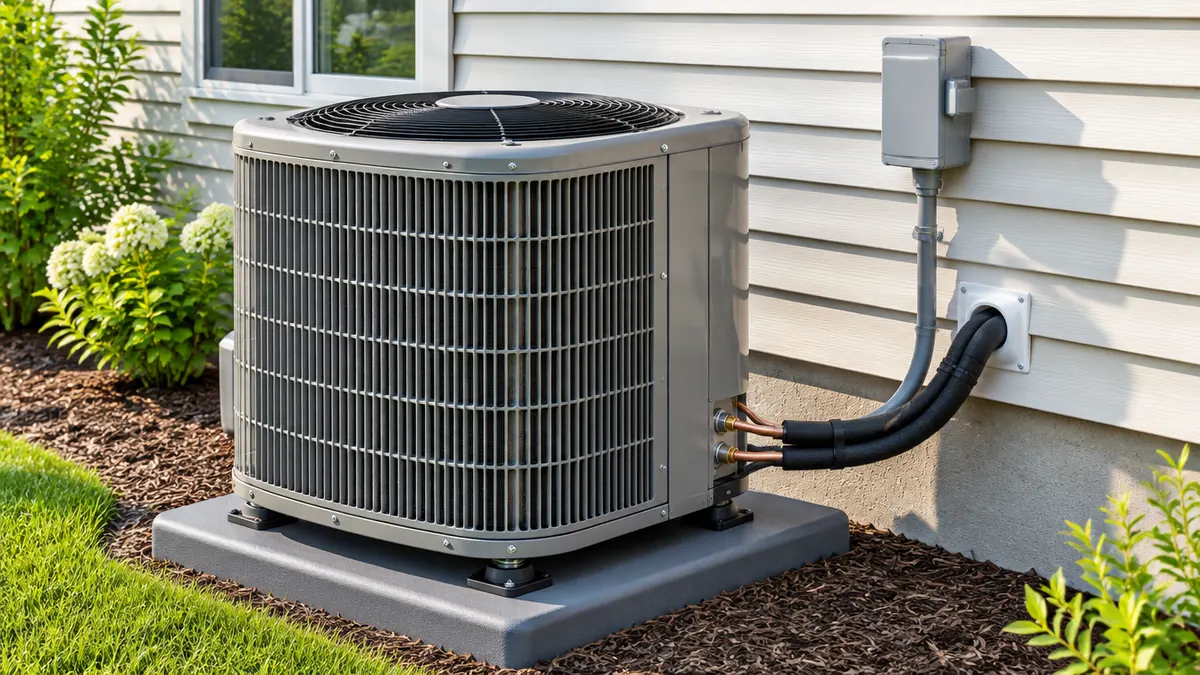
Stand in the yard and you can’t tell a heat pump from an air conditioner by looking. Both are a metal box with a fan on a pad beside the house, connected to the indoor unit by copper lines. The difference is inside, and it decides how your house is heated, what your thermostat settings mean, and what you should buy when it’s time to replace. This guide explains the difference, how to tell which one you have, and which makes more sense for a Sacramento-area home. If you’re already planning a replacement, JM Comfort handles heat pump installation and repair as well as central air.
Heat pump vs air conditioner: what’s the difference?
An air conditioner only cools; a heat pump cools exactly the same way in summer, then reverses the flow of refrigerant to heat your home in winter.
Both systems work by moving heat, not making it. In summer, refrigerant picks up heat from your house at the indoor coil and carries it to the outdoor unit, which releases it outside. An air conditioner stops there, so a home with central AC also needs a furnace for winter. A heat pump adds one key part, the reversing valve, which flips the direction of the refrigerant so the outdoor coil pulls heat out of the winter air and the indoor coil releases it into your house. ENERGY STAR describes heat pumps as serving double duty, heating in winter and cooling in summer.
| Feature | Central air conditioner | Heat pump |
|---|---|---|
| Cools | Yes | Yes, the same way |
| Heats | No; paired with a furnace | Yes, by moving heat from outdoor air |
| Reversing valve | No | Yes |
| Outdoor unit in winter | Sits idle | Runs to heat the house |
| Thermostat settings | Heat, Cool, Off | Adds Em Heat and Aux |
| Efficiency ratings | SEER2 (cooling) | SEER2 (cooling) and HSPF2 (heating) |
| Federal minimum in California (split system under 45,000 Btu/h) | 14.3 SEER2, plus 11.7 EER2 (or 9.8 EER2 at 15.2 SEER2 and up) | 14.3 SEER2 and 7.5 HSPF2 |
| SMUD rebate (as of Nov. 2026) | None listed | $1,000 to $3,000 for qualifying two-stage or variable-stage systems |
The efficiency minimums come from the Department of Energy’s 2023 standards, which put California in the hot-dry Southwest region. Those regional rules apply only to air conditioners; heat pumps follow the national standard. Larger split ACs, at 45,000 Btu/h and up, need 13.8 SEER2 and 11.2 EER2 (or 9.8 EER2 at 15.2 SEER2 and up). DOE notes that EER is especially important in hot-dry climates, which have more high-temperature days. Rebate amounts are from SMUD’s heating and cooling rebates page as of November 2026 and can change.
Is a heat pump an air conditioner?
Yes, in summer: a heat pump is an air conditioner that can also run in reverse, so in cooling mode it does the same job the same way.
One major manufacturer puts it simply: a heat pump acts as a heater in winter and reverses the process to act as an air conditioner in summer. That’s why heat pumps are rated for cooling with the same SEER2 metric as air conditioners, and why a heat pump’s cooling problems look just like an AC’s. If yours isn’t cooling, start with why an AC blows warm air; the checks are the same.
The reverse isn’t true. An air conditioner can’t heat, because it has no reversing valve. Its outdoor unit sits quiet all winter while a furnace or other heat source warms the house.
AC unit vs heat pump: which should you buy?
If you heat with electricity, or your AC and furnace are both near the end, a heat pump usually makes more sense; if you have a good gas furnace and only need to replace the AC, compare a new AC with a heat pump that pairs with that furnace.
The Department of Energy says that in moderate climates, heat pumps can be an energy-efficient alternative to furnaces and air conditioners, and Sacramento’s mild winters fit that description. Most California homes still heat with a furnace, though: in EIA’s 2020 Residential Energy Consumption Survey, 62% of California homes listed a furnace as their main heating equipment and about 3% a central heat pump. Our heat pump vs. gas furnace guide walks through the heating side, and do heat pumps work in Sacramento covers how they fit local homes.
You have a newer gas furnace and an old AC
This is the classic case for a heat pump instead of an AC. ENERGY STAR suggests that homeowners with a relatively new furnace and an older central AC consider an ENERGY STAR certified heat pump, which creates a dual fuel system for a modest extra cost over an AC. The heat pump cools in summer and heats on mild days; the furnace covers the coldest hours.
You heat with electric resistance, or have no gas
Here a heat pump is usually the clear choice. ENERGY STAR says a heat pump can deliver up to 3 times more heat energy to a home than the electricity it consumes, because it moves heat instead of making it.
Cooling performance and cost
In summer, there’s no penalty for choosing a heat pump. In California, a new split heat pump and a new split AC under 45,000 Btu/h must both meet at least 14.3 SEER2, and a higher SEER2 means lower cooling costs for either. Upfront, ENERGY STAR describes the extra cost of a heat pump over an AC as modest, and the heat pump also takes over much of your heating.
Rebates lean toward heat pumps. As of November 2026, SMUD lists $3,000 for a variable-stage heat pump and $2,000 for a two-stage heat pump (15.2 SEER2 minimum) when you convert from gas to electric, and $1,000 for an electric-to-electric upgrade to a two-stage or variable-stage heat pump. Single-stage systems aren’t eligible, rebates are subject to funding, and the equipment must be installed by a participating contractor in the SMUD Contractor Network. For price ranges, see what a new HVAC system costs, and for the ratings, our SEER2 guide.
Refrigerant rules don’t tip the choice either way. CARB prohibits refrigerants with a global warming potential (GWP) of 750 or greater in new residential air-conditioning equipment as of January 1, 2025, and its definition of that equipment includes ducted central air conditioners and heat pumps. See refrigerant types for what that means for an older system.
How can you tell if you have a heat pump or an AC?
Check your thermostat for Em Heat or Aux settings, read the outdoor unit’s nameplate, or see whether the outdoor unit runs when the thermostat calls for heat in winter; any one of those usually settles it.
Safety first: These are look-only checks. Turn the system off at the thermostat and wait for the outdoor fan to stop before you look into the unit. Don’t remove panels, reach inside, or open the electrical box on the wall.
4 quick checks
- Check the thermostat. Look for Em Heat, Emer or Aux. One major manufacturer says only a heat pump thermostat will have these settings. A thermostat with only Heat, Cool and Off usually means an AC with a separate furnace.
- Read the labels. Find the metal nameplate on the outdoor unit. Some manufacturers print the words heat pump on it; if not, search the brand and model number online. A yellow EnergyGuide label showing both SEER2 and HSPF2 ratings means a heat pump, since air conditioners only show cooling ratings.
- Run a winter heat test. On a cool day, set the thermostat to Heat and raise it a few degrees. If the outdoor unit starts and its fan blows cold air out the top while the house warms, it’s a heat pump. An AC stays silent.
- Look for a reversing valve. With the system off and the fan stopped, shine a flashlight through the top grille. A brass valve with several copper tubes attached, 3 on one side and 1 on the other, is a reversing valve. One major manufacturer notes that an AC unit won’t have this valve.
Still not sure? The model number is the tiebreaker: search it online, or ask a technician to check it during any service visit.
Why does it matter which one you have?
Knowing whether you have a heat pump changes how you set the thermostat, what’s normal in winter, and what to check when the heat stops working.
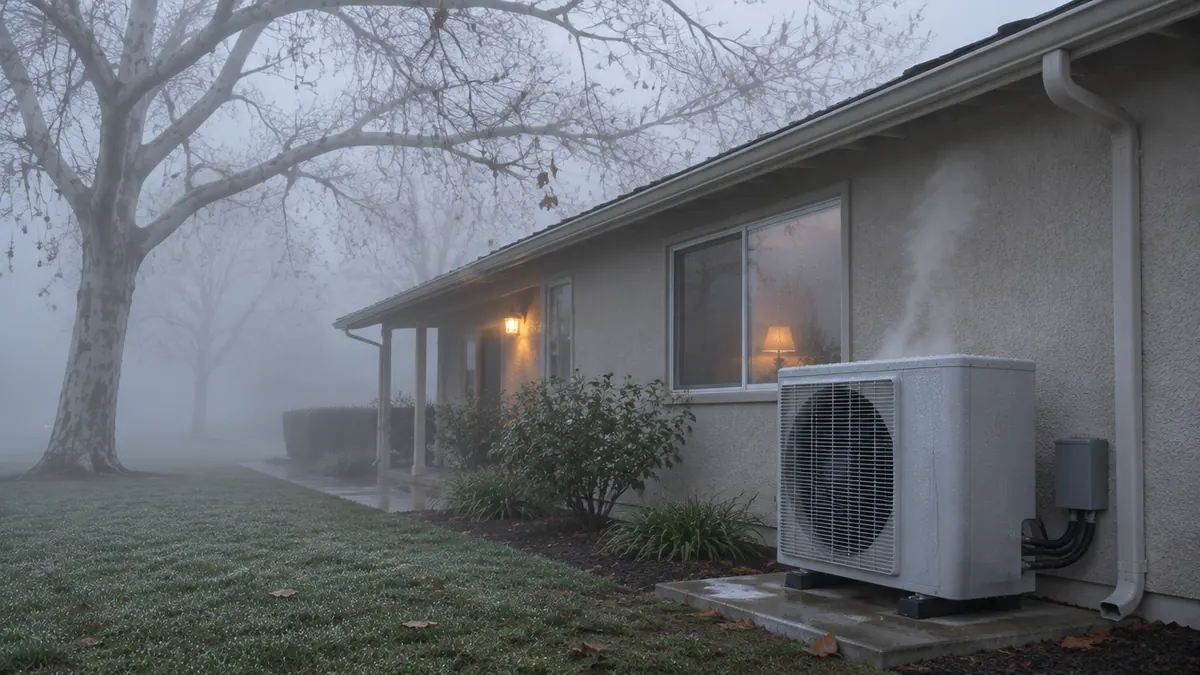
- Winter surprises. A heat pump’s outdoor unit runs all winter and periodically defrosts, sending up steam on cold, damp mornings. That’s normal; see heat pump defrost mode.
- Thermostat settings. Em Heat and Aux only appear on heat pump thermostats, and they do very different jobs. See emergency heat vs. aux heat.
- Troubleshooting. No heat from a heat pump has different causes than no heat from a furnace. Start with why a heat pump isn’t heating.
- Replacement timing. ENERGY STAR suggests considering replacement for either a heat pump or an AC once it’s more than 10 years old. A heat pump works in both seasons, so it logs more hours each year than an AC that rests all winter. For more, see how long HVAC systems last.
When should you call a pro?
Call a technician when you’re planning a replacement and want options priced side by side, when your system won’t switch between heating and cooling, or when you can’t tell what you have and need it for a repair.
A heat pump that heats but won’t cool, or cools but won’t heat, may have a stuck reversing valve. That’s a technician repair. If you’re replacing an aging AC, ask any contractor to price a central AC and a heat pump for the same house, to confirm the SEER2, EER2 and HSPF2 ratings in writing, and to say who pulls the permit, since a California changeout has to meet the Title 24 energy code. If you want a SMUD rebate, ask whether the contractor is in the SMUD Contractor Network. When you’re ready, request a heat pump estimate, or compare with AC installation.
What should you look for in an HVAC company?
Look for a licensed contractor who prices both options honestly and puts the details in writing.
For questions to ask and red flags, see how to choose an HVAC company.
Why do Sacramento-area homeowners call JM Comfort?
JM Comfort is a locally owned heating and air conditioning contractor based in North Highlands, serving North Highlands, Sacramento and nearby communities. It’s a licensed C-20 HVAC contractor (CSLB #1016274), licensed since 2016 and bonded, with workers’ comp insurance on file; you can check the license on the CSLB website. JM Comfort installs and repairs heat pumps, central air conditioners and furnaces for homes, so you can see a heat pump and an AC priced for the same house by the same team.
Call (916) 247-6358 or request a heat pump estimate online and we’ll call you back.
Frequently asked questions
Can I replace my AC with a heat pump and keep my furnace?
Usually, yes. That creates a dual fuel system: the heat pump cools in summer and heats on mild winter days, and the furnace takes over in the cold. ENERGY STAR suggests considering a heat pump if you have a fairly new furnace and an older central AC. See heat pump vs. furnace for how dual fuel works.
Do heat pumps cool as well as air conditioners?
Yes. In summer, a heat pump works as an air conditioner, moving heat from inside your house to the outdoors. Cooling efficiency is rated the same way for both, with SEER2, so compare SEER2 numbers when you shop, along with EER2, which matters on very hot days.
Why is steam coming off my outdoor unit in winter?
Because it’s a heat pump running a defrost cycle. An air conditioner doesn’t run in winter. Steam during defrost is normal, especially on cold, foggy mornings; see heat pump defrost mode for what to expect.
Does a heat pump need a furnace?
No. Many heat pumps pair with an indoor air handler that has electric backup heat instead of a furnace. A furnace is only part of the system if you choose dual fuel. Our guide to emergency heat vs. aux heat explains the backup.
Does JM Comfort install both heat pumps and air conditioners?
Yes. JM Comfort installs and repairs heat pumps and central air conditioners, along with furnaces and ductwork, for homes in North Highlands, Sacramento and nearby communities. Call (916) 247-6358 or request an estimate online.
Sources
- How Do I Know If I Have A Heat Pump? (Carrier)
- How Do I Know If I Have a Heat Pump? (Trane)
- Air-Source Heat Pumps (ENERGY STAR)
- Heat Pumps (U.S. Department of Energy)
- Guidance: Central Air Conditioners, 2023 Energy Conservation Standards FAQ (issued October 5, 2022) (U.S. Department of Energy)
- Heating and cooling rebates (SMUD)
- Highlights for space heating in U.S. homes by state, 2020 (U.S. Energy Information Administration (Residential Energy Consumption Survey))
- Air-conditioning Equipment (California Air Resources Board)
- Heat Pump vs Furnace - Pros & Cons of Each Heating Type (Carrier)
- When is it time to replace? (ENERGY STAR)
Find this helpful? Add JM Comfort as a preferred source on Google.