Carbon Monoxide Safety: Symptoms, Sources and Where to Put Alarms
Carbon monoxide gives no warning you can see or smell. Here’s how it gets into a house, the symptoms to know, where alarms belong, what California law requires, and how to keep your furnace from becoming the source.
JM Comfort can help: furnace and heating repair for homes in Sacramento and nearby. Licensed C-20 HVAC contractor, CSLB #1016274.
CPSC calls carbon monoxide the “Invisible Killer” for good reason: it’s a colorless, odorless, poisonous gas, and it can make you sick before you suspect anything is wrong. CDC counts more than 400 Americans who die each year from unintentional CO poisoning not linked to fires, more than 100,000 emergency department visits and more than 14,000 hospital stays. This guide covers what CO is, the symptoms, where it comes from in a house, where alarms belong, and how yearly furnace service helps keep it out.
Safety first: If your CO alarm is sounding, or anyone in the home has symptoms that could be CO poisoning, get everyone outside to fresh air immediately, then call 911. Don’t try to find the source. Don’t go back inside until emergency responders say it’s safe. If the cause turns out to be a malfunctioning appliance, don’t use it again until it has been properly serviced.
What is carbon monoxide?
Carbon monoxide (CO) is a colorless, odorless, poisonous gas that forms when fuel doesn’t burn completely. EPA ties it to incomplete combustion in appliances like gas ranges and unvented heaters, and PG&E, the gas utility for Sacramento County, describes it as a byproduct of burning fossil fuels that you cannot smell or see. The California Air Resources Board adds a third “no”: it’s tasteless too.
Because you can’t see or smell it, your senses won’t warn you. That catches people off guard: in a 2026 survey by UL Standards & Engagement, 27% of adults wrongly believed CO has a smell that would warn them. If you smell rotten eggs, that’s the odorant added to natural gas, a different hazard with its own steps. See what to do if you smell gas near your furnace.
It’s most dangerous when you can’t notice symptoms. CDC warns that people who are sleeping, drunk or under the influence of other substances can die from CO poisoning, which is why alarms belong near every bedroom.
What are the symptoms of carbon monoxide poisoning?
The most common symptoms are headache, dizziness, weakness, upset stomach, vomiting, chest pain and confusion, according to CDC, which notes they’re often described as flu-like.
CPSC adds a useful clue: the first symptoms of low to moderate CO poisoning are similar to the flu, but without the fever. As exposure climbs, symptoms get worse.
| Exposure | Symptoms CPSC lists | What to do |
|---|---|---|
| Low to moderate | Headache, fatigue, shortness of breath, nausea, dizziness | Get everyone outside to fresh air, then call 911 |
| High | Mental confusion, vomiting, loss of muscle coordination, loss of consciousness, death | Get outside and call 911 immediately |
CDC says everyone is at risk, but infants, older adults and people with chronic heart disease, anemia or breathing problems are more likely to get sick. Flu-like symptoms without a fever are a reason to think about CO, especially if they ease when you leave the house: EPA lists flu-like symptoms that clear up after leaving home among the effects of higher exposure. PG&E’s carbon monoxide page says to call 9-1-1 and seek medical attention if anyone experiences possible CO poisoning symptoms.
What causes carbon monoxide in a house?
CO in a house comes from something burning fuel that malfunctions, isn’t vented properly or is used indoors when it shouldn’t be: a furnace, water heater, range or space heater, a fireplace, a car in an attached garage, or a generator.
CPSC lists malfunctioning fuel-burning appliances such as furnaces, ranges, water heaters and room heaters as sources. EPA adds unvented kerosene and gas space heaters, leaking chimneys and furnaces, gas stoves, and back-drafting from furnaces, gas water heaters, wood stoves and fireplaces.
| Source | How CO gets in | Prevention |
|---|---|---|
| Gas furnace | Malfunction, a leaking furnace, or a blocked or disconnected flue | Professional inspection every year |
| Gas water heater | Back-drafting or malfunction | Have it serviced every year |
| Gas range or oven | Burns indoors; dangerous when used for heat | Use an exhaust fan vented outdoors; never use it to heat the house |
| Fireplace or wood stove | Back-drafting or a closed flue | Open the flue when in use; have the chimney checked yearly |
| Unvented space heater | Exhaust stays in the room | Consider a vented heater when you replace it |
| Portable generator | Exhaust drifts into the house or garage | Never run it inside a home or garage, even with doors and windows open |
| Car in an attached garage | Exhaust seeps into the house | Never leave a car running in the garage, even with the door open |
| Charcoal grill | Burning charcoal indoors | Never burn charcoal inside a home, garage, vehicle or tent |
Generators deserve special mention. CPSC says more than 100 deaths a year are linked to portable generators. If a storm or a power outage has you running one, CDC says to keep it outdoors and well away from windows, doors and vents, never in the house or garage, even with the doors and windows open.
Why gas heat matters in California homes
Most California homes burn fuel for heat. The U.S. Energy Information Administration’s 2020 housing survey found that natural gas was the main space heating fuel in 64% of California homes, with electricity at 20%. If your home is one of them, the furnace is the first place to look when you think about CO, along with any gas water heater, and the yearly check-up below matters.
Can a furnace leak carbon monoxide?
Yes. A gas furnace burns fuel, and EPA lists leaking furnaces and chimneys, and back-drafting from furnaces, among the sources of CO in homes.
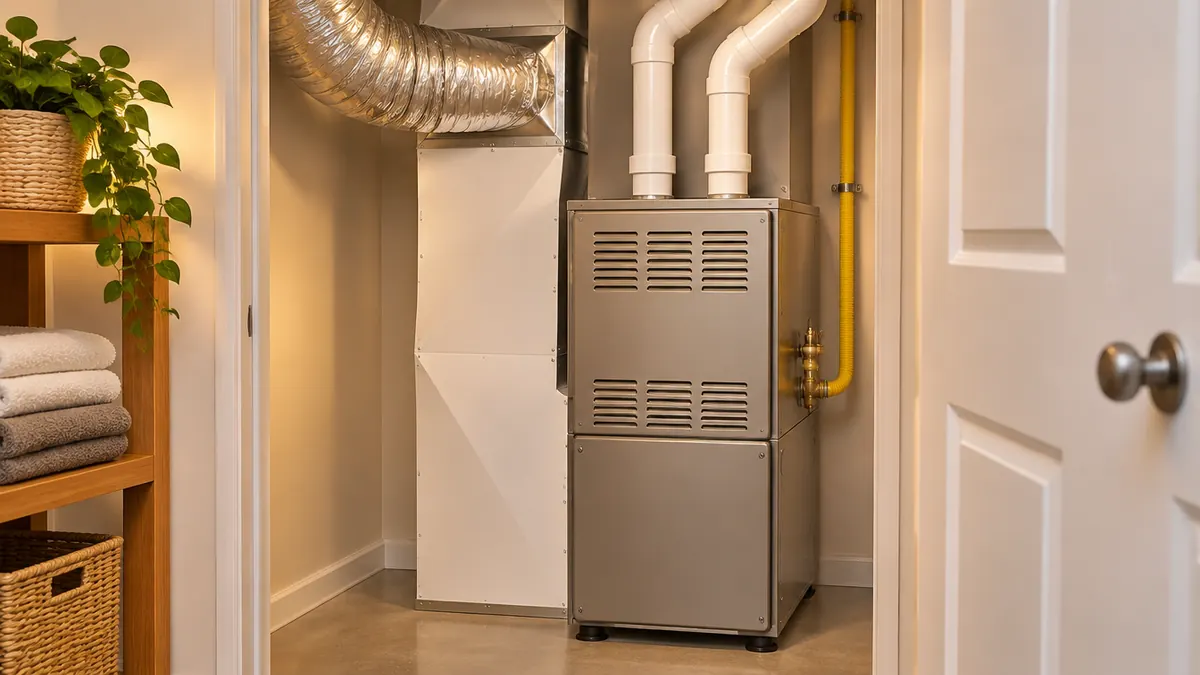
A furnace that’s working right sends its exhaust outside through a flue or vent pipe, and PG&E notes that most fuel-burning equipment produces little CO when it’s properly installed and maintained. Trouble starts when exhaust doesn’t make it out or the flame doesn’t burn cleanly: PG&E says CO can reach dangerous levels if the burner is short of oxygen or venting is inadequate, and EPA points to flues that are improperly sized, blocked, disconnected or leaking. That’s why EPA says to keep gas appliances properly adjusted, and why CPSC wants the inspector to check chimneys and flues for blockages, corrosion, partial and complete disconnections, and loose connections.
To understand the parts involved, see how a furnace works. If a technician has mentioned your heat exchanger, read what a cracked heat exchanger means.
A heat pump or electric furnace doesn’t burn fuel, so it can’t make CO on its own. You still need alarms if the house has a gas water heater, gas range, fireplace or attached garage.
How do you keep your furnace from causing carbon monoxide problems?
Have the furnace inspected and serviced by a trained professional every year, and keep working CO alarms in the house. EPA recommends having a trained professional inspect, clean and tune up the central heating system, including furnaces, flues and chimneys, annually. CDC gives the same advice for the heating system, water heater and any other gas, oil or coal burning appliance.
PG&E gives Sacramento-area gas customers the same advice: have a qualified professional maintain and inspect heating systems and fuel-burning appliances every year, and have appliance vents and chimney flues inspected annually for blockages, corrosion, cracks or leakage. An alarm doesn’t replace that upkeep. CPSC says a CO alarm is no substitute for proper use and upkeep of appliances that can produce CO, and PG&E calls detectors a backup, not a replacement for proper use and maintenance.
For what a yearly check covers, read what an HVAC tune-up includes.
Where should you put carbon monoxide detectors?
Put CO alarms on every level of your home and outside sleeping areas, CPSC says, and interconnect them if you can: when one sounds, they all sound. CDC adds that they should be battery-operated or have battery backup and sit near every sleeping area.
More placement rules from CPSC:
- Follow the manufacturer’s instructions for where and how to mount the alarm.
- Plug-in or high on the wall both work. Hard-wired and plug-in alarms should have battery backup.
- Avoid heating vents and spots where furniture or drapes can cover the alarm.
- Skip the kitchen and the space directly above fuel-burning appliances.
- Buy an alarm that meets the current UL 2034 safety standard.
A smoke alarm isn’t a CO alarm. UL Standards & Engagement points out that CO alarms are labeled as such on the front, and suggests combination smoke and CO alarms when you buy new ones. If yours is beeping or chirping, read why a carbon monoxide alarm goes off.
What does California require?
California requires CO alarms in homes that burn fuel or have an attached garage. The California Air Resources Board explains that the Carbon Monoxide Poisoning Prevention Act of 2010 requires carbon monoxide detectors or alarms in all dwellings that have any kind of fuel-burning appliance, such as gas or propane, or an attached garage, and that the alarms must be approved by the California Office of the State Fire Marshal.
In practice, that covers any home with a gas furnace, gas water heater, gas range or gas fireplace, and all-electric homes with an attached garage. When you shop, look for a model approved by the State Fire Marshal that also meets the UL 2034 standard CPSC recommends. For questions about how the law applies to a specific home or rental, CARB points readers to the state’s Department of Housing and Community Development.
Carbon monoxide vs. carbon dioxide: what’s the difference?
Carbon monoxide (CO) is a poison made when fuel burns incompletely. Carbon dioxide (CO2) is the gas people and animals breathe out, and it’s also produced when fossil fuels and wood burn.
| Carbon monoxide (CO) | Carbon dioxide (CO2) | |
|---|---|---|
| Where it comes from | Incomplete burning of fuel | Breathing; burning fossil fuels and wood |
| Main danger | Poisoning that can kill without warning | At high indoor levels, headaches, dizziness and restlessness |
| What warns you | A CO alarm | A CO2 monitor |
| What to do | Get outside, then call 911 | Bring in fresh air and have ventilation checked |
Wisconsin’s Department of Health Services notes that CO2 exposure can cause headaches, dizziness and restlessness, and treats indoor levels above 2,000 parts per million as a potentially serious condition. High indoor CO2 usually means the house needs more fresh air, which is an air quality issue. Ventilation is part of JM Comfort’s indoor air quality services. CO is a life-safety emergency.
What should you do if you suspect carbon monoxide?
Get everyone outside to fresh air immediately, then call 911. CPSC’s steps, in order:
- Move outside to fresh air. Don’t try to find the source of the CO first.
- Call 911, the fire department or your local emergency number. Tell the dispatcher if anyone has symptoms.
- Do a head count to make sure everyone is out.
- Stay out until emergency responders give you permission to go back in. CPSC warns you could lose consciousness and die if you go back into the home.
- Don’t use a malfunctioning appliance that responders identify as the source until trained personnel have serviced it.
- If the alarm goes off again within 24 hours of going back in, repeat these steps and call a qualified appliance technician to check every fuel-burning appliance.
PG&E’s carbon monoxide page also lists turning off a suspected gas appliance (if it’s safe to do so) and opening windows to ventilate. When an alarm is sounding or anyone feels sick, don’t stay inside to do either: get out first and let responders handle the house. Afterward, PG&E says to contact PG&E or a qualified professional to have the appliance inspected.
Why do Sacramento-area homeowners call JM Comfort?
JM Comfort is for after the emergency, not during it. If an alarm is sounding or someone feels sick, call 911 first. Once responders have cleared your home, JM Comfort, a locally owned heating and air conditioning contractor based in North Highlands, can repair, maintain or replace your furnace for homes in North Highlands, Sacramento and nearby communities. It’s a licensed C-20 HVAC contractor (CSLB #1016274), licensed since 2016 and bonded, with workers’ comp insurance on file; you can check the license on the CSLB website. The same team handles yearly tune-ups and maintenance, the check that helps keep a furnace from becoming a CO source.
Call (916) 247-6358 or book furnace and heating repair online and we’ll call you back.
Frequently asked questions
Can you smell carbon monoxide?
No. EPA and CDC both describe CO as odorless and colorless, which is why you need an alarm. A rotten-egg smell is the odorant added to natural gas, a different hazard: leave the house, then call 911 and PG&E from outside. See what to do if you smell gas.
Do I need a CO alarm if my home is all-electric?
Yes. EPA notes that CPSC recommends every home have CO alarms on each level, outside each sleeping area. An all-electric house can still get CO from a car running in an attached garage or a generator run too close to the house, and California’s CO alarm law covers homes with an attached garage.
Does the test button prove my CO alarm works?
Not completely. CPSC says pressing the test button checks that the circuitry works, not the accuracy of the sensor. Follow the manufacturer’s testing instructions and replace the alarm when it reaches its recommended replacement age.
How often should a gas furnace be inspected for carbon monoxide?
Every year. EPA, CDC and CPSC all recommend having your heating system inspected and serviced annually by a trained professional, including the flue and chimney. A fall check before the first cold night is the easiest time to schedule it.
Who should check my furnace after a CO scare?
A qualified heating technician. CPSC says that if a malfunctioning appliance is the source, don’t operate it until it has been properly serviced by trained personnel. JM Comfort provides furnace and heating repair once emergency responders have cleared your home.
Sources
- Carbon Monoxide (CO) Poisoning Basics (Centers for Disease Control and Prevention)
- Carbon Monoxide (U.S. Consumer Product Safety Commission)
- Carbon Monoxide Questions and Answers (U.S. Consumer Product Safety Commission)
- Carbon Monoxide's Impact on Indoor Air Quality (U.S. Environmental Protection Agency)
- The Difference Between Smoke Alarms and CO Alarms – And Why It’s Important (UL Standards & Engagement)
- Carbon Dioxide (Wisconsin Department of Health Services)
- Combustion Pollutants & Indoor Air Quality (California Air Resources Board)
- Carbon Monoxide (Pacific Gas and Electric Company)
- Highlights for space heating fuel in U.S. homes by state, 2020 (Residential Energy Consumption Survey, PDF) (U.S. Energy Information Administration)
Find this helpful? Add JM Comfort as a preferred source on Google.