Gas Furnace vs Electric Furnace: Which Is Cheaper to Run?
Both push warm air through the same ducts, but they make heat in different ways. Here’s how gas and electric furnaces compare on running cost, install cost, lifespan and safety in a Sacramento-area home, and how to run the numbers with your own PG&E and SMUD bills.
JM Comfort can help: furnace installation for homes in Sacramento and nearby. Licensed C-20 HVAC contractor, CSLB #1016274.
If you’re replacing a furnace or buying a house, the fuel question comes first. A gas furnace and an electric furnace look alike in the closet and push warm air through the same ducts, but they make heat in different ways, cost different amounts to install and run, and need different safety precautions. In California, the energy code also has a say. This guide compares the two side by side, shows you how to check running costs with your own PG&E and SMUD bills, and explains where a heat pump fits. When you’re ready to choose, start with a furnace installation estimate.
What’s the difference between a gas furnace and an electric furnace?
A gas furnace burns natural gas or propane and passes that heat to your air through a heat exchanger, while an electric furnace runs current through resistance heating elements that get hot. Both use a blower to move air through your ducts.
Inside a gas furnace, burners ignite the gas and heat a metal chamber called the heat exchanger. The blower pulls cool air in through the return ducts, pushes it across the outside of that hot chamber, and sends it back out through the supply vents. The heat exchanger keeps the combustion gases separate from the air you breathe and sends them outdoors through a vent pipe. An electric furnace skips all of that: no burner, no flame, no vent. Air simply passes over the heating elements on its way to your rooms. For the full step-by-step, see how a furnace works.
| Factor | Gas furnace | Electric furnace |
|---|---|---|
| How it makes heat | Burns natural gas or propane; a heat exchanger warms the air | Electric resistance elements warm the air |
| Venting | Needs a vent pipe to the outdoors | No vent or chimney |
| Efficiency (AFUE) | 80% on standard models, up to 98.5% on high-efficiency models | Can approach 100% at the point of use |
| Upfront cost | Higher: needs a gas hookup and venting | Usually lower to buy and install |
| Running cost | Typically lower where gas service is available | Depends heavily on your electric rate; often higher |
| Typical lifespan | 15 to 20 years with maintenance | Often 20 to 30 years |
| Carbon monoxide | Possible; needs CO alarms and yearly checks | None from the furnace itself |
| Power outage | Stops: the blower, igniter and controls need power | Stops |
| California replacement rule | Not covered by the electric resistance limit | Generally not allowed as the main heat, with narrow exceptions |
AFUE, short for annual fuel utilization efficiency, is the share of the fuel’s energy that ends up as heat in your home. Our HVAC glossary explains it and other terms you’ll see on a quote, and what is an HVAC system shows how the furnace fits with the rest of your equipment.
Are furnaces gas or electric?
Furnaces come in both types, but most American furnaces burn natural gas. The Department of Energy says furnaces are the most common way to heat a home in the United States, and that most are fueled by natural gas, with others using electricity, oil or propane.
California leans even further toward gas. In the Energy Information Administration’s 2020 survey of home energy use, natural gas was the main heating fuel in about 64% of California homes, electricity in about 20%, and propane in about 2%. Nationally, the split was roughly 51% natural gas and 34% electricity. Keep in mind that “electricity” counts heat pumps and electric furnaces together, so it doesn’t mean 1 in 5 California homes has an electric furnace.
How to tell which one you have
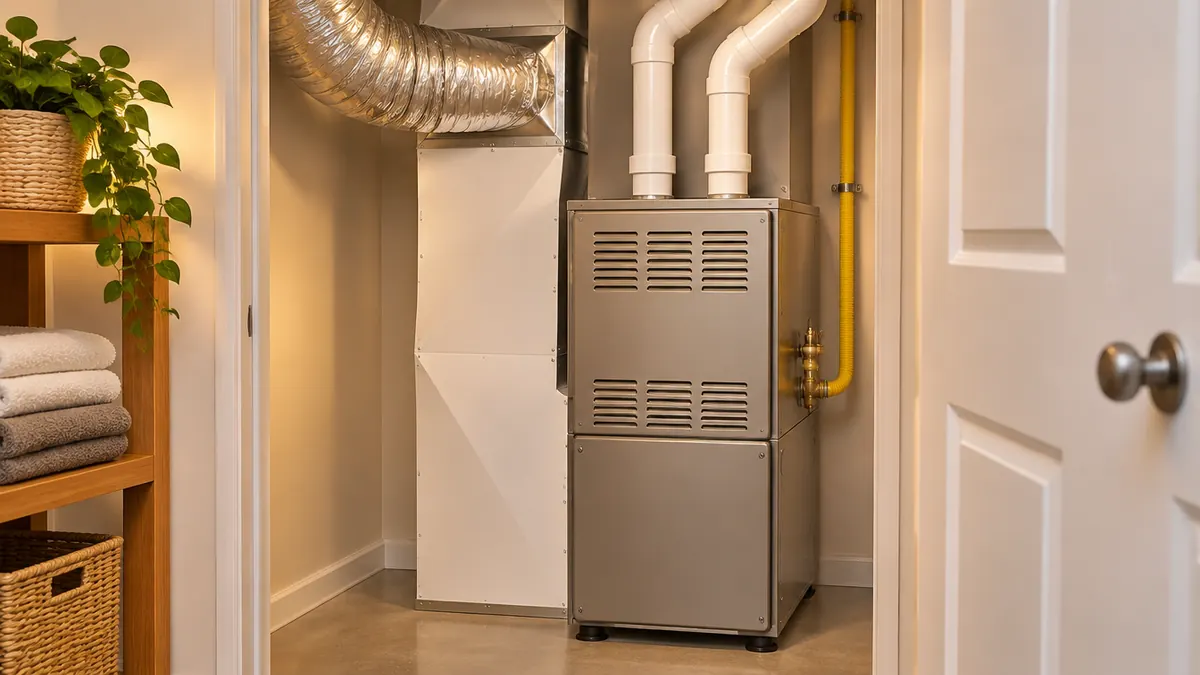
- Look for a gas line. A gas furnace has a gas pipe running to it, usually with a shutoff valve beside the unit.
- Look for a vent pipe. Standard gas furnaces vent through a metal flue; high-efficiency models vent through white PVC pipes. An electric furnace has no vent at all.
- Check your bills. In Sacramento County, SMUD sells the electricity and PG&E supplies the natural gas. A PG&E bill that climbs every winter usually means gas heat. If your only winter spike is on the SMUD bill, you have an electric furnace or a heat pump.
Not sure whether yours is a heat pump? Our guide to heat pumps vs. furnaces covers the differences.
Does a furnace use gas or electricity?
A gas furnace uses both: gas makes the heat, and electricity powers the blower fan, the electronic ignition and the control board. An electric furnace runs on electricity alone.
That matters in two ways. First, a gas furnace won’t heat your home during a power outage, because the parts that light the burners and move the air can’t run without power. If your system won’t come back on after the lights return, see HVAC not working after a power outage. Second, a gas furnace still adds some electric use for its fan and controls, so your SMUD bill doesn’t drop to zero for heating.
An electric furnace draws every bit of its heat from your electric meter. On the coldest days, when it runs the longest, that’s where your winter bill will show it.
Which is cheaper to run, a gas or electric furnace?
Gas is typically cheaper to run than an electric furnace where natural gas is available, but the real answer depends on your gas and electric rates. One major manufacturer puts it plainly: heating with gas is typically cheaper, and electric operating costs depend heavily on local electricity rates. The Department of Energy agrees that electric heat can be more expensive than other fuel options.
An electric furnace’s near-100% efficiency sounds unbeatable, but efficiency only tells you how much of the energy you buy becomes heat. What you pay for each unit of energy matters just as much. A 95% gas furnace can still cost less per hour of heat than a 100% electric furnace if gas costs less per Btu.
How to compare costs with your own utility bills
You don’t need anyone’s estimate to run this math. You need your PG&E gas bill, your SMUD electric bill, and the conversion factors the Energy Information Administration publishes: 1 therm of natural gas contains 100,000 Btu, 1 kilowatt-hour of electricity contains 3,412 Btu, and 1 gallon of propane contains 91,452 Btu.
- Find your real price per unit. Divide a bill’s total, including delivery charges and fees, by the therms, kilowatt-hours or gallons it covers.
- Convert to the same amount of heat. It takes about 29.3 kilowatt-hours or about 1.09 gallons of propane to equal the 100,000 Btu in 1 therm of gas.
- Adjust for efficiency. Divide by the furnace’s AFUE written as a decimal, such as 0.80 or 0.95.
| Heating type | Cost of 100,000 Btu of heat delivered |
|---|---|
| Natural gas furnace | Price per therm ÷ AFUE |
| Propane furnace | Price per gallon × 1.09 ÷ AFUE |
| Electric furnace | Price per kWh × 29.3 |
| Heat pump | Price per kWh × 29.3 ÷ the heat pump’s efficiency (up to about 3 in DOE’s figures) |
Use the rates on your own bills, since both utilities’ prices change over time. Run them through that table and the cheaper option for your house is usually obvious. If the numbers land close together, let install cost, lifespan and safety break the tie.
Can you install a new electric furnace in California?
Usually not as a replacement for your main heat: when a home’s heating system is replaced, California’s 2025 Energy Code says the new system must not use electric resistance as its primary heat source unless an exception applies.
The California Energy Commission’s compliance manual lists three exceptions for the code’s standard (prescriptive) path, and each one starts with a home that already has electric resistance heat:
- The existing system is electric resistance, and the replacement isn’t ducted.
- The existing system is electric resistance, and no ducted cooling system is being replaced or installed.
- The existing system is electric resistance, and the home is in climate zone 7 or 15.
In plain terms, if your home heats with gas today, swapping in a ducted electric furnace generally doesn’t fit the standard path. The code’s other route, performance compliance, models the whole house’s energy use, and how it applies to your home is a question for the contractor who pulls the permit. Our guide to HVAC permits and Title 24 in Sacramento explains permits and inspections.
This rule is a big reason the all-electric choice in California is usually a heat pump, which moves heat instead of making it with resistance coils.
Is a gas furnace or an electric furnace safer?
An electric furnace is simpler on safety because it burns nothing, while a gas furnace needs a sound vent, working carbon monoxide alarms and a yearly professional check to run safely.
Safety first: If you smell gas (a rotten-egg odor) or a carbon monoxide alarm sounds, leave the home now. Once you’re outside, call 911, then PG&E about a gas smell (see PG&E’s Report an Emergency page). Don’t flip light switches, start appliances or try to find the leak. See what to do if you smell gas near your furnace.
Gas and oil furnaces burn fuel and must vent to the outdoors, and that brings two risks an electric furnace doesn’t have: a gas leak, or carbon monoxide getting into the house. The EPA describes carbon monoxide as an odorless, colorless, toxic gas and lists leaking chimneys and furnaces among its sources in homes. It recommends having a trained professional inspect, clean and tune up a central heating system, including furnaces, flues and chimneys, every year.
Alarms are your backup. The California Air Resources Board notes that state law requires carbon monoxide detectors in homes with any fuel-burning appliance or an attached garage, and that the detectors must be approved by the State Fire Marshal. Our carbon monoxide safety guide covers placement and testing, and cracked heat exchanger explains the furnace problem technicians watch for most closely.
Which costs less to install, and which lasts longer?
An electric furnace usually costs less to install and tends to last longer, while a gas furnace costs more upfront because it needs a gas hookup and venting.
Electric furnaces don’t require venting systems or gas hookups, so they can cost less to buy and put in. One major manufacturer says electric furnaces often last 20 to 30 years, compared with 15 to 20 years for gas furnaces with proper maintenance.
The trade-off is the monthly bill. The same manufacturer calls gas furnaces generally better for cold climates because of their higher heat output and lower fuel costs, and electric furnaces better where winters are mild. Sacramento’s mild winters might seem to favor electric, but in a replacement, the code rule above usually points all-electric buyers to a heat pump instead. Compare the install quote and the running cost together. For national price ranges and what drives them, see what a new HVAC system costs. If you’re weighing whether to fix an aging furnace, try the repair-or-replace calculator.
Should you get a heat pump instead of an electric furnace?
If you want electric heat, a heat pump is usually the better choice: the Department of Energy says that when electricity is the only option, heat pumps are preferable in most climates.
The reason is how they make heat. An electric furnace turns each unit of electricity into one unit of heat. A heat pump moves heat from the outdoor air into your home instead of making it, and DOE says heat pumps can provide up to 3 times more heat than the energy they use. That’s why the heat pump row in the cost table above divides by its efficiency. A heat pump also cools your home in summer, so one outdoor unit handles both jobs.
SMUD heat pump rebates (as of November 2026)
As of November 2026, SMUD’s heating and cooling rebate page lists $3,000 for a variable-stage heat pump system and $2,000 for a two-stage heat pump system (15.2 SEER2 minimum) when you switch from gas heat, plus $1,000 for an electric-to-electric upgrade to a two-stage or variable-stage heat pump. A SMUD Contractor Network installer is required, the system has to pass Title 24 verification, and rebates are subject to available funding, so check SMUD’s page before you count on one. Our guide to HVAC rebates and tax credits in Sacramento covers the rest.
Wondering how a heat pump handles a Sacramento winter? Read do heat pumps work in Sacramento and heat pump vs. furnace before you decide, and see the heat pump repair and installation page for what’s involved.
Why do Sacramento-area homeowners call JM Comfort?
JM Comfort is a locally owned heating and air conditioning contractor based in North Highlands, serving North Highlands, Sacramento and nearby communities. It’s a licensed C-20 HVAC contractor (CSLB #1016274), licensed since 2016 and bonded, with workers’ comp insurance on file; you can check the license on the CSLB website. The same team installs, repairs and maintains furnaces and heat pumps for homes and also handles AC, ductwork and indoor air quality, so you can talk through gas and heat pump options for your house before you decide on furnace installation.
Call (916) 247-6358 or book a furnace estimate online, and we’ll call you back.
Frequently asked questions
Is an electric furnace 100% efficient?
Close to it. Electric resistance heat can approach 100% AFUE because almost all of the electricity becomes heat inside your home and nothing goes up a vent. But efficiency isn’t the same as cost: what you pay per unit of energy matters just as much, which is why a gas furnace is often cheaper to run.
Can I switch from an electric furnace to a gas furnace?
Only if natural gas can reach your house, or you’re willing to use propane from a tank. A gas furnace also needs a gas line and a vent to the outdoors, which adds to the install cost. In Sacramento County, ask PG&E whether gas service reaches your address first, then have a contractor price the options for your house.
Does a gas furnace work during a power outage?
No. A gas furnace needs electricity for its blower fan, electronic ignition and control board, so it stops when the power does. See what to do when your HVAC won’t restart after an outage.
Is propane cheaper than an electric furnace?
It depends on your propane price per gallon and your electric rate per kilowatt-hour. A gallon of propane holds 91,452 Btu, so about 1.09 gallons equals 100,000 Btu. Multiply your price per gallon by 1.09, divide by the furnace’s AFUE, and compare that with your electric rate times 29.3.
Do I need a carbon monoxide alarm if my furnace is electric?
If anything in your home burns fuel, or you have an attached garage, yes. The California Air Resources Board notes that state law requires CO detectors in homes with any fuel-burning appliance or an attached garage. Gas water heaters, stoves and fireplaces can all produce carbon monoxide. If an alarm sounds, get outside to fresh air and call 911.
Can JM Comfort help me choose between gas, electric and a heat pump?
Yes. JM Comfort is a licensed C-20 HVAC contractor (CSLB #1016274) that installs and repairs furnaces and heat pumps for homes in North Highlands, Sacramento and nearby communities, and can walk you through the trade-offs for your house. Call (916) 247-6358 or book a visit online.
Sources
- Energy Saver: Tips on Saving Money and Energy in Your Home (2022) (U.S. Department of Energy)
- Gas vs Electric vs Oil Furnace: Which Is Best? (Carrier)
- What Is A Furnace? How Gas Furnaces Work & Heat Your Home (Carrier)
- Highlights for space heating fuel in U.S. homes by state, 2020 (U.S. Energy Information Administration)
- British thermal units (Btu) (U.S. Energy Information Administration)
- Utility Providers (Sacramento County Economic Development)
- 2025 Single-Family Residential Compliance Manual, Chapter 9: Additions, Alterations, and Repairs (California Energy Commission)
- Heating and cooling rebates (SMUD)
- Combustion Pollutants & Indoor Air Quality (California Air Resources Board)
- Carbon Monoxide's Impact on Indoor Air Quality (U.S. Environmental Protection Agency)
Find this helpful? Add JM Comfort as a preferred source on Google.