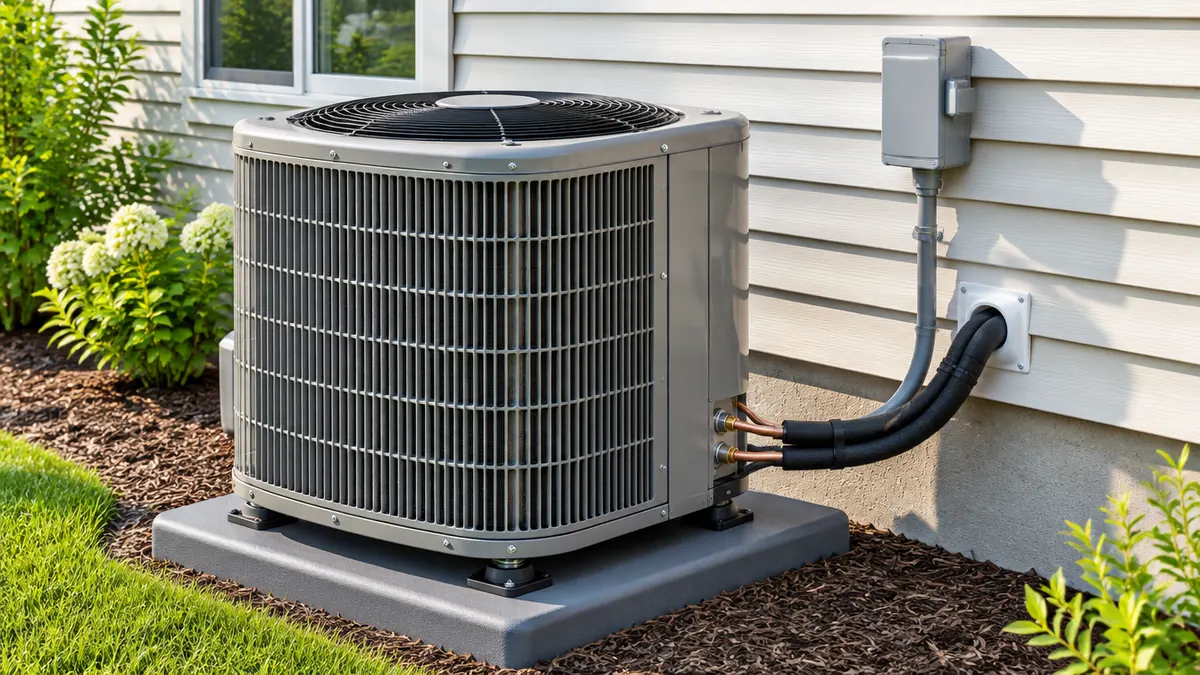
AC Compressor Not Working? Causes, Repair and Cost
When the outdoor unit clicks, hums or sits silent while the house warms up on a hot Sacramento afternoon, the compressor is the part everyone worries about. Here’s how to tell what’s really wrong and what it takes to fix it.
JM Comfort can help: AC repair for homes in Sacramento and nearby. Licensed C-20 HVAC contractor, CSLB #1016274.
The compressor is the heart of your air conditioner, and when it stops, cooling stops with it. The good news: a compressor that won’t run hasn’t always failed. Plenty of “compressor problems” turn out to be a thermostat setting, a tripped breaker, or one of the small electrical parts that start the compressor. This guide walks through the causes, the warning signs, what you can safely check, and how to think about cost when it really is the compressor. If you already know you need help, schedule AC repair.
What does an AC compressor do?
The compressor pumps refrigerant through your air conditioner and raises its pressure and temperature so the system can release your home’s heat outdoors. If it stops, cooling stops.
Here’s the loop. Indoors, refrigerant soaks up heat at the evaporator coil. The compressor, inside the outdoor unit, pulls that refrigerant outside, squeezes it, and sends it to the condenser coil, where a large fan helps release the heat into the yard. Then the cycle repeats. One major manufacturer puts a compressor’s typical life at 10 to 15 years, depending on the compressor type.
AC compressor vs. condenser: what’s the difference?
The compressor is the pump that moves and pressurizes refrigerant; the condenser is the coil that releases the heat outside. Both sit in the outdoor unit, which is why many people call the whole outdoor box “the condenser.”
| Part | Where it is | What it does | Typical trouble |
|---|---|---|---|
| Compressor | Inside the outdoor unit | Pumps and pressurizes refrigerant | Won’t start, overheats, trips the breaker, grinds or rattles |
| Condenser coil | Wrapped around the sides of the outdoor unit | Releases your home’s heat outdoors | Dirt, debris, bent fins, leaks |
| Outdoor fan | Top of the outdoor unit | Pulls air across the condenser coil | Failed motor or fan capacitor, worn bearings |
| Evaporator coil | Indoors, at the furnace or air handler | Absorbs heat from your home’s air | Ice, dirt, leaks |
Why it matters: when someone says “the condenser went out,” they may mean the compressor, the fan, the coil or the whole outdoor unit. Those are very different repairs. Ask the technician which part failed and why.
Why is my AC compressor not working?
Most of the time the compressor isn’t getting the signal or the power to start, a starting part has failed, or a safety device has shut it off; an internal compressor failure is the most serious possibility, so rule out the others first.
No call for cooling
If the thermostat isn’t set to Cool, or the set temperature isn’t below the room temperature, the compressor has no reason to run. If the screen is blank, replace the batteries. See why a thermostat stops working.
No power
A tripped breaker or a loose power connection to the outdoor unit can cut the compressor off completely. One major manufacturer notes that repeated trips point to an electrical fault tied to the compressor’s power draw.
A failed capacitor or contactor
The capacitor gives the compressor motor the jolt of electricity it needs to start. The contactor is the switch that lets power reach the compressor. When either fails, you may hear clicking or humming from the outdoor unit while it never fully starts. Minor electrical problems like these can often be fixed without replacing the compressor, but they’re a job for a technician.
Overheating
On very hot days or after long, heavy use, a compressor can overheat and trip its internal thermal overload, which shuts it down until it cools. Leaves, dirt and overgrowth around the outdoor unit restrict airflow and make that more likely, which is why a crowded unit tends to quit on the hottest Sacramento afternoons. If it keeps happening, something deeper is wrong.
Low refrigerant
Low refrigerant almost always points to a leak. Running on a low charge strains the compressor and risks major damage.
A worn-out compressor
Years of wear and tear can end in a complete breakdown inside the compressor itself. Only an HVAC professional can confirm that diagnosis.
What are the signs of a bad AC compressor?
The clearest signs are warm air while the indoor fan runs, an outdoor unit that clicks or hums but won’t start, a breaker that keeps tripping, and grinding, squealing or banging from the outdoor unit.
| What you notice | What it may mean | What to do |
|---|---|---|
| Indoor fan runs, but the air isn’t cold | Compressor isn’t running or isn’t moving refrigerant properly | Check the thermostat and breaker, then call |
| Clicking or humming; outdoor unit never starts | Failed capacitor or contactor, or a compressor that can’t start | Set the thermostat to Off and call |
| Breaker trips again after one reset | Compressor overheating or drawing too much power | Leave it off and call |
| Grinding, squealing, banging or rattling | Internal mechanical failure | Turn the system off and call |
| Shuts off on hot afternoons, restarts later | Thermal overload tripping | Clear around the unit; call if it repeats |
| Hissing, ice on the lines, longer run times | Refrigerant leak | Turn the system off and call |
| Cooling bills climbing | A struggling compressor or low refrigerant | Schedule a check |
Not sure what a sound means? Our guide to HVAC noises breaks down hums, buzzes, clicks and grinding.
What can you check before calling a technician?
Check the thermostat, the breaker and outdoor power switch, the area around the outdoor unit, and the filter; everything past that, including anything inside the outdoor unit’s cabinet, belongs to a technician.
Safety first: Don’t open the outdoor unit’s electrical panel or touch the capacitor, contactor or wiring. Air conditioners carry high voltage, and one major manufacturer warns that it can stay stored in components even after the power is disconnected. Refrigerant work is a job for a certified technician.
6 safe checks, in order
- Check the thermostat. Set it to Cool, with the set temperature below the current indoor temperature. Replace the batteries if the screen is blank.
- Check the breaker and the outdoor power switch. Make sure the switch in the box near the outdoor unit is on. Reset a tripped AC breaker once: fully off, then on. If it trips again, leave it off and call. Resetting it over and over without finding the cause can damage the system.
- Let an overheated unit cool down. If the outdoor unit quit on a scorching afternoon, set the thermostat to Off and wait about 30 minutes before trying again.
- Clear around the outdoor unit. Pull away leaves and debris and keep plants at least 2 feet from the unit so air can move across the coil.
- Check the air filter. A clogged filter makes the whole system work harder. Most need changing every 30 to 90 days, depending on the filter. See how often to change your air filter.
- Listen and look, then stop. Note any clicking, humming, grinding or hissing, and look for ice on the copper lines. If you find any of these, set the thermostat to Off and call.
If the outdoor unit runs but the air is still warm, work through why your AC is blowing warm air. If the house is getting dangerously hot while you wait, see what to do when your AC goes out in a heat wave.
Will an AC compressor run without refrigerant?
It may try, but it shouldn’t: running on a low refrigerant charge strains the compressor and risks major damage, so if you suspect a leak, turn the system off and call.
Your AC doesn’t burn through refrigerant like fuel. When the charge is low, a leak is almost always the reason. Watch for warm or weak airflow, longer run times, ice on the coils, a hissing sound while the system runs, and higher energy bills.
The fix is to find and repair the leak, then recharge the system to the correct level. Adding refrigerant without fixing the leak only postpones the next breakdown. Refrigerant work is a job for a certified technician, and the type of refrigerant your system uses affects repair options and cost. See R-22, R-410A and R-454B explained, and if you’ve seen ice, read why an AC freezes up.
Can an AC compressor be repaired?
The parts around the compressor usually can be repaired, but a compressor that has burned out is replaced, not fixed.
Repairs that often bring a “dead” compressor back include a new capacitor or contactor, a wiring repair, or a leak repair and recharge. Fixing those is a very different job from replacing the compressor, which is why a careful diagnosis matters before anyone quotes a replacement.
Replacing the compressor itself is a major repair that takes professional tools, refrigerant handling and a full system evaluation. One national cost guide notes that the capacitor and contactor may need replacing at the same time. One major manufacturer says repairing a compressor is often cost-effective on newer units still under warranty, so check your system’s age and paperwork before you decide.
How much does an AC compressor cost?
This Old House’s 2026 cost guide puts the national average for AC compressor replacement at about $1,550 for parts and professional installation. These are national figures; local quotes vary.
| System size | Low | Average | High |
|---|---|---|---|
| 1.5–2 tons | $700 | $1,050 | $1,400 |
| 2.5–3 tons | $900 | $1,500 | $2,100 |
| 3.5–4 tons | $1,100 | $1,600 | $2,100 |
Source: This Old House, compressor replacement cost by system size, 2026. The same guide lists labor at about $113 an hour, or an average flat fee of $600 for the job.
What drives the price
- System size. Bigger systems need bigger compressors.
- Compressor type and brand. One major manufacturer notes that cost varies with the compressor type, the brand and warranty coverage.
- Refrigerant. The refrigerant your system uses, and how available it is, affects the bill.
- Extra parts. The capacitor and contactor may need replacing along with the compressor.
- Warranty. A compressor still covered by the manufacturer’s parts warranty changes the math.
For other common repair bills, see the AC repair cost guide.
Should you replace the compressor or the whole AC?
Replace just the compressor when the system is fairly young and otherwise healthy; lean toward a new system when it’s more than about 10 years old, needs frequent repairs, or the repair would cost a big share of a new unit.
- Age. ENERGY STAR suggests considering replacement once a heat pump or air conditioner is more than 10 years old, and lists frequent repairs and rising energy bills as other signs.
- The 50 percent rule. This Old House’s rule of thumb: if the repair bill is more than half the price of a new unit, and the system is over 10 years old, replacement is often the smarter investment.
- Efficiency. ENERGY STAR says correctly installed high-efficiency units can save up to 20 percent on heating and cooling costs.
- Refrigerant rules. The EPA says homeowners can maintain and repair existing systems throughout their useful life. It also says that replacing both the outdoor condensing unit and the indoor coil together counts as installing a new system. In California, CARB’s rule also prohibits refrigerants with a global warming potential (GWP) of 750 or more in new air-conditioning equipment as of January 1, 2025.
- California’s Energy Code. Replacing the whole outdoor unit is more than a parts swap here. The California Energy Commission says installing a heating or cooling appliance (other than a plug-in room unit) requires a building permit, and that replacing the outdoor unit (or indoor unit) of a split system by itself triggers duct sealing and third-party verification by an ECC-Rater. Ask any contractor what permit and testing their quote includes.
Run your numbers through the repair-or-replace calculator, read should you repair or replace your AC, and look over the signs you need a new HVAC system. For the paperwork side, see HVAC permits and Title 24 in Sacramento. If replacement wins, start with AC installation. If a repair makes sense, book AC repair and get a clear diagnosis first.
Why do Sacramento-area homeowners call JM Comfort for compressor problems?
JM Comfort is a locally owned heating and air conditioning contractor based in North Highlands, serving North Highlands, Sacramento and nearby communities. It’s a licensed C-20 HVAC contractor (CSLB #1016274), licensed since 2016 and bonded, with workers’ comp insurance on file; you can check the license on the CSLB website. The same team handles AC repair, AC installation and tune-ups for homes, so you can weigh a compressor repair against a new system with one contractor.
Call (916) 247-6358 or book AC repair online and we’ll call you back.
Frequently asked questions
How long does an AC compressor last?
One major manufacturer puts a compressor’s typical life at 10 to 15 years, depending on the type of compressor and how the system is used and cared for. Clean filters, a clear outdoor unit and a yearly tune-up help it reach the long end of that range.
Is it worth replacing the compressor on a 10-year-old AC?
Often it isn’t. ENERGY STAR suggests considering replacement once an air conditioner is more than 10 years old, and This Old House’s rule of thumb is to replace the system when a repair costs more than half the price of a new unit. Get a quote for both before you decide.
Why does my AC compressor keep shutting off?
On very hot days or after long, heavy use, a compressor can overheat and trip its internal overload, which shuts it off until it cools. If that keeps happening, look for a deeper cause: a dirty filter, a blocked outdoor unit, low refrigerant or an electrical problem. Frequent on-off cycling is covered in AC short cycling.
Why is my outdoor AC unit humming but not starting?
A hum or click from an outdoor unit that never fully starts often means the compressor is getting power but can’t get going, commonly because of a failed capacitor or contactor. Turn the system off at the thermostat instead of letting it keep trying, and call for AC repair.
Does JM Comfort repair AC compressor problems?
Yes. JM Comfort is a licensed C-20 HVAC contractor (CSLB #1016274) that handles AC repair for homes in North Highlands, Sacramento and nearby communities, including the capacitors and contactors that start a compressor. A technician will tell you which part failed before any work starts. Call (916) 247-6358 or book online.
Sources
- Central AC Compressor Not Turning On? Find Out Why (Trane)
- Why Is My AC Compressor Not Turning On? (Lennox)
- What Is an AC Compressor? | Function, Cost & Repair Guide (Carrier)
- How to identify an AC Refrigerant leak (Lennox)
- How to Repair and Troubleshoot Your AC (Bryant)
- How Much Does an AC Compressor Cost? (2026 Pricing) (This Old House)
- When is it time to replace? (ENERGY STAR)
- Frequent Questions on the Phasedown of Hydrofluorocarbons (U.S. Environmental Protection Agency)
- 2025 Single-Family Heating, Ventilation, and Air Conditioning (HVAC) (California Energy Commission)
- Air-conditioning Equipment (California Air Resources Board)
Find this helpful? Add JM Comfort as a preferred source on Google.